

On this page
Bernoulli's equation connects pressure, velocity, and height for a fluid in steady flow. While the formula looks long, it is built on a single, fundamental idea. OpenStax College Physics notes that it is "just a convenient statement of conservation of energy for an incompressible fluid in the absence of friction."
Deriving it yourself through the work-energy theorem is often the clearest way to remember it, because it forces you to track exactly how forces transfer energy into the fluid.
Why use the work-energy theorem?
The work-energy theorem states that the net work done on a system equals its change in kinetic energy (W = ΔK). When you push a fluid through a pipe, that fluid experiences forces from pressure and gravity. Mapping these forces to energy changes gives you the complete equation.
A study published in *Physical Review Physics Education Research* (Suarez et al., 2017) found that 27% of students mistakenly assume the pressure of a moving fluid is exactly its hydrostatic pressure. They ignore the contribution of velocity entirely. Deriving the equation from energy conservation helps prevent this error by showing exactly where the velocity term comes from.
How do you set up the fluid element?
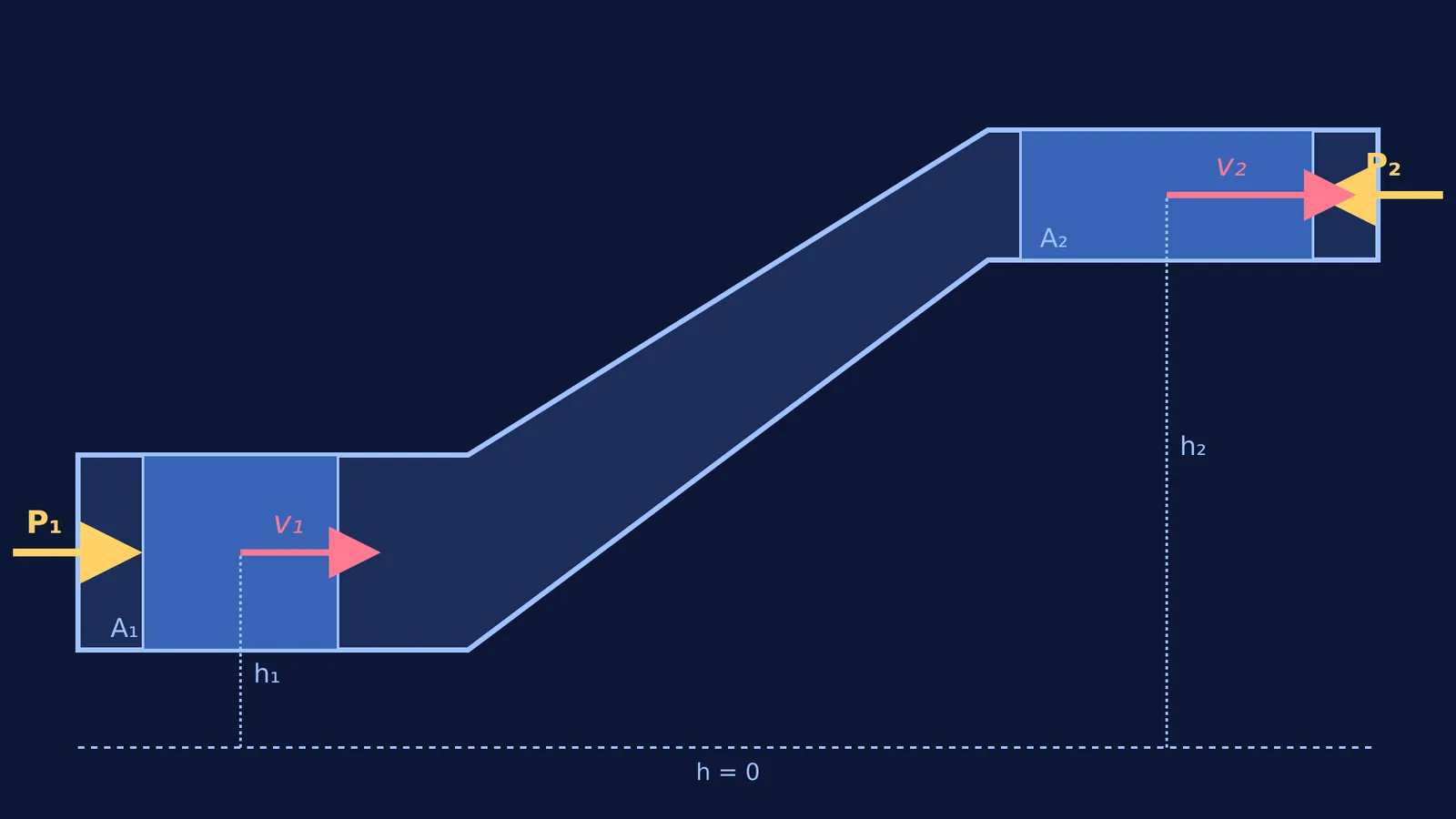
Imagine a fluid element of mass m flowing through a pipe that changes both in its cross-sectional area (A) and its elevation (h).
In a small time interval Δt, the fluid moves a distance Δx1 at the entrance (Point 1) and a distance Δx2 at the exit (Point 2). Because we assume the fluid is incompressible, the volume that moves at both ends must be exactly the same:
ΔV = A1 × Δx1 = A2 × Δx2
The mass of this fluid element is m = ρΔV, where ρ is the fluid's density.
How do you calculate work done by pressure?
The fluid behind our element pushes it forward at Point 1, doing positive work. The fluid ahead of our element pushes back against it at Point 2, doing negative work.
Work done at Point 1: W1 = P1 × A1 × Δx1 = P1 × ΔV
Work done at Point 2: W2 = -P2 × A2 × Δx2 = -P2 × ΔV
The net work done by pressure is simply the sum of these two:
W_pressure = (P1 - P2)ΔV
How do you apply the work-energy theorem?
The net work done by pressure changes the fluid element's mechanical energy. It changes its kinetic energy (ΔK) by speeding it up or slowing it down, and it changes its gravitational potential energy (ΔU) by lifting it or dropping it.
W_pressure = ΔK + ΔU
Substitute the standard formulas for kinetic energy (1/2 m v²) and potential energy (m g h):
(P1 - P2)ΔV = (1/2 m v2² - 1/2 m v1²) + (m g h2 - m g h1)
Now, replace the mass m with ρΔV:
(P1 - P2)ΔV = 1/2 (ρΔV) v2² - 1/2 (ρΔV) v1² + (ρΔV) g h2 - (ρΔV) g h1
Notice that every term contains the volume ΔV. Divide the entire equation by ΔV to get energy per unit volume:
P1 - P2 = 1/2 ρ v2² - 1/2 ρ v1² + ρ g h2 - ρ g h1
Finally, rearrange the terms so that all the variables for Point 1 are on the left side, and all the variables for Point 2 are on the right side:
P1 + 1/2 ρ v1² + ρ g h1 = P2 + 1/2 ρ v2² + ρ g h2
This is Bernoulli's equation. It shows that the sum of the static pressure (P), dynamic pressure (1/2 ρ v²), and hydrostatic pressure (ρgh) remains constant along a streamline.
Where do students go wrong?
Many students try to apply Bernoulli's equation between a moving fluid and a stationary one. The same study (Suarez et al., 2017) noted that 20% of students make the mistake of using the equation between points that are not connected by the flow.
If you find yourself confusing static and dynamic pressure during your exam preparation, or misapplying the continuity equation, the Fermi Concept Library can help you trace these physical constraints from first principles. Practice mapping out the energy balance before you reach for the formula.


