

On this page
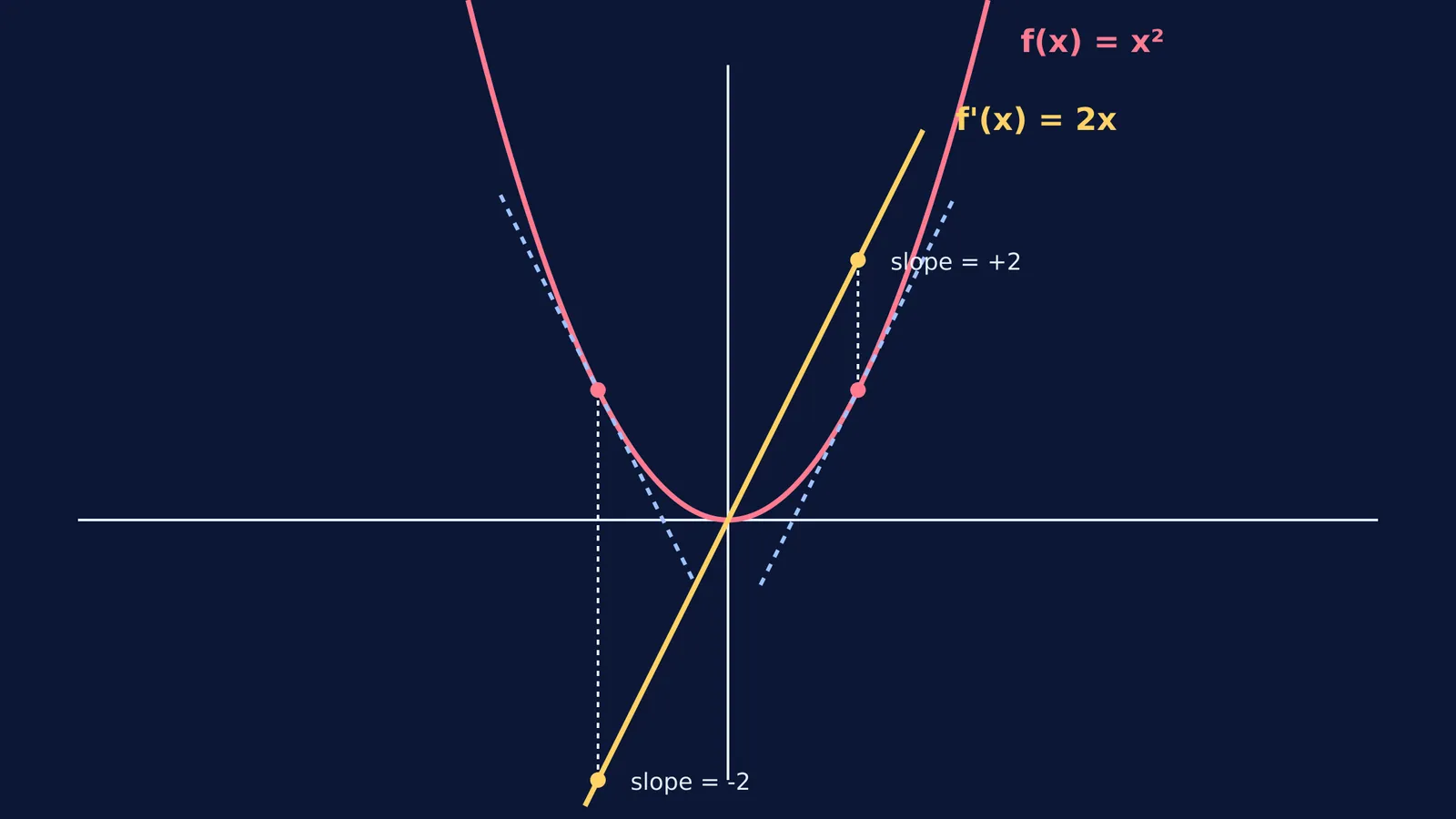
The symmetry of mathematical functions often carries over to their rates of change. If you have an even function—one that reflects perfectly across the y-axis, such as y = x² or y = cos x—you might wonder what happens to its symmetry when you find its derivative.
The answer is consistent across calculus: the derivative of an even function is always an odd function. Similarly, taking the derivative of an odd function always yields an even function.
Understanding this parity switch is a powerful tool when differentiating parametric functions or checking your work on a calculus exam.
Is the derivative of an even function always odd?
Yes. If a function is even and differentiable, its derivative is odd.
An even function satisfies the condition f(x) = f(-x) for every x in its domain. Geometrically, this means the graph looks identical on the left and right sides of the y-axis. If the curve slopes upwards at a given rate on the right side, it must slope downwards at the exact opposite rate at the corresponding point on the left side.
Because the slopes at x and -x have opposite signs but the same steepness, the derivative function satisfies f'(-x) = -f'(x). This is the exact mathematical definition of an odd function.
How to prove it with the chain rule
We can prove this parity switch rigorously using the chain rule of differentiation, which tells us how to differentiate composite functions.
Start with the formal definition of an even function: f(-x) = f(x)
Differentiate both sides of the equation with respect to x.
The right side simply becomes the standard derivative, f'(x).
For the left side, we must apply the chain rule. Treat f(-x) as a composite function where the outer function is f and the inner function is -x. Multiplying the outer derivative by the derivative of the inner term (-x) gives us f'(-x) × (-1).
This gives us the equation: -f'(-x) = f'(x).
Multiply both sides by -1 to isolate f'(-x), yielding the final relationship: f'(-x) = -f'(x).
The resulting equation proves that the derivative f'(x) is an odd function.
What about the antiderivative of an even function?
A common follow-up question is whether this rule works in reverse. If you integrate an even function, do you get an odd function?
The answer is nuanced. While the derivative of an odd function is strictly even, the indefinite integral of an even function is an odd function plus a constant of integration (C). An odd function must pass through the origin, meaning f(0) = 0. If C ≠ 0, the resulting function is shifted vertically and loses its strict odd symmetry.
However, the symmetry heavily influences definite integrals. If an odd function is integrable over a symmetric interval [-A, A], the total area perfectly cancels out, meaning the integral over that interval is exactly zero. For an even function over the same interval [-A, A], the integral is simply twice the area from 0 to A.
The periodic-derivative analogue: What happens to a repeating function?
Symmetry properties extend beyond even and odd parity. For example, if a differentiable function is periodic with a period T, its derivative is also periodic with the exact same period T. Periodic functions, such as the sine and cosine waves used to model sound or alternating currents, repeat their values at regular intervals.
This holds true because the mathematical condition for a periodic function is f(x + T) = f(x). If we differentiate both sides using the chain rule, the inner derivative of (x + T) is just 1. This leaves us with f'(x + T) = f'(x), proving that the rate of change repeats on the same cycle as the original function.
This periodic symmetry is extremely useful when integrating over n periods. Because the curve's behaviour repeats perfectly, you only need to evaluate the area or slope over a single period and scale the result, which makes complex boundary evaluations much simpler.
A framework for checking calculus symmetry
When solving problems involving function parity, you can use a quick checklist to verify your results:
Check the powers: For polynomials, differentiating drops the exponent by 1. Even polynomials become odd, and odd polynomials become even.
Check the trigonometry: Differentiating cos x (even) gives -sin x (odd). Differentiating sin x (odd) gives cos x (even).
Check the constants: If you are integrating an even function to find an odd function, ensure your boundary conditions require C = 0.
Calculus is full of these structural patterns. If you are struggling to spot them during exam prep, the Fermi Concept Library maps out how mathematical rules interlock. Rather than printing an answer, Fermi's AI tutor builds a plan for the session based on what you already know, helping you reason through the proofs until the symmetry clicks.


