

On this page
Infinite nested radicals and infinite power towers look intimidating in calculus exams, but they all share a structural weakness. Because they go on forever, chopping off the first layer leaves an expression that is exactly the same as the whole.
By replacing that repeating inner sequence with y, you can turn an infinite limit into a standard algebraic equation. This self-similarity trick transforms some of the hardest-looking calculus problems into basic implicit differentiation.
What is the derivative of y equals root x plus root x plus to infinity?
If you are asked to find dy/dx for the infinite nested radical:
y = √(x + √(x + √(x + …)))
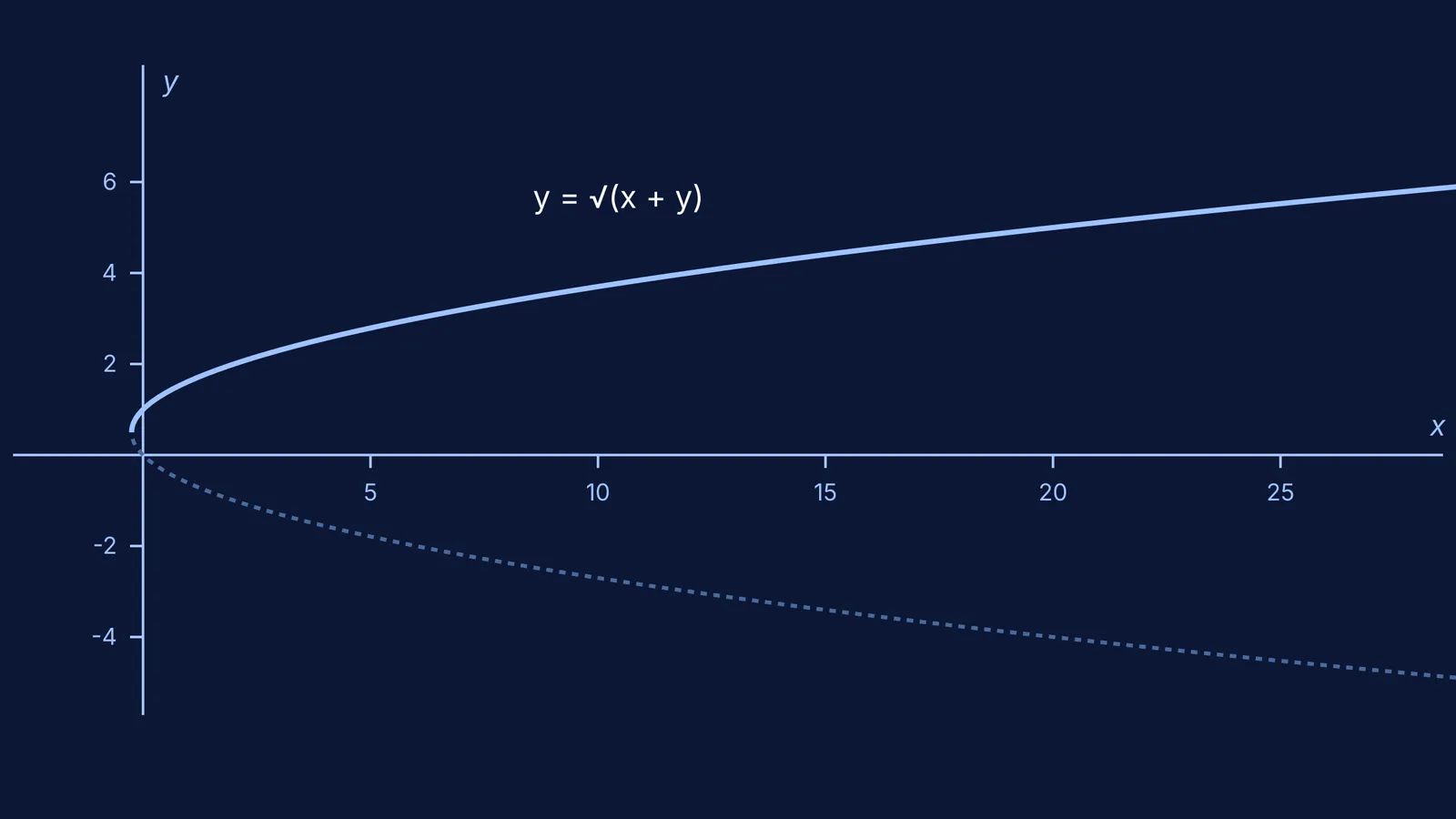
Start by looking at the part under the main square root. The expression x + √(x + √(x + …)) goes on to infinity. That means the inner nested radical is exactly equal to the original function y.
Substitute y back into the right-hand side:
y = √(x + y)
Now, clear the square root by squaring both sides:
y² = x + y
This is an ordinary equation. Differentiate both sides with respect to x, remembering to use the chain rule for the y terms (implicit differentiation):
2y(dy/dx) = 1 + dy/dx
Group the dy/dx terms on the left:
2y(dy/dx) - dy/dx = 1
Factor out dy/dx:
(dy/dx)(2y - 1) = 1
Divide to find the final derivative:
dy/dx = 1 / (2y - 1)
How do you find the derivative of an infinite power tower?
The exact same self-similarity method works for the infinite power tower, another common fixture in competitive exams like JEE Advanced.
Consider the function:
y = x^(x^(x^…))
If you look at the exponent of the base x, it is an infinite stack of x's. That exponent is exactly y. You can rewrite the function as:
y = x^y
Before differentiating, bring the y out of the exponent by taking the natural logarithm of both sides:
ln y = y ln x
Now differentiate implicitly with respect to x. Use the product rule on the right-hand side:
(1/y)(dy/dx) = (dy/dx) ln x + y(1/x)
Bring the dy/dx terms to one side:
(1/y)(dy/dx) - (dy/dx) ln x = y/x
Factor out dy/dx:
(dy/dx)(1/y - ln x) = y/x
Find a common denominator for the bracket:
(dy/dx)((1 - y ln x) / y) = y/x
Finally, multiply and divide to isolate the derivative:
dy/dx = y² / (x(1 - y ln x))
Unlike finite expressions, infinite towers behave strangely depending on the value of x. A 2019 study published on arXiv shows that an infinite power tower of x only converges to a single real value when x lies in the interval between e^(-e) and e^(1/e). Outside of this narrow band, the tower either diverges to infinity or oscillates forever.
Taking the next step in calculus
Calculus becomes much easier when you learn to spot patterns like self-similarity instead of memorising separate rules for every shape of function.
If you are stuck on a derivation that looks impossible, the Fermi Problem Library can help. Instead of just printing an answer, Fermi's AI tutor acts as a guide and facilitator, holding a line of reasoning across a whole session to help you spot the substitution yourself. If the algebraic foundations are shaky, you can map out the relationships between different function types in the Fermi Concept Library.
The next time you see "to infinity" in an exam, do not look for a complicated limit theorem. Look for the copy hidden inside the whole. Once you have isolated the first derivative, you can use similar tricks to handle limits of the form 1^∞ or prove relations with second-order derivatives.