

On this page
The density of a mixture is not always a simple average. When you combine two liquids, the resulting density depends entirely on the proportions you use.
Density is defined as the total mass of an object or substance divided by its total volume, typically measured in kg/m³ (OpenStax University Physics). This fundamental rule—total mass over total volume—is the starting point for every mixture problem.
If you are mixing gases, you might also find our guide to the average molar mass of a gas mixture or the γ of a gas mixture useful.
How do you find the density of a mixture with equal volumes?
When two liquids are mixed in equal volumes, the calculation is straightforward.
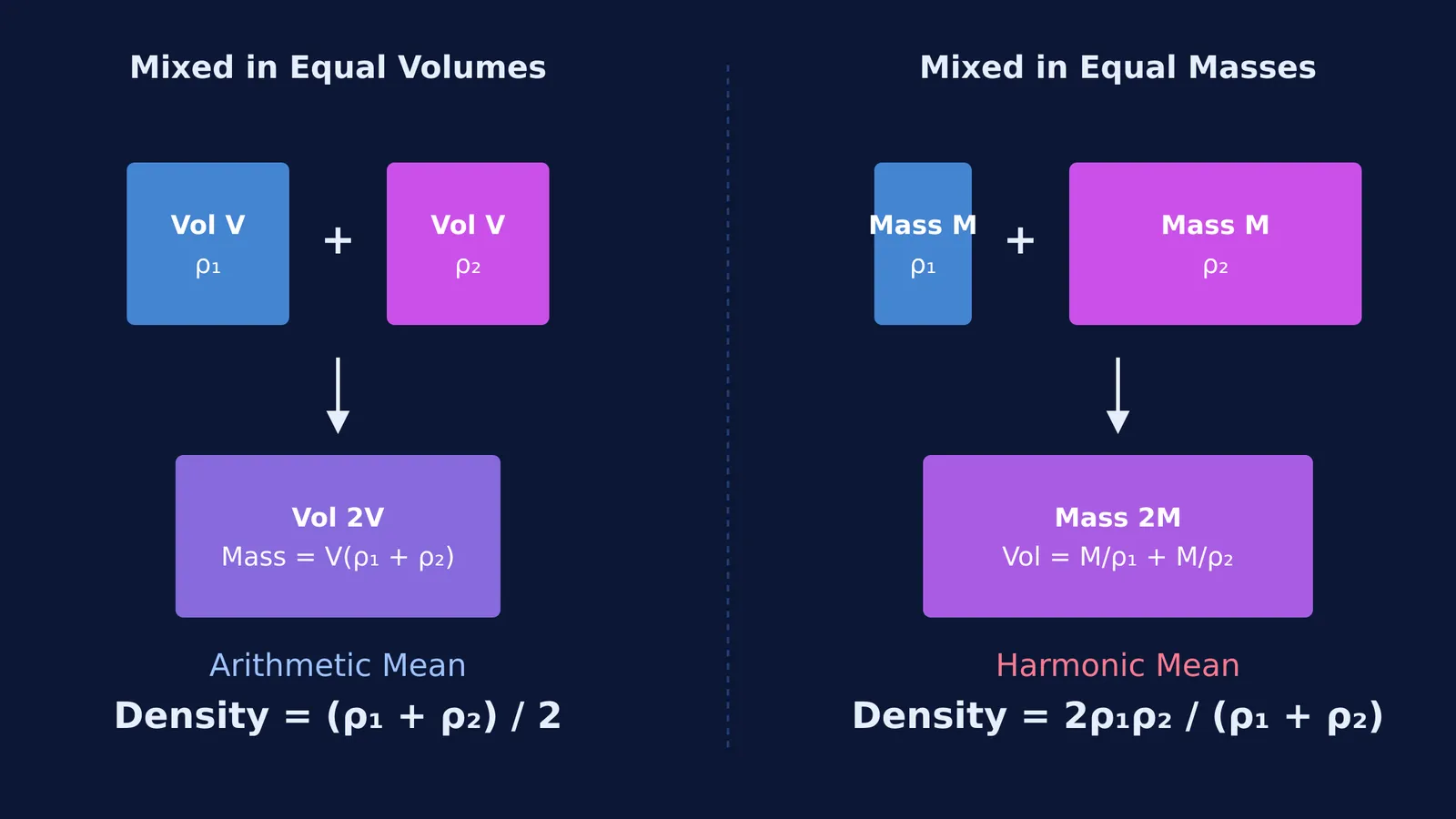
Imagine taking a volume V of the first liquid (density ρ₁) and the same volume V of the second liquid (density ρ₂).
The total volume of the mixture is V + V = 2V.
The mass of the first liquid is ρ₁ × V.
The mass of the second liquid is ρ₂ × V.
The total mass is ρ₁V + ρ₂V = V(ρ₁ + ρ₂).
To find the mixture density, divide the total mass by the total volume: Density = V(ρ₁ + ρ₂) / 2V = (ρ₁ + ρ₂) / 2
This is the arithmetic mean. If you mix 1 litre of water and 1 litre of a heavier liquid, the final density sits exactly halfway between their individual densities.
How do you find the density of a mixture with equal masses?
The logic shifts when the two liquids are mixed in equal masses, a common trap in fluid mechanics problems.
Take a mass M of the first liquid (density ρ₁) and an equal mass M of the second liquid (density ρ₂).
The total mass is M + M = 2M.
The volume of the first liquid is M / ρ₁.
The volume of the second liquid is M / ρ₂.
The total volume is M/ρ₁ + M/ρ₂ = M(1/ρ₁ + 1/ρ₂) = M(ρ₁ + ρ₂) / (ρ₁ρ₂).
Divide the total mass by the total volume: Density = 2M / [M(ρ₁ + ρ₂) / (ρ₁ρ₂)] = 2ρ₁ρ₂ / (ρ₁ + ρ₂)
This result is called the harmonic mean. Because the less dense liquid takes up more space per kilogram, it contributes a larger share to the total volume, pulling the overall density lower than the simple average.
It is easy to misread a question and blindly average the numbers. The Fermi Problem Library is designed to catch this: its step-by-step solver explains the reasoning behind the harmonic mean rather than just printing an answer, helping you see how the volumes differ.
What happens if the proportions are unequal?
The equal-mass and equal-volume formulas are shortcuts for very specific cases. In many practical situations, you will need to mix unequal amounts. When this happens, you cannot use the arithmetic mean or the harmonic mean. Instead, you must return to the fundamental definition of density: total mass divided by total volume.
Suppose a problem states that two liquids are mixed such that you have a volume 2V of the first liquid and a volume V of the second liquid.
The mass of the first liquid becomes 2V × ρ₁.
The mass of the second liquid becomes V × ρ₂.
The total mass is V(2ρ₁ + ρ₂).
The total volume is 3V.
When you divide the total mass by the total volume, the V cancels out, leaving a mixture density of (2ρ₁ + ρ₂) / 3. This is a weighted average. The mixture density will always sit closer to the density of the liquid that takes up the largest share of the total volume.
Similarly, if the problem gives you a mass ratio, you calculate the individual volumes in terms of mass and density, add them together, and divide the total mass by that combined volume. As long as you rigorously apply the rule of total mass over total volume, you will never go wrong, no matter how the proportions are given. You can see this method in action with two immiscible liquids in a manometer.
"Mixed in equal volumes": Use the arithmetic mean, (ρ₁ + ρ₂) / 2.
"Mixed in equal masses": Use the harmonic mean, 2ρ₁ρ₂ / (ρ₁ + ρ₂).
Unknown proportions: Start from the definition. Find the total mass, find the total volume, and divide them.
Why do equal masses give a lower density?
Let us test both formulas with a worked example. Suppose you mix water (density 1000 kg/m³) and a light oil (density 800 kg/m³).
Mixing equal volumes (e.g. 1 m³ of each):
Total mass = 1000 kg + 800 kg = 1800 kg.
Total volume = 2 m³.
Mixture density = 1800 / 2 = 900 kg/m³.
This matches the formula: (1000 + 800) / 2 = 900.
Mixing equal masses (e.g. 800 kg of each):
Total mass = 800 kg + 800 kg = 1600 kg.
Volume of water = 800 / 1000 = 0.8 m³.
Volume of oil = 800 / 800 = 1.0 m³.
Total volume = 1.8 m³.
Mixture density = 1600 / 1.8 = 888.89 kg/m³.
This matches the formula: 2 × 1000 × 800 / 1800 = 1600000 / 1800 = 888.89.
The equal-mass mixture is less dense (888.89 kg/m³ vs 900 kg/m³). To get 800 kg of oil, you need a full cubic metre, but you only need 0.8 cubic metres to get 800 kg of water. The mixture is physically dominated by the bulk of the lighter oil, so its final density leans closer to 800 than to 1000.


