

On this page
When we deposit money in a bank, the interest is usually compounded at discrete intervals—such as monthly, quarterly or annually. But what if the bank compounded interest at every single instant? This theoretical scenario is known as continuous compounding, and it is a classic application of differential equations heavily tested in exams like the JEE.
By modelling continuous compound interest as an exponential growth process, we can determine exactly how money grows over time and predict when an investment will double.
What is the differential equation for continuous compound interest?
If P is the principal amount at any time t, the rate at which the principal increases is directly proportional to the principal itself. Let r be the continuous interest rate expressed as a percentage (for instance, 5 for 5%). The statement "the principal increases continuously at the rate of r% per year" translates directly to the differential equation:
dP/dt = (r/100) × P
Here, dP/dt is the instantaneous rate of change of the money. Because the rate of growth depends on the current amount P, this is a standard first-order separable differential equation.
How do you solve the equation dP/dt = rP/100?
To find the formula for the principal P as a function of time t, we must solve the differential equation by separating the variables. We move all the P terms to one side and the t terms to the other:
dP / P = (r/100) dt
Next, we integrate both sides:
∫ (1/P) dP = ∫ (r/100) dt
ln|P| = (r/100)t + C
To find the integration constant C, we use the initial condition. Let the initial principal at t = 0 be P₀. Plugging these values in gives ln(P₀) = C.
Substituting C back into our equation, we get:
ln(P) − ln(P₀) = (r/100)t
ln(P/P₀) = (r/100)t
Taking the exponential of both sides yields the continuous compound interest formula:
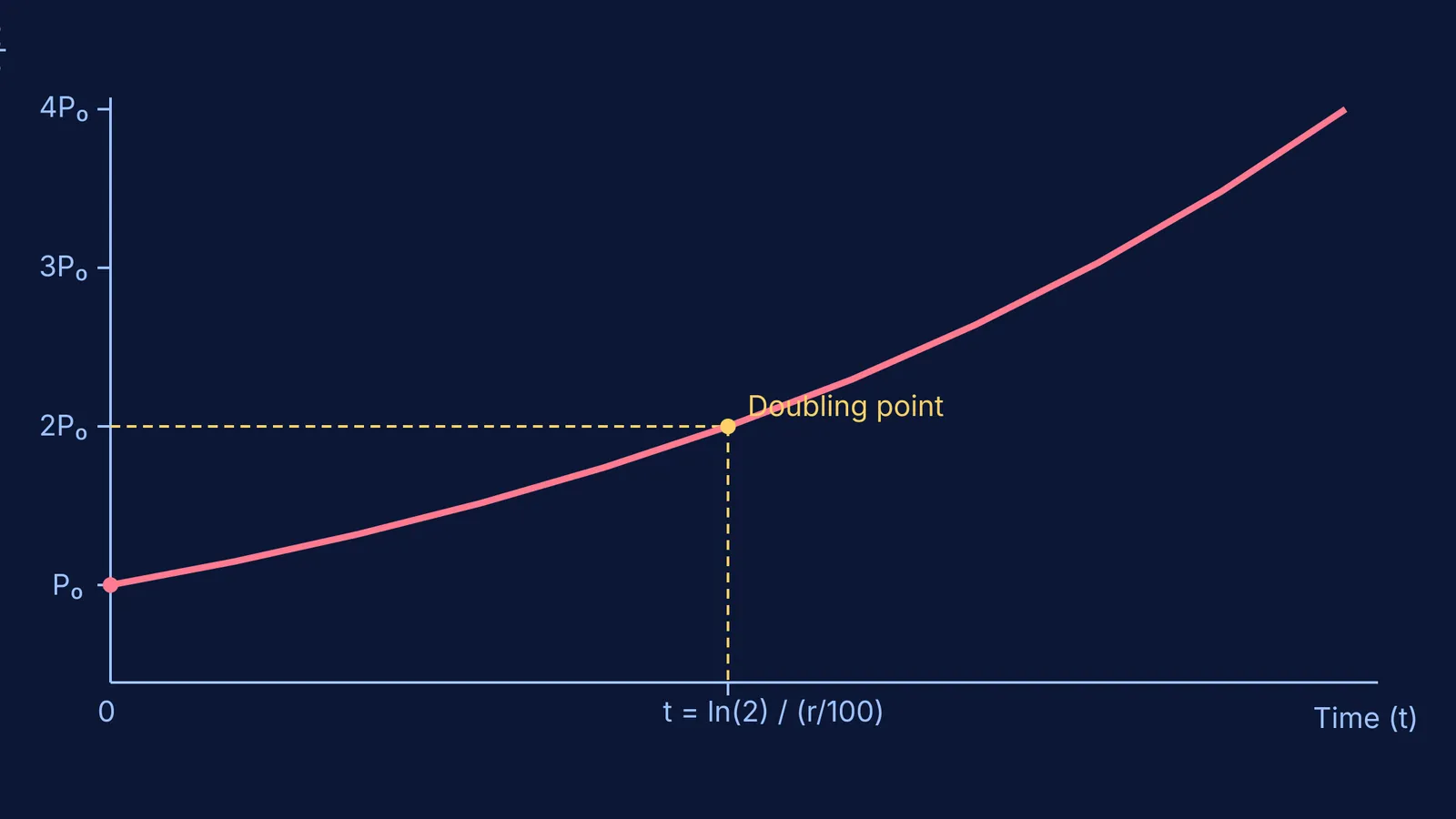
P(t) = P₀ e^(rt/100)
If the interest rate was given as a decimal k (where k = r/100), the formula is written simply as P(t) = P₀ e^(kt). This is the exact exponential growth curve for continuously compounded interest.
How to find the time for money to double?
A frequent exam question asks for the time it takes for an investment to double itself under continuous compounding. As OpenStax Calculus shows, we want to find the time t when the principal P(t) becomes twice the initial amount, or 2P₀.
Setting P(t) = 2P₀ in our solution:
2P₀ = P₀ e^(rt/100)
Divide both sides by P₀:
2 = e^(rt/100)
Now, take the natural logarithm (ln) of both sides:
ln(2) = (r/100)t
Solving for t, we get the exact doubling time:
t = 100 × ln(2) / r
Since ln(2) is approximately 0.693, a quick rule of thumb for the doubling time is 69.3 / r years.
Worked example: Rs 1000 at 5% continuous interest
Let's apply this to a concrete problem, similar to the exponential growth models in OpenStax Calculus, often found in Class 12 and JEE textbooks: *In a bank, principal increases continuously at the rate of 5% per year. In how many years will 1000 rupees double itself?*
Identify the given values: r = 5, and P₀ = 1000.
Set up the differential equation: dP/dt = (5/100) × P = 0.05P.
Use the doubling time formula we derived: t = ln(2) / 0.05.
Calculate the result: t = 20 × ln(2).
If we use the approximation ln(2) ≈ 0.6931, the time is 20 × 0.6931 = 13.86 years.
This framework of translating a word problem into a differential equation is not just for finance. The same logic applies to population growth and cooling models or radioactive decay. If you are preparing for exams, practising homogeneous differential equations and separable equations is essential.
When a word problem leaves you unsure how to start the integration, the Fermi Problem Library has worked problems with a step-by-step solver that explains the reasoning rather than printing an answer. For a deeper dive into the underlying calculus, you can explore the Fermi Concept Library, which covers every concept in physics, chemistry, biology, mathematics and computing, each with its own lesson and its place in the map.


