

On this page
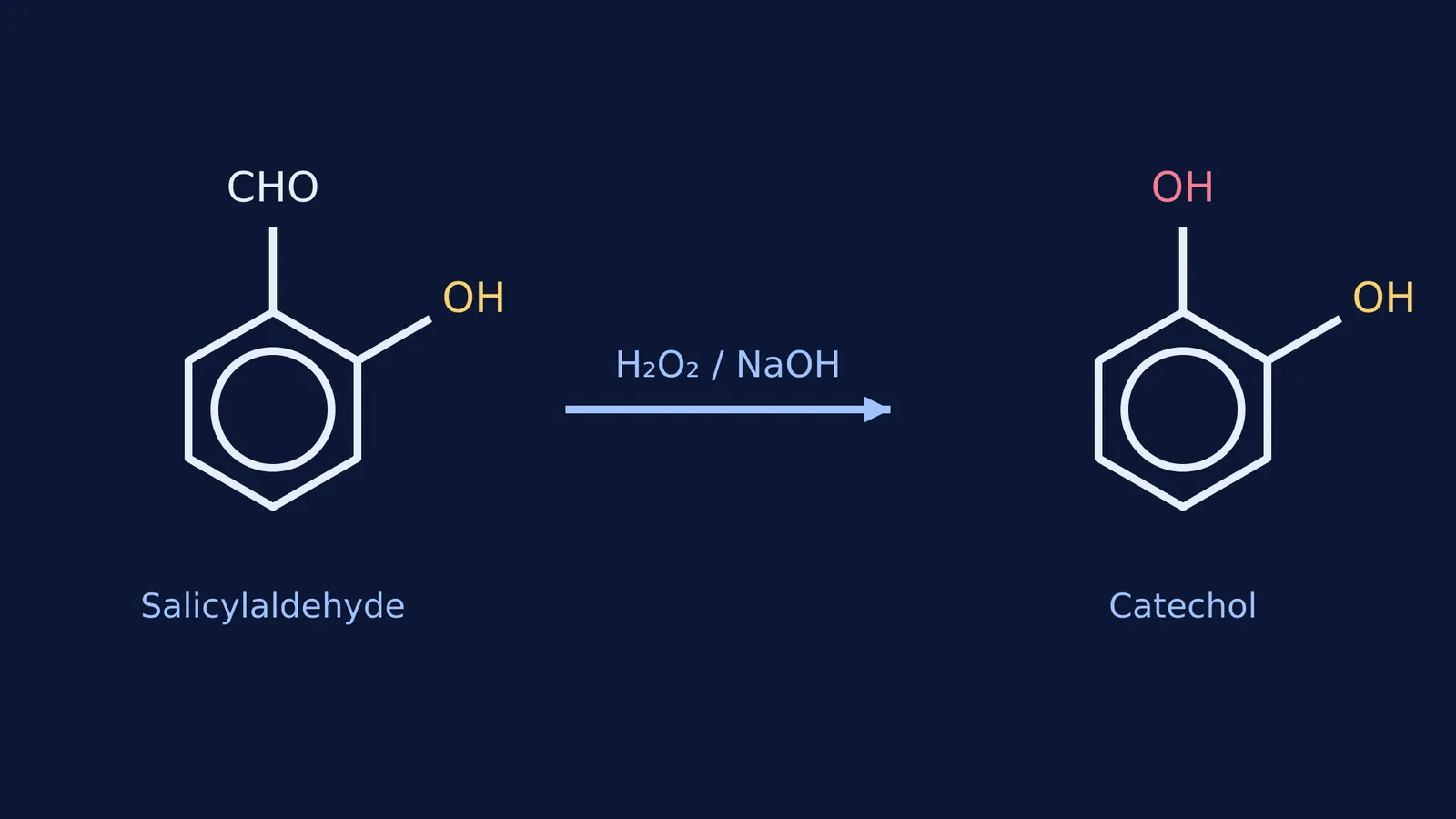
When you treat an *ortho*- or *para*-hydroxybenzaldehyde with hydrogen peroxide in a basic solution, the aldehyde group drops off and is replaced by a hydroxyl group. This transformation is known as the Dakin reaction, first described by Henry Drysdale Dakin in 1909. The overall reaction converts starting materials like salicylaldehyde into catechol (benzene-1,2-diol) and sodium formate.
Converting an aldehyde directly to a phenol is an unusual transformation in organic chemistry. Most oxidation reactions on aldehydes simply produce carboxylic acids. The Dakin oxidation provides a useful workaround. If you are exploring organic mechanisms in the Fermi Concept Library, the Dakin reaction is a great test of how well you understand nucleophilic addition and the rules of migratory aptitude.
What is the Dakin reaction mechanism?
The reaction runs in an aqueous base, such as sodium hydroxide or potassium hydroxide. The base deprotonates hydrogen peroxide (H₂O₂) to form the hydroperoxide anion (HOO⁻). This anion is a much stronger nucleophile than neutral hydrogen peroxide, setting up the first key step of the mechanism.
Nucleophilic addition: The hydroperoxide anion attacks the electrophilic carbonyl carbon of the aldehyde. This pushes the carbon-oxygen double bond's electrons up to the oxygen, forming a negatively charged tetrahedral intermediate.
Aryl migration: The intermediate collapses. The carbon-oxygen double bond reforms, and the entire phenyl ring breaks its bond to the carbon and shifts over to the adjacent oxygen atom of the peroxide. This shift kicks out a hydroxide ion (OH⁻), leaving behind a phenyl formate ester.
Ester hydrolysis: Because the reaction takes place in a basic solution, the formate ester does not last long. Hydroxide ions from the base attack the ester, hydrolysing it into a phenoxide ion and formic acid.
Proton transfer: Formic acid is a stronger acid than the phenol. The phenoxide ion immediately takes a proton from the formic acid, giving the final benzenediol and a formate salt.
The [1,2]-aryl migration in the second step is the rate-determining step. It dictates whether the reaction succeeds or fails.
Why does meta-hydroxybenzaldehyde fail the Dakin reaction?
The Dakin reaction is closely related to the Baeyer-Villiger oxidation, which also inserts an oxygen atom next to a carbonyl group. However, in a standard Baeyer-Villiger oxidation of an aldehyde, the hydrogen atom (hydride) migrates rather than the phenyl ring, yielding a carboxylic acid instead of a phenol.
For the aryl ring to migrate instead of the hydrogen, the ring must be highly nucleophilic. The hydroxyl (-OH) group on the starting benzaldehyde pushes electron density into the ring through resonance. Because this electron density only concentrates at the *ortho* and *para* positions, only *ortho*- or *para*-hydroxybenzaldehydes have the migratory aptitude required to shift the ring.
If you try the reaction on a *meta*-hydroxybenzaldehyde, the resonance effect does not reach the carbon attached to the aldehyde. As a result, the hydride migrates instead of the ring, and you get a carboxylic acid, exactly as you would in a normal Baeyer-Villiger oxidation.
How is the Dakin reaction used in synthesis?
The Dakin reaction provides a clean, high-yield way to synthesise polyhydroxylated benzenes, which are common building blocks for pharmaceuticals and natural products. Catechol, the product of oxidising salicylaldehyde, is used to manufacture pesticides, flavours, and fragrances.
Because it uses inexpensive reagents—hydrogen peroxide and sodium hydroxide—the Dakin oxidation is highly scalable for industrial use. It avoids the toxic heavy metals often required for other oxidation pathways. Moreover, the reaction typically runs at room temperature, making it both energy-efficient and safe for sensitive laboratory preparations. For students planning their own synthesis routes, recognizing when to deploy a Dakin oxidation instead of a standard oxidation can save steps and improve overall yield.
Its mechanism is a classic example of how substituents on a benzene ring can steer a reaction's path by altering electron density. The addition of hydrogen peroxide in the Dakin reaction completely changes the intermediate, forcing the unique aryl shift that yields a phenol instead of the alcohols and carboxylic acids you would expect from basic conditions.
To see how this transformation compares to others in a basic medium, explore the Cannizzaro reaction.


