

On this page
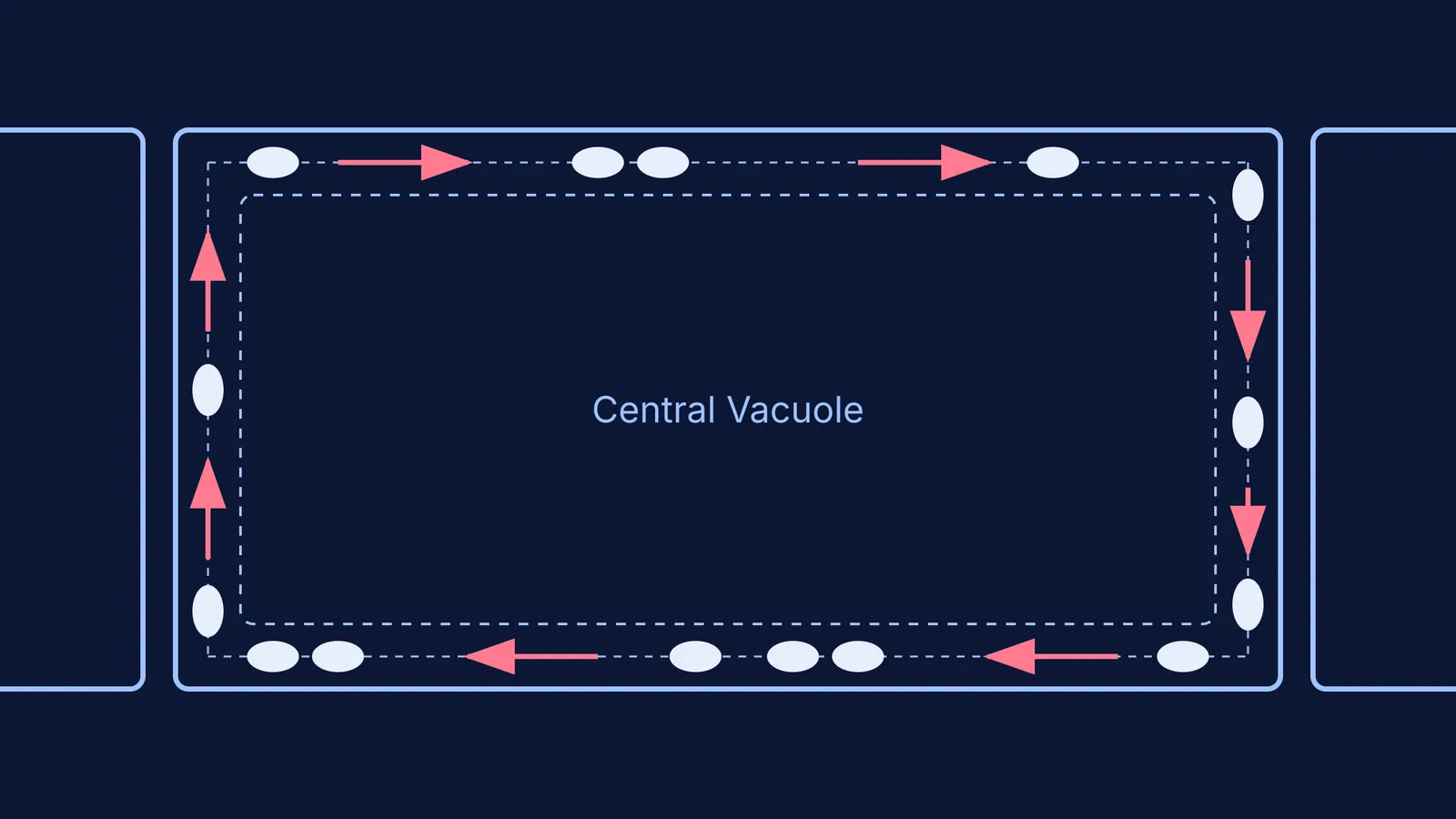
Look down a microscope at a *Hydrilla* leaf and you will not see a still picture. Instead, you will see green chloroplasts marching in a steady, one-way circuit around the edge of each cell. This active flow is called cytoplasmic streaming, or cyclosis.
It is a striking sight, but it is not just for show. Streaming is the transport network that keeps large plant cells alive.
Why is Hydrilla the classic example?
*Hydrilla verticillata* (along with *Elodea*) is the standard laboratory plant for observing cyclosis because its cells are built for visibility.
The leaves are only two cell layers thick, making them highly transparent. Inside each cell, a large central vacuole takes up most of the space. This balloon of sap pushes the cytoplasm—and the chloroplasts within it—to the very periphery of the cell. Because the chloroplasts are confined to this narrow outer lane, their movement is easy to track.
What drives the flow?
The chloroplasts are not swimming under their own power. They are being dragged by the cell's cytoskeleton.
The movement is driven by an interaction between actin and myosin, the same family of proteins that makes your muscles contract:
Actin filaments: These act as structural tracks. In *Hydrilla*, they form bundles just inside the cell membrane.
Myosin XI motors: These motor proteins attach themselves to organelles like chloroplasts, mitochondria and endoplasmic reticulum vesicles. Using energy from ATP, the myosin motors "walk" along the actin tracks.
As the motors drag these large organelles forward, they entrain the surrounding fluid. This creates a bulk flow that sweeps the entire cytosol around the central vacuole in a continuous loop.
How fast is the flow?
Cytoplasmic streaming is remarkably fast for an intracellular process. In higher plants like *Hydrilla*, the streaming velocity usually ranges from 2 to 10 µm/s (Tominaga et al., 2013).
To put that into perspective, certain giant algae, such as *Chara corallina*, have highly specialised myosin motors that can drive streaming at speeds of 50 to 100 µm/s (Tominaga et al., 2013).
By experimenting with these motor proteins, researchers have found that the speed of cytoplasmic streaming is actually a key determinant of overall plant size (Tominaga et al., 2013). When they engineered plants to have faster-moving myosin, the plants grew larger.
Why do plants need cyclosis?
Cells rely on simple diffusion to move molecules around, but diffusion is extremely slow over long distances. Plant cells are often much larger than animal cells. If a plant cell relied on diffusion alone, it would starve before nutrients reached its centre.
Cyclosis solves this by physically stirring the cell's contents. It speeds up the transport of:
Gases like oxygen and carbon dioxide for respiration and photosynthesis.
ATP and enzymes.
Nutrients absorbed from the outside environment.
Streaming also plays a crucial role in photorelocation. By actively circulating the chloroplasts, the cell ensures they all get their turn in the light, which optimises photosynthesis and helps minimise waste like photorespiration by RuBisCO. (If you want to read more about how plants respond to light on a larger scale, see our guide to phototropism and other tropic movements).
Moving beyond static diagrams
When you first study cell biology, static textbook diagrams make it easy to picture the cell as a fixed bag of water. But as cyclosis shows, cells are heavily structured, dynamic machines (just like the microtubules that power cilia and flagella).
If you want to understand this active machinery, the Fermi Concept Library contains every concept in physics, chemistry, biology, mathematics and computing, each with its own lesson and its place in the map. It can help you piece together how the cytoskeleton, energy from ATP, and organelle transport all fit together.


