

On this page
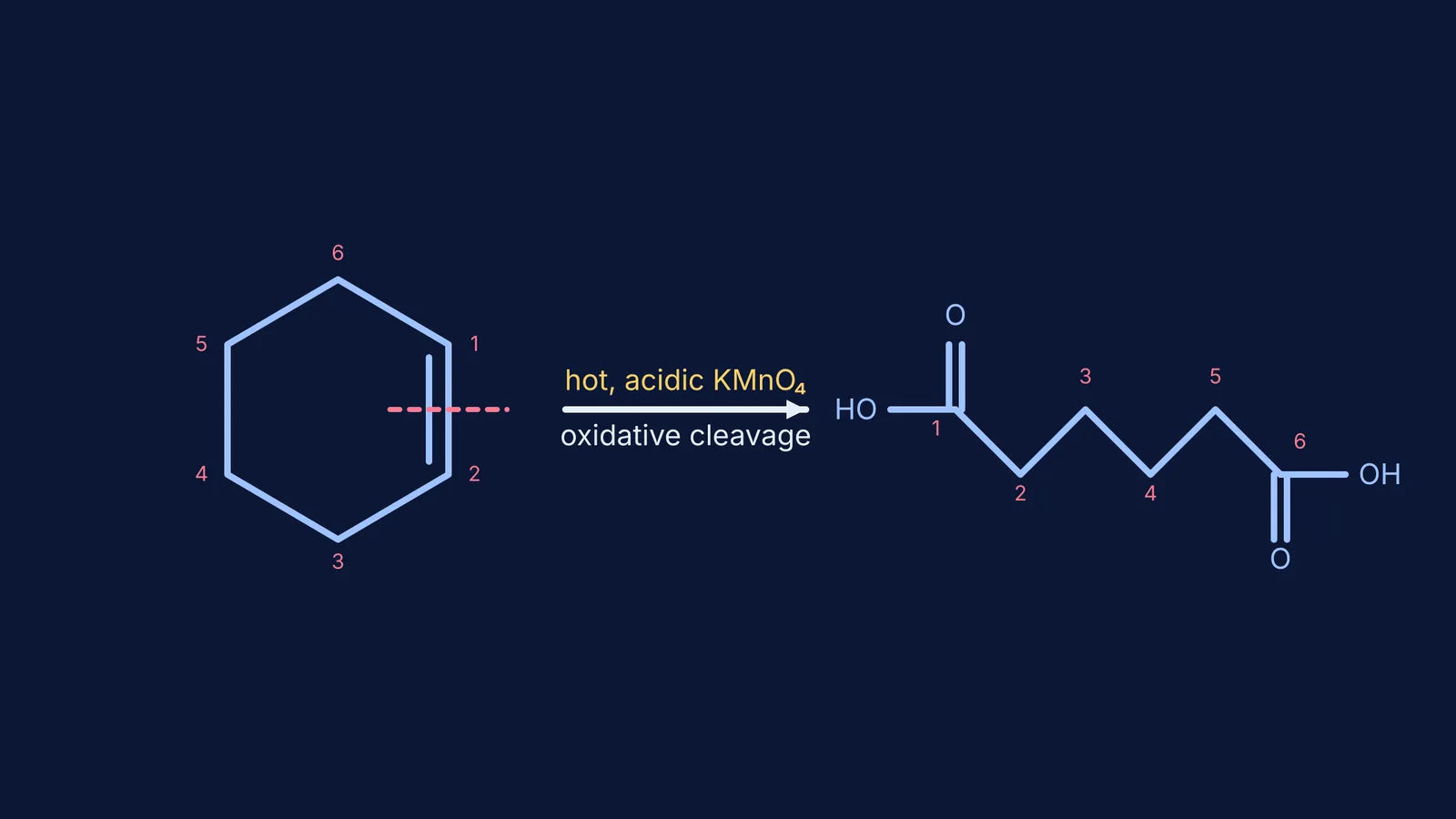
When you treat an alkene with hot, acidic potassium permanganate (KMnO₄), the reaction does not stop at simply adding hydroxyl groups across the double bond. The harsh, energetic conditions break the carbon-carbon double bond entirely—cleaving both the π (pi) and σ (sigma) bonds. For a cyclic alkene like cyclohexene, this dramatic cut opens the ring, creating a straight-chain dicarboxylic acid known as adipic acid.
Here is how the oxidative cleavage works, why it yields hexane-1,6-dioic acid, and how to track the carbons through the reaction.
What are the rules of oxidative cleavage?
Potassium permanganate is a powerful, deep purple oxidizing agent. When it is heated in an acidic medium (often written as KMnO₄ / H⁺ / Δ), it slices through double bonds (OrgoSolver).
You can predict the final products of any such reaction by looking at what is attached to the carbons of the double bond:
Terminal carbons (=CH₂): These oxidize initially to formaldehyde, which cannot survive the strong oxidizer. It quickly over-oxidizes to carbonic acid, which decomposes into carbon dioxide (CO₂) and water.
Disubstituted carbons (=CR₂): These carbons have no hydrogen attached. They oxidize into ketones. Because ketones resist further oxidation, the reaction stops there.
Monosubstituted carbons (=CHR): These initially form aldehydes when the bond breaks. However, aldehydes are highly reactive towards KMnO₄ in acid, so they immediately oxidize further into carboxylic acids (-COOH).
In the case of cyclohexene, both carbons participating in the double bond are monosubstituted. Each is attached to one hydrogen atom and one alkyl group (the rest of the ring). Therefore, both ends of the severed bond follow the third rule and become carboxylic acid groups.
How does the mechanism open the ring to a straight chain?
The reaction happens in a series of rapid stages that rip the original molecule apart.
Forming the intermediate: The permanganate ion (MnO₄⁻) first adds across the double bond in a *syn* fashion. This creates a five-membered cyclic manganate ester intermediate.
Cleaving the bond: Under hot conditions, this intermediate is highly unstable. The manganese atom pulls electrons away, snapping the carbon-carbon bond and leaving two carbonyl groups. At this exact instant, the six-carbon ring unrolls into a straight six-carbon chain with an aldehyde at both ends (hexanedial).
Over-oxidation: Because aldehydes cannot survive in hot acidic KMnO₄, they are rapidly oxidized. The C–H bonds on the aldehyde carbons are replaced by C–OH bonds.
Because the original molecule was a continuous ring of six carbons, breaking just one bond creates a single straight chain containing all six original carbons. The result is hexane-1,6-dioic acid, commonly known as adipic acid.
How do you balance the equation and observe the change?
The balanced chemical equation for the oxidative cleavage of cyclohexene in acidic conditions is:
5C₆H₁₀ + 8KMnO₄ + 24H⁺ → 5HOOC(CH₂)₄COOH + 8Mn²⁺ + 8K⁺ + 12H₂O
In a laboratory setting, this reaction provides a stark visual change. The initial solution of KMnO₄ is a brilliant, dark purple. As the cyclohexene is oxidized, the permanganate is reduced to Mn²⁺ ions, which are almost colorless (or very pale pink) in solution. This decolorization confirms that the double bond has reacted. Upon cooling or concentration, the newly formed adipic acid, which is largely insoluble in cold water, precipitates out as white crystals.
How do you keep track of the carbon chain?
When rings open or multiple bonds break, it is incredibly easy to miscount the carbons in your final product. A simple rule is to number the ring starting from one side of the double bond. When you draw the open chain, number it again to ensure you still have exactly the same number of carbon atoms.
If you often lose track of atoms during complex organic mechanisms, the Fermi Problem Library provides worked problems with a step-by-step solver that explains the reasoning rather than printing an answer. It helps you see exactly how the ring unfolds.
This aggressive oxidation is the opposite of reduction reactions—like those covered in Clemmensen vs Wolff-Kishner: reducing a C=O group to CH2—which strip oxygen away to leave bare hydrocarbons. And while KMnO₄ cleaves the bond entirely, other reagents like those in Hydroboration-oxidation: anti-Markovnikov alcohols from alkenes simply add functional groups across the double bond without breaking the underlying carbon skeleton.
Whenever you face an oxidative cleavage problem in organic chemistry, check your reagents carefully. Cold, dilute KMnO₄ will simply add two -OH groups to make a diol. But if you see heat and acid, prepare to break the bond completely. For a broader look at how different reagents steer organic reactions, you can explore the Fermi Concept Library, which covers every concept in physics, chemistry, biology, mathematics and computing, each with its own lesson and its place in the map.


