

On this page
When you draw a four-sided shape so that all of its corners touch the edge of a single circle, you create a cyclic quadrilateral. These shapes possess unique symmetries that make them a favourite in geometry exams.
The most important rule to remember is that the opposite angles of a cyclic quadrilateral sum to 180 degrees. This property, famously formalised in Euclid's *Elements* Book III Proposition 22, lets you find missing angles instantly.
Why do the opposite angles of a cyclic quadrilateral sum to 180?
To understand why this is always true, you can prove it using arcs and the central angle theorem.
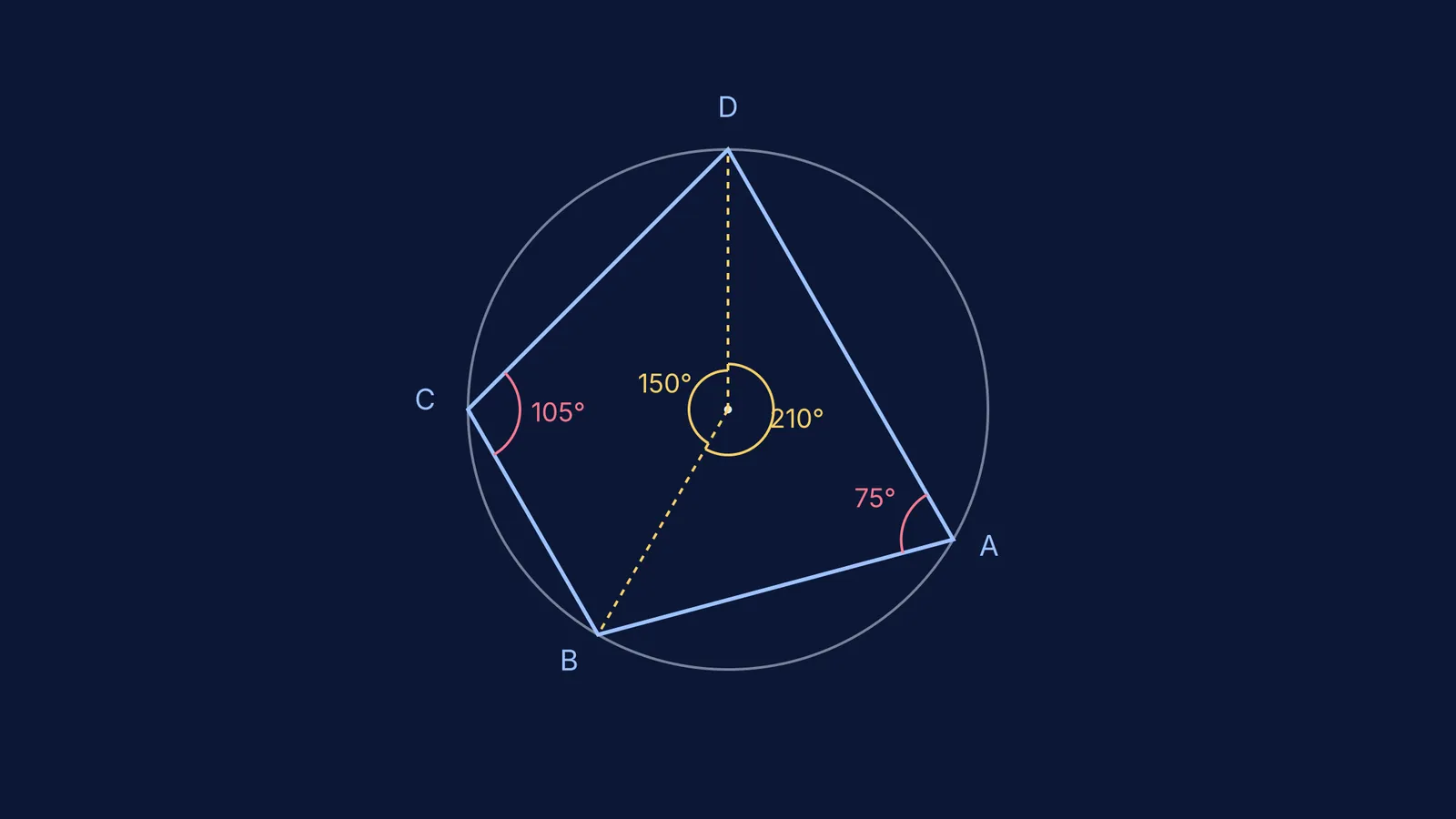
Imagine a cyclic quadrilateral with vertices A, B, C, and D placed in order around a circle. Let the centre of the circle be O. If you draw straight lines from the centre O to the vertices B and D, you split the circle into two arcs: the minor arc BD and the major arc DB.
According to the inscribed angle theorem, the angle subtended by an arc at the centre is always twice the angle it subtends at the circumference:
The interior angle at A looks at the minor arc BCD. Therefore, the central angle looking at the same arc (angle BOD) is exactly twice the size of angle A.
The opposite interior angle at C looks at the major arc DAB. The reflex central angle looking at that arc is exactly twice the size of angle C.
The two central angles around the point O must add up to a full circle, which is 360°. Since the angles at A and C are exactly half of these central angles, their sum must be half of 360°. Therefore, angle A plus angle C equals 180°.
Since the sum of interior angles in any quadrilateral is 360°, the remaining pair (B and D) must also sum to 180°.
Suppose you have a cyclic quadrilateral ABCD where angle A is 85° and angle B is 110°. To find angles C and D, remember opposite angles sum to 180°. Thus, angle C = 180° − 85° = 95°, and angle D = 180° − 110° = 70°. The total sum is 85° + 110° + 95° + 70° = 360°, confirming the calculation. For more foundational geometry rules, you can review our guide to Quadrilaterals in Class 9: parallelograms and the mid-point theorem.
If geometry proofs feel overwhelming when written out, it can help to see the theorems visually. The Fermi Concept Library contains every concept in physics, chemistry, biology, mathematics and computing, each with its own lesson and its place in the map.
What is the exterior angle corollary?
If you extend one side of a cyclic quadrilateral outwards, you create an exterior angle. For instance, if you extend the line segment AB past B to a point E, the exterior angle is angle CBE. The adjacent interior angle is angle ABC. Because they lie on the straight line AE, angle CBE + angle ABC = 180°.
Inside the cyclic quadrilateral, the opposite interior angle is angle ADC. By the main theorem, angle ADC + angle ABC = 180°. Comparing these two equations, it is clear that angle CBE must exactly equal angle ADC.
Therefore, the exterior angle of a cyclic quadrilateral is exactly equal to the interior opposite angle. Spotting this relationship will often save you several steps in a long exam question.
How do you test if four points are concyclic?
In advanced geometry problems, you are rarely handed a circle. Instead, you are given four points and asked to prove they are concyclic (lying on the same circle).
You can prove this using the converse of the theorem: if you can calculate the angles of the quadrilateral formed by the four points and show that one pair of opposite angles adds up to 180°, the points must be concyclic.
In coordinate geometry, you might be given the coordinates of four points. Rather than finding the algebraic equation of a circle that passes through three of the points and testing if the fourth point lies on it, you can often just calculate the slopes of the lines to find the angles. If you show the opposite interior angles sum to 180°, you have proven they are concyclic with much less calculation.
There is a second standard test using arcs. If a line segment joining two points subtends equal angles at two other points situated on the same side of the line, those four points are concyclic. This relies on the fact that angles in the same segment of a circle are equal. You can read more about these relationships in Circles in Class 9: chords, arcs and cyclic quadrilaterals.
Once you have proven the points are concyclic, you can apply other advanced properties, such as the theorems covered in Circles in Class 10: tangent theorems with worked examples, to find lengths and tangents.


