

On this page
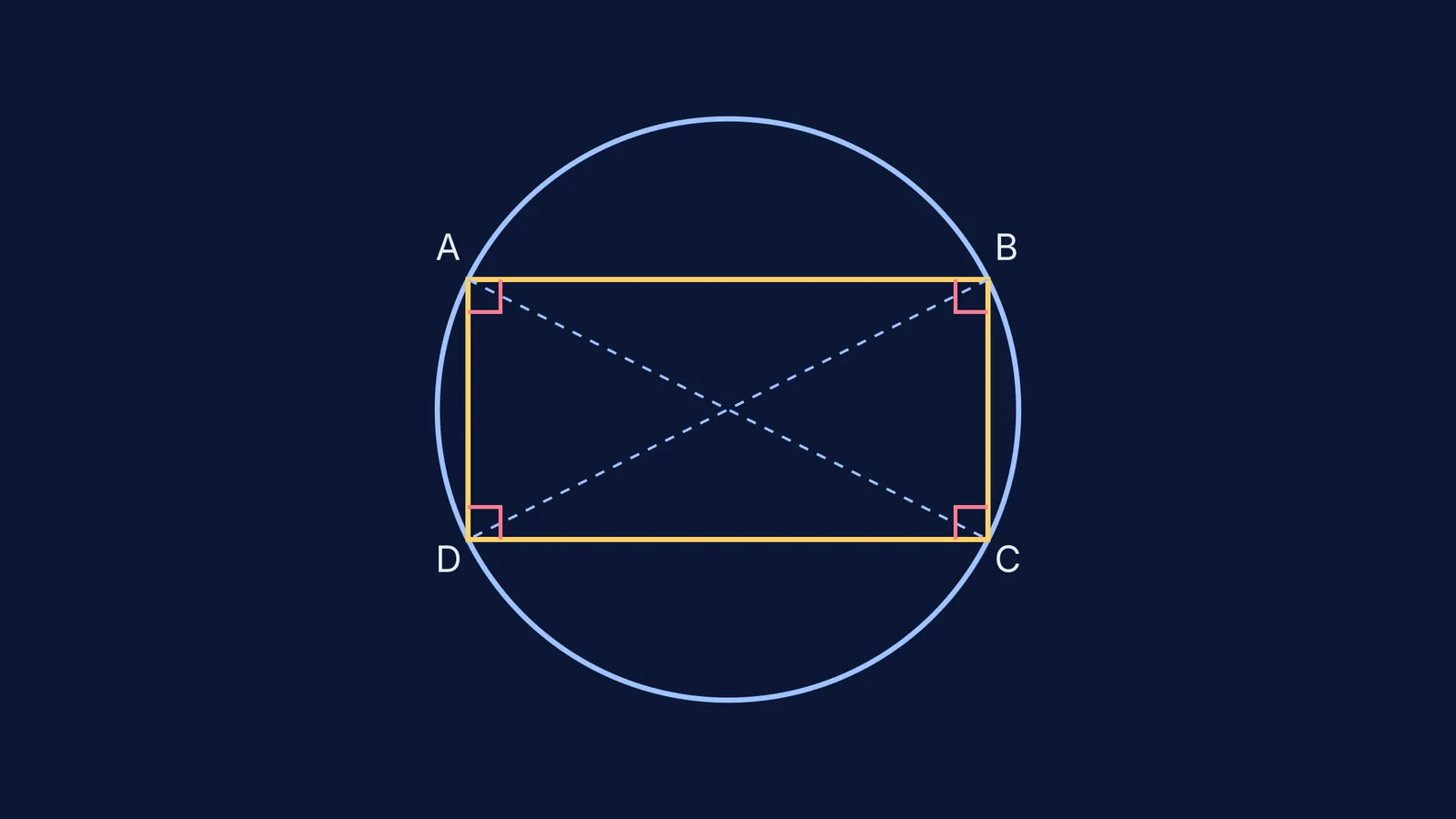
Many students memorise geometry theorems as isolated facts, treating the properties of circles and quadrilaterals as completely separate topics. But geometry is a connected system. One of the clearest examples of this connection is the proof that a cyclic parallelogram must be a rectangle.
By combining just two basic rules—one about parallelograms and one about cyclic quadrilaterals—you can prove that all four angles of the shape are exactly 90°. Working through this yourself is a highly effective form of active learning. A 2014 meta-analysis by Scott Freeman and colleagues found that failure rates under traditional lecturing increase by 55% over the rates observed under active learning (Freeman et al., PNAS).
Instead of just passively reading the result, let's break down the logic step by step.
What is a cyclic parallelogram?
Before diving into the proof, it helps to understand the two distinct geometric ideas we are combining.
First, a parallelogram is a four-sided shape where opposite sides are parallel (Wikipedia). Because of these parallel lines, opposite angles are always equal to each other. If you label the interior angles A, B, C and D in order around the shape, angle A equals angle C, and angle B equals angle D.
Second, a cyclic quadrilateral is any four-sided shape whose four vertices all touch the edge of a single circle (Wikipedia). The defining rule for a cyclic quadrilateral is that its opposite angles are supplementary, meaning they add up to 180°. So, angle A plus angle C equals 180°, and angle B plus angle D equals 180°.
A cyclic parallelogram is simply a shape that follows both sets of rules at the exact same time.
How do you prove a cyclic parallelogram is a rectangle?
To prove that this shape is a rectangle, we need to show that its angles measure 90°. Let us name our cyclic parallelogram ABCD.
Use the parallelogram rule: Because ABCD is a parallelogram, its opposite angles are equal.
Angle A = Angle C
Use the cyclic rule: Because ABCD is inscribed in a circle, its opposite angles must add up to 180°.
Angle A + Angle C = 180°
Combine the equations: Since Angle A and Angle C are the exact same size, we can replace Angle C with Angle A in our addition.
Angle A + Angle A = 180° 2 × Angle A = 180° Angle A = 90°
Since Angle A is 90° and Angle C is equal to Angle A, Angle C must also be 90°. The exact same logic applies to angles B and D. Because Angle B = Angle D and Angle B + Angle D = 180°, they both equal 90° as well. Therefore, every angle in the parallelogram is a right angle, which means the shape is a rectangle.
A four-step framework for geometry proofs
You can use the structure of this proof as a template for tackling other geometry problems. When you are faced with a new proof, follow these four steps:
Identify the givens: Write down every property you are told. If a question gives you a cyclic parallelogram, list the properties of a parallelogram and a cyclic quadrilateral separately.
State the goal: Be precise about what you need to prove. To prove a shape is a rectangle, you do not need to prove the sides are straight; you just need to prove one interior angle is 90° in a known parallelogram.
Find the bridge: Look for a property that connects your givens. Here, the bridge is the angles. Both shapes have specific, interacting rules about their opposite angles.
Write the logical chain: Use simple algebra to substitute one rule into the other, just as we replaced Angle C with Angle A.
Why learning proofs actively matters
It is tempting to skip the proof steps and just memorise the final sentence for your exams. However, studying the reasoning builds a much stronger foundation for harder questions. When you encounter a complex geometry problem, you will rarely be asked to just state a theorem. Instead, you will need to combine properties of different shapes, just like we did here.
This is where the Fermi Concept Library can help you connect the dots. Because it covers every concept in mathematics, each with its own lesson and its place in the map, you can explore the underlying rules and see how they link together to form a proof, rather than just reading a final answer.
If you are preparing for board exams, writing out your logic clearly is crucial. As we outlined in our guide on Class 10 CBSE maths: board answer mistakes and how to show working, examiners look for these clear, step-by-step deductions.
Replacing passive reading with active problem solving fundamentally changes how you retain information. The shift towards engaging with the material directly is backed by decades of research; you can read more about Carl Wieman: why a Nobel physicist moved beyond the lecture to see how science education is changing. By working through proofs like this one, you build the analytical habits needed for long-term academic success.


