

On this page
Curved arrows are how you show, on paper, which electrons move in a reaction. In board answers and in JEE-style mechanism questions, an arrow that starts in the wrong place or has the wrong head can turn a correct product into a wrong mechanism.
Where does a curved arrow start and end?
NCERT's Class 11 chemistry textbook gives the rule in one sentence: the curved arrow “starts from the point from where an electron pair is shifted and it ends at a location to which the pair of electron may move” (NCERT Class 11 Chemistry Part 2, Unit 8, section 8.7.3).
Start on a lone pair (draw the dots and touch them), a pi bond, or a sigma bond that is breaking.
End on an atom that will hold the pair as a lone pair, or between two atoms where a new bond will form.
Never start on a positive charge, a bare H+, or an atom with no electrons to give.
Arrows run from electron-rich to electron-poor, so first spot the nucleophile and the electrophile before you draw anything.
When do you use a full arrow and when a fishhook?
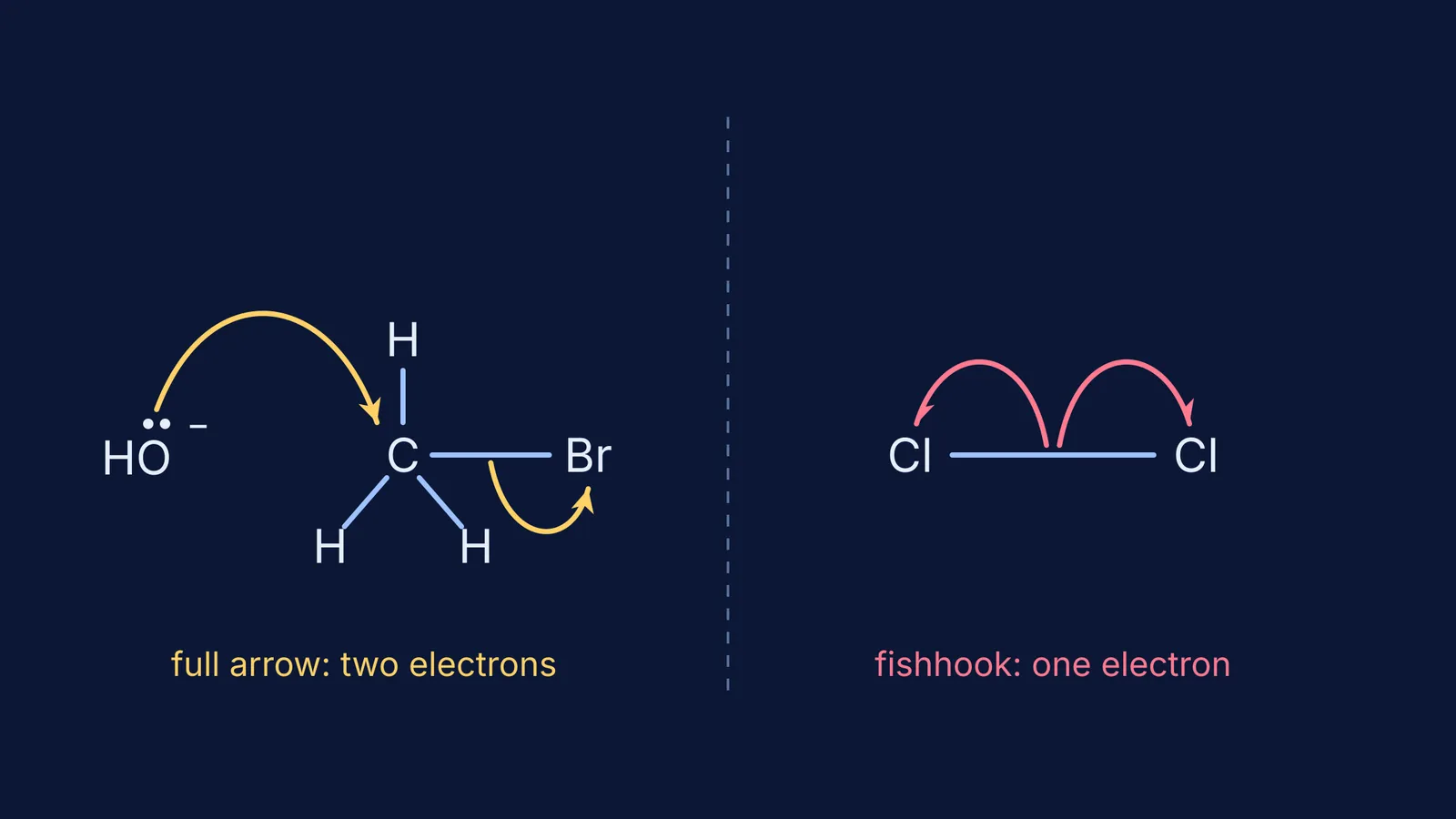
A full arrow, with a double barb, moves a pair of electrons. A half-headed arrow moves one electron; in the same section NCERT calls it a single-barbed fish hook, a “half headed curved arrow” (NCERT Unit 8).
Use full arrows for polar steps such as heterolytic cleavage, substitution and resonance. Use fishhooks for homolytic cleavage and radical steps. Chlorine splitting into two chlorine atoms needs two fishhooks, each starting at the middle of the Cl–Cl bond and ending on one chlorine.
Jim Clark's guide on Chemistry LibreTexts warns that if you use “an ordinary full arrow to show the movement of a single electron you run the risk of losing marks” (The Use of Curly Arrows, Chemistry LibreTexts).
What are the most common arrow-pushing mistakes?
Arrow from H+ to a double bond. Wrong: an arrow from the proton to C=C. Right: start on the pi bond and end on H+, because the pi electrons move, not the proton. NCERT's electromeric-effect example also starts the arrow on the pi bond (NCERT Unit 8, section 8.7.8).
One arrow where two are needed. For hydroxide and bromomethane, a single arrow from oxygen to carbon leaves carbon with five bonds. Right: one arrow from the oxygen lone pair to carbon, and a second from the C–Br bond to bromine, which leaves as bromide. NCERT shows this pair of arrows in section 8.7.3, and the same logic decides whether a haloalkane reacts by SN1 or SN2.
A full arrow for one electron. Wrong: one full arrow splitting Cl–Cl in sunlight. Right: two fishhooks, one to each chlorine atom.
An arrow from a positive charge. Wrong: an arrow from the + of a carbocation towards a water molecule. Right: an arrow from a lone pair on the water oxygen to the positive carbon.
Straight or floating arrows. Clark's guide says electron pair movements must be shown as curly arrows, not straight ones. End each head clearly on an atom or on the midpoint of the new bond.
Why do good students still draw arrows that make no sense?
Purdue University chemists Gautam Bhattacharyya and George Bodner interviewed 14 graduate students as they solved mechanism problems aloud (Journal of Chemical Education, 2005). Their one-sentence finding: “The curved arrows used in the electron-pushing formalism held no physical meaning for the graduate students involved in this study.” The most common justification students gave for a step was “It gets me to the product.” On one problem, 12 of the 14 used the electrons of a vinyl group to attack a four-membered ring, a path the authors call particularly egregious; on another, all of them proposed a highly unstable phenyl cation.
The lesson for you is that an arrow is a claim about where electrons go, not a route to the answer you already know. If you like the history, read how Robert Robinson and curly arrows shaped mechanism drawing.
A 60-second check before you move on
Draw every lone pair on the atoms that react.
Label the nucleophile and the electrophile.
Draw each arrow from electrons to their new home: an atom or a bond position.
Choose the head: double barb for a pair, fishhook for one electron.
Count bonds and charges after each step; the total charge on both sides must match.
Ask whether each intermediate is reasonable. If it is a primary or phenyl cation, look for another path.
If you get the product right but your arrows keep coming back marked, work through mechanism questions in the Fermi Problem Library, where a step-by-step solver explains the reasoning rather than printing an answer. If the gap is earlier, in why a carbonyl carbon is electron-poor or what makes a good nucleophile, the Fermi Concept Library has a lesson on each concept.
Tonight, redraw one mechanism from your current chapter using the six checks.


