

On this page
You might have wondered about this while drawing circuit diagrams. We draw arrows on wires to show the direction of conventional current, and current obviously has a magnitude (like 5 A or 10 A). Since a vector is generally introduced in early physics as any quantity having both magnitude and direction, shouldn't current be a vector?
The short answer is no. According to OpenStax University Physics, electric current is a scalar quantity. Unlike true vectors, it does not obey the laws of vector addition.
Does electric current obey vector addition?
The defining test for a vector is not just having a direction in space, but obeying the fundamental laws of vector addition (such as the parallelogram or triangle law). Electric current fails this test completely.
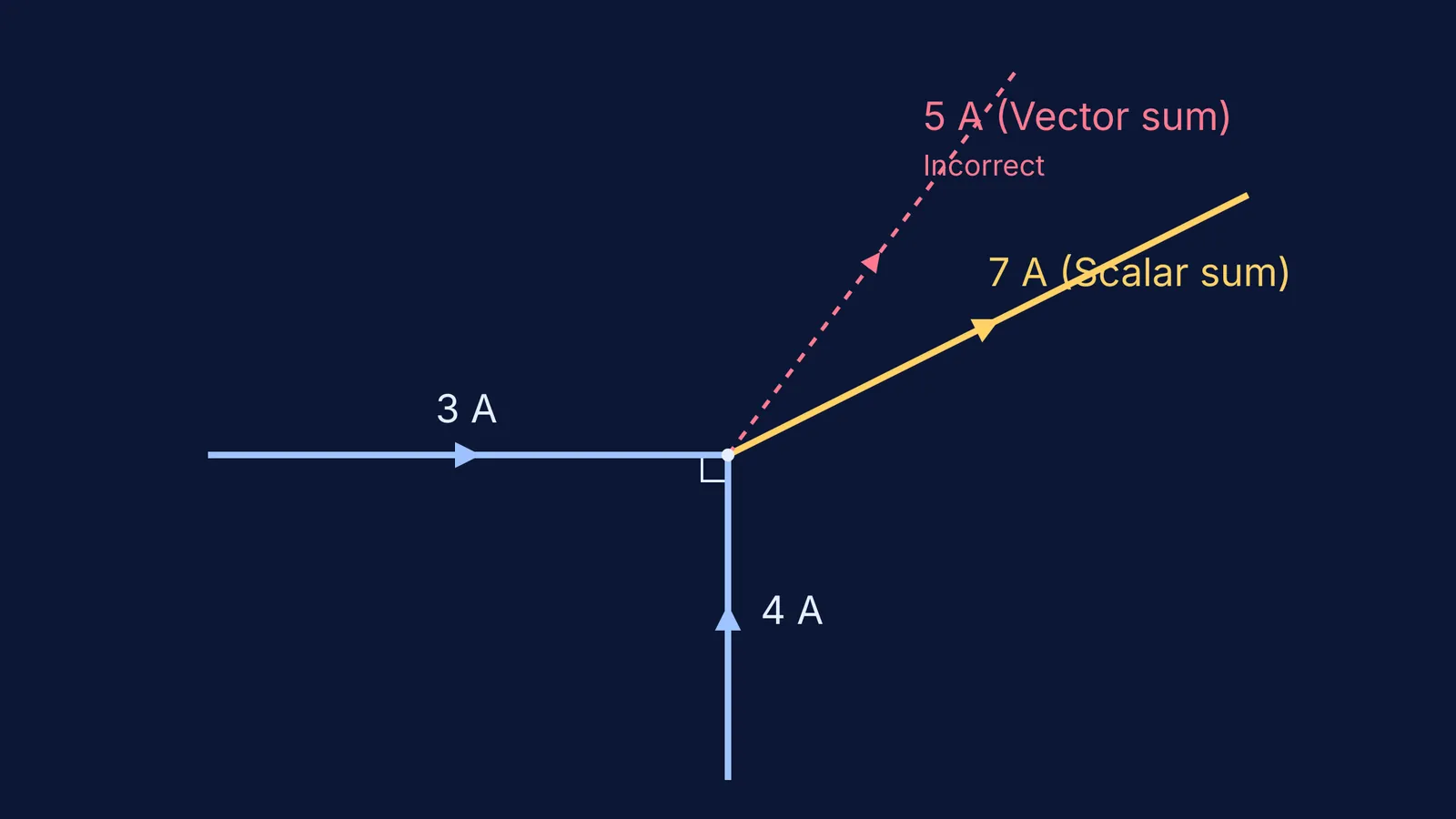
When two wires meet at a junction in a circuit, the total current leaving the junction is just the algebraic sum of the incoming currents. According to Kirchhoff's junction rule (a consequence of the conservation of charge), if a 3 A current and a 4 A current meet at a 90° angle, the resulting current is exactly 7 A.
If they were true vectors, you would use the Pythagorean theorem to find a vector sum of 5 A, which is physically incorrect. You could bend the wires to meet at 180°, 60° or 12°—the outgoing current will remain exactly 7 A. Because the physical angle between the wires does not change the total current, it must be treated as a scalar quantity. (For more on applying Kirchhoff's rule correctly, see Kirchhoff's laws: sign conventions that stop circuit mistakes.)
How is electric current defined mathematically?
If current is a scalar, what do the arrows on a circuit diagram actually mean? Mathematically, electric current I is defined as the rate at which electric charge Q flows through a surface over time t. The formula is I = dQ/dt.
Since electric charge is a scalar quantity and time is a scalar quantity, their ratio must also be a purely scalar quantity. The arrows we draw on circuits do not represent a spatial 3D vector; they merely indicate the sign convention of positive charge flow along the fixed path of the conductor.
In a solid metal wire, electrons flow in one direction, and we say the "conventional current" flows in the opposite direction. This is a one-dimensional constraint.
What is the difference between current and current density?
While current is a scalar, physics does have a vector counterpart that is closely related: current density j. Current density describes the amount of current flowing per unit cross-sectional area and has a specific direction at any point in three-dimensional space.
In fact, current is mathematically calculated as the dot product of the current density vector and the area vector A (I = j · A). By definition, the dot product (or scalar product) of any two vectors always yields a scalar. Therefore, electric current is mathematically guaranteed to be a scalar.
Here is a quick checklist to tell them apart when solving problems:
Electric Current (I): Scalar. Measured in Amperes (A). Represents the total charge passing through a cross-section per second. Added algebraically at junctions.
Current Density (j): Vector. Measured in Amperes per square metre (A/m²). Represents the flow of charge at a specific microscopic point in space. It follows vector addition rules.
Some advanced textbooks might refer to scalars as "tensors of rank zero", which simply means they are scalars that remain invariant under coordinate transformations. Rotating your circuit board does not change the current flowing through it!
Why does this distinction matter for exams?
For students preparing for competitive exams like JEE Main, JEE Advanced and NEET-UG, misunderstanding the scalar nature of current can lead to unforced errors in physics numericals.
When you encounter a complex circuit mesh with multiple branches, you might be tempted to break the currents into x and y components. If you treat current as a vector, you will incorrectly attempt to resolve a 10 A diagonal current into 10 cos θ and 10 sin θ components. This immediately ruins the calculation.
Instead, you only need to track the algebraic values (positive for currents entering a junction, negative for currents leaving). The geometry of the wires—whether they are twisted, coiled, or straight—has absolutely no effect on the application of Kirchhoff's Current Law. The only exception is when calculating magnetic fields using the Biot-Savart Law, where you use a "current element" I dl. In this specific case, the vector nature is carried entirely by the length element dl, not by the current I itself.
By keeping the definitions clear, you avoid these common traps. Understanding this distinction is a common stumbling block for students, often leading to conceptual mistakes covered in Vectors in JEE physics: common errors and how to avoid them. If you find yourself confused by similar overlapping concepts while studying for exams, the Fermi Concept Library can help you trace these ideas back to first principles and clear up the confusion.


