

On this page
A cubic's coefficients tell you three facts about its roots, even when you cannot find the roots. These facts are Vieta's formulas, and many JEE-style questions on cubics test how well you use them.
What are the relations between roots and coefficients of a cubic?
Take ax³ + bx² + cx + d = 0 with a ≠ 0 and roots α, β, γ. As the Wikipedia entry on Vieta's formulas states:
α + β + γ = −b/a
αβ + βγ + γα = c/a
αβγ = −d/a
Why: the cubic factorises as a(x − α)(x − β)(x − γ), which expands to a[x³ − (α + β + γ)x² + (αβ + βγ + γα)x − αβγ]. Match the coefficients and the signs come out minus, plus, minus.
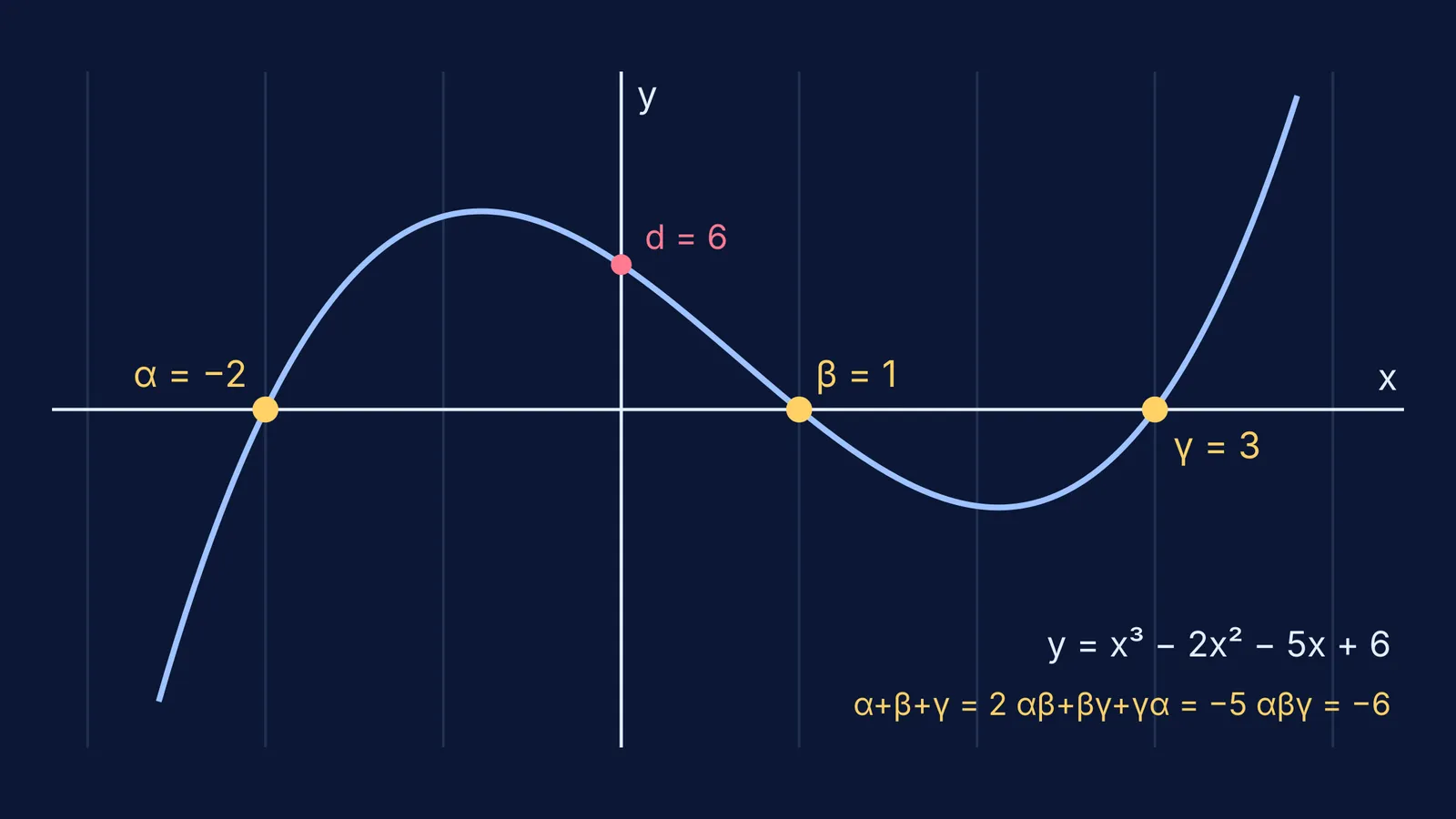
Check it on the cubic in the image above, x³ − 2x² − 5x + 6 = (x + 2)(x − 1)(x − 3). The roots add up to 2, their pairwise products to −5, and their product is −6.
Wolfram MathWorld credits Viète (1579) with proving the rule for positive roots only, and Albert Girard with the general theorem. Read our profile of François Viète and the letters that made algebra general.
How do Vieta's formulas extend to a quartic?
For degree n, the sum of the products of the roots taken k at a time equals (−1)^k times the coefficient of x^(n−k), divided by the leading coefficient (MathWorld). For ax⁴ + bx³ + cx² + dx + e = 0 with roots α, β, γ, δ:
Σα = −b/a (four terms)
Σαβ = c/a (six terms)
Σαβγ = −d/a (four terms)
αβγδ = e/a
The product of all the roots has a plus sign for a quartic but a minus sign for a cubic, a common slip.
How do you form a cubic equation from given roots?
Run the formulas backwards. A monic cubic with roots α, β, γ is x³ − (Σα)x² + (Σαβ)x − αβγ = 0.
For roots 1, 2 and 3, the sum is 6, the pairwise sum is 2 + 3 + 6 = 11 and the product is 6. So the equation is x³ − 6x² + 11x − 6 = 0.
For transformed roots, substitute instead of recomputing. If f(x) = 0 has roots α, β, γ:
Roots kα, kβ, kγ: replace x by x/k.
Roots α + h, β + h, γ + h: replace x by x − h.
Roots 1/α, 1/β, 1/γ: replace x by 1/x and clear fractions; the coefficients reverse order.
Our guide to forming a quadratic whose roots are transformed from given roots applies the same idea to quadratics.
How do you find Σα²β without solving the cubic?
Σα²β means α²β + α²γ + β²α + β²γ + γ²α + γ²β: six terms, one for each ordered pair of different roots. The key identity is (α + β + γ)(αβ + βγ + γα) = Σα²β + 3αβγ, because expanding the left side gives each α²β-type term once and αβγ three times. So Σα²β = (Σα)(Σαβ) − 3αβγ.
Worked example: let α, β, γ be the roots of 2x³ − 3x² + 4x − 5 = 0, so a = 2, b = −3, c = 4 and d = −5.
Σα = −b/a = 3/2.
Σαβ = c/a = 2.
αβγ = −d/a = 5/2.
Σα²β = (3/2)(2) − 3(5/2) = 3 − 15/2 = −9/2.
The same three numbers give the other common sums:
α² + β² + γ² = (Σα)² − 2Σαβ = 9/4 − 4 = −7/4.
1/α + 1/β + 1/γ = Σαβ ÷ αβγ = 2 ÷ 5/2 = 4/5.
α³ + β³ + γ³ = (Σα)³ − 3(Σα)(Σαβ) + 3αβγ = 27/8 − 9 + 15/2 = 15/8.
The negative sum of squares shows that this cubic has two non-real roots, since the squares of real numbers cannot add up to less than zero.
Which mistakes cost marks in these questions?
Did you divide by a? The formulas use b/a, not b, unless the cubic is monic.
Are the signs right? Minus, plus, minus for a cubic.
Did you count the terms? For a cubic, Σα²β has six terms, not three.
Did you treat a missing power as zero? In x³ − 7x + 6 = 0, b = 0, so Σα = 0.
For the two-root versions of these identities, see symmetric functions of roots such as α² + β² and α³ + β³.
If a Vieta question keeps going wrong at the same step, the Fermi Problem Library has worked problems with a step-by-step solver that explains the reasoning rather than printing an answer. If the gap is in what a symmetric function is, the Fermi Concept Library gives each mathematics concept its own lesson.


