

On this page
If you look at the electron configuration of copper, the Cu⁺ ion seems like it should be the undisputed winner. It has a completely filled 3d¹⁰ subshell, which usually means exceptional stability across the periodic table. However, drop copper into water, and the rules change entirely. In aqueous solutions, Cu²⁺ is significantly more stable than Cu⁺.
This apparent contradiction is a frequent question in exams because it tests whether you are looking at the whole picture. An ion's stability in a beaker of water depends on its environment, not just the isolated atom in a vacuum. By comparing the gas phase to the aqueous phase, we can see exactly why the chemistry behaves the way it does.
What is the problem with isolated electron configurations?
To understand the stability of these ions, we must first look at how they are formed from a neutral copper atom. A neutral copper atom has an anomalous electron configuration of [Ar] 3d¹⁰ 4s¹. When copper loses its first electron to become Cu⁺, that electron is removed from the 4s orbital, leaving a stable [Ar] 3d¹⁰ configuration.
To turn this into Cu²⁺, you have to break into that highly stable, fully filled d-orbital and pull away a second electron. Because the 3d¹⁰ configuration is so stable, it resists giving up another electron.
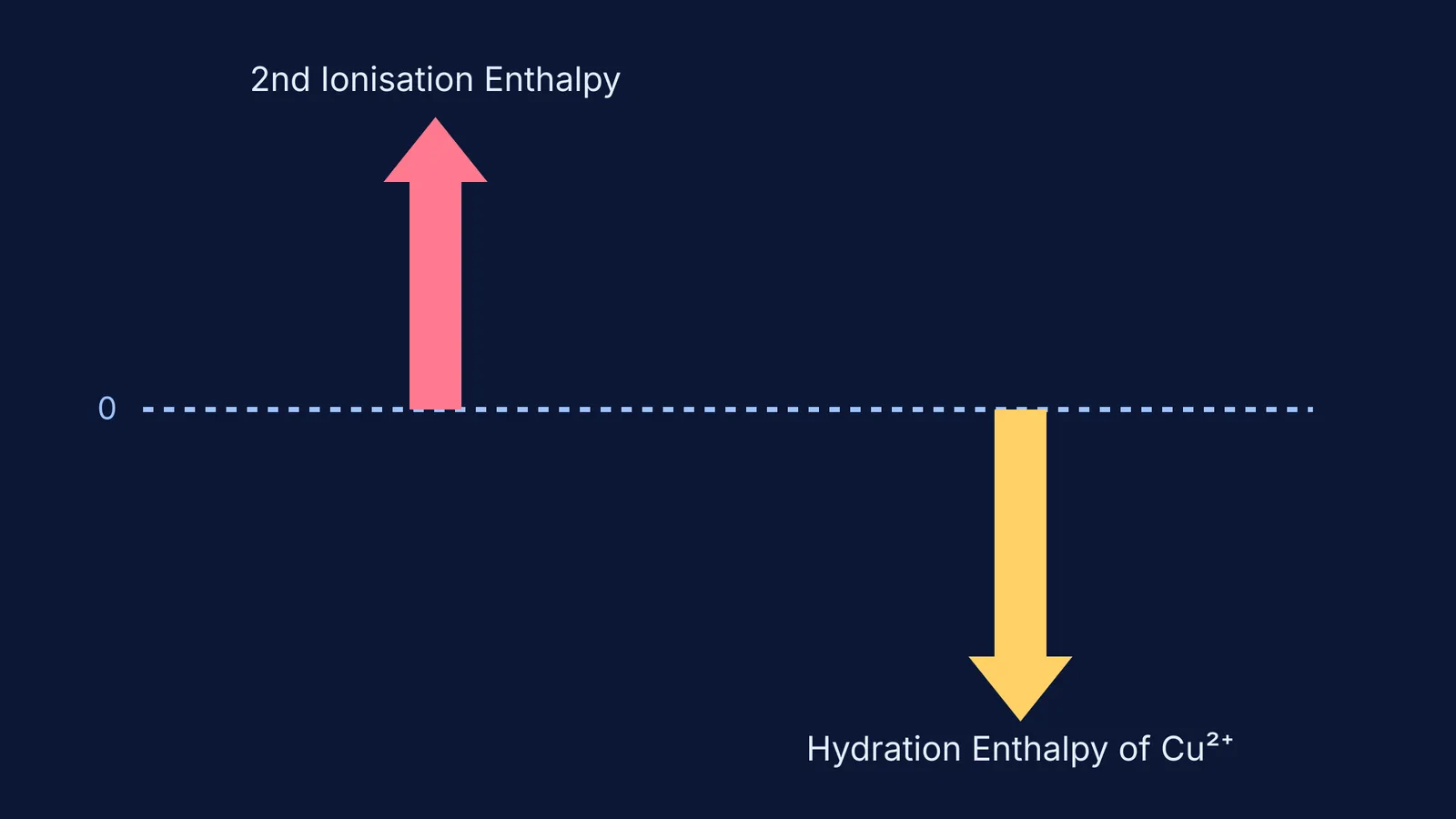
That takes a massive amount of energy. The second ionisation enthalpy of copper is 1958 kJ/mol. In the gas phase, this steep energy cost means the +1 state is strongly preferred. If you were only looking at isolated ions in a vacuum, Cu⁺ would always be the more stable form. But water changes the math entirely by introducing a new, powerful energetic factor.
Why is Cu²⁺ more stable than Cu⁺ in aqueous solution?
When an ion enters water, it does not sit there alone. Water molecules crowd around it and bind to it, pointing their negative oxygen ends toward the positive ion. This process forms a hydration shell and releases a large amount of energy, which is known as hydration enthalpy.
The amount of energy released depends heavily on the ion's charge density—the ratio of its charge to its size. Because Cu²⁺ has a higher charge and a slightly smaller ionic radius than Cu⁺, it has a much higher charge density. This allows it to pull water molecules in far more tightly, creating stronger electrostatic interactions with the water's dipole moments.
Because of this intense interaction, the hydration enthalpy for Cu²⁺ is a massive release of energy. By comparison, the hydration enthalpy for the +1 ion is much less negative, as its lower charge cannot attract water molecules nearly as strongly.
The stability of the ion depends on the net balance of these energies. You have to pay that steep energy cost to tear the second electron away, but by doing so, you release a much larger hydration energy. The massive, exothermic hydration enthalpy of Cu²⁺ more than compensates for the high second ionisation enthalpy of copper.
Because the overall energy released during the hydration of the +2 ion is so large, the Cu²⁺ state is thermodynamically favoured in water.
How do you write the perfect exam answer?
When a paper asks why Cu²⁺ is more stable than Cu⁺ in aqueous solution, examiners are looking for two specific keywords: *hydration enthalpy* and *second ionisation enthalpy*. Leaving either of these out will usually cost you marks. Use this simple checklist to build a complete and accurate answer:
Acknowledge the configuration: Briefly state that while Cu⁺ has a highly stable 3d¹⁰ configuration, its overall stability in solution depends on hydration.
State the cost: Mention that the second ionisation enthalpy of copper is very high because it requires breaking a full d-subshell.
Deliver the reason: Conclude that the much more negative hydration enthalpy of Cu²⁺ more than compensates for its high second ionisation enthalpy.
When you are piecing together these complex energy cycles, it is easy to get stuck on why one value beats another. The Fermi Concept Library has a lesson for every concept in chemistry, each with its place in the map, helping you see exactly how hydration enthalpy connects to ionisation energy and overall stability.
For more practice on transition metals and their energy trends, you can explore how we compare enthalpies of atomisation, sublimation and phase change, or review why zinc, cadmium and mercury are not called transition elements in the first place. If you are revising your basics, it is also worth reviewing the electronic configuration of ions like Fe³⁺ and Cu⁺ to see which electrons leave first and how that dictates their chemical behaviour.


