

On this page
Crossed aldol questions are counting questions. Once you know which molecule can form an enolate, the number of products falls out of a small grid, and so does the way to get just one.
What is a crossed aldol condensation?
NCERT's Class 12 chemistry textbook, in Unit 8 on aldehydes, ketones and carboxylic acids, gives the definition: "When aldol condensation is carried out between two different aldehydes and / or ketones, it is called cross aldol condensation." The same page adds that if both of them contain α-hydrogen atoms, the reaction gives a mixture of four products.
The α-hydrogen is the key. NCERT says aldehydes and ketones with at least one α-hydrogen undergo the aldol reaction in dilute alkali, because that hydrogen is acidic: a base removes it, leaving the enolate. The enolate (the donor) attacks the carbonyl carbon of another molecule (the acceptor). Any aldehyde or ketone can be an acceptor, but only one with an α-hydrogen can be a donor. As LibreTexts' crossed aldol chapter puts it, aldehydes lacking α-hydrogens can only act as acceptors, which reduces the number of possible products by half.
How many products form in a crossed aldol condensation?
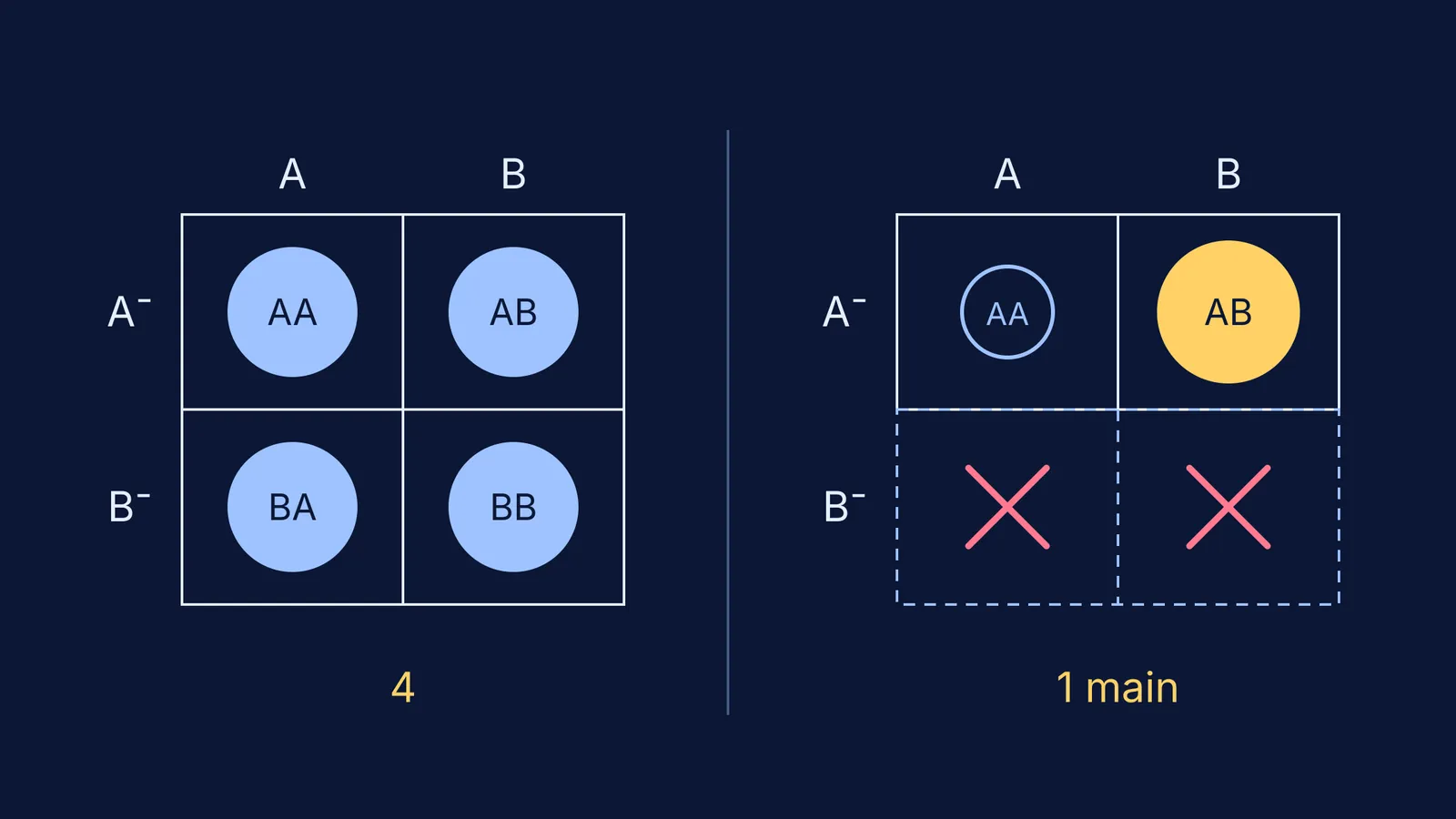
Use the grid method: products = donors × acceptors.
Find each α-carbon, the carbon right next to C=O, and check whether it carries at least one hydrogen.
Count donors: every partner with an α-hydrogen. An unsymmetrical ketone with hydrogens on both sides can form two different enolates, so it counts twice.
Count acceptors: both partners.
Multiply. Each box in the grid is one aldol, and on heating most aldols lose water to give the condensation product.
For two simple partners, that gives three cases:
Both have α-hydrogens: 2 × 2 = 4 products, two self and two crossed.
One has no α-hydrogen: 1 × 2 = 2 products, one self and one crossed.
Neither has one: no aldol at all. NCERT notes that aldehydes without an α-hydrogen undergo the Cannizzaro reaction instead when heated with concentrated alkali.
This count ignores E/Z stereoisomers.
Worked examples: ethanal, propanal and benzaldehyde
Ethanal + propanal. This is the example in the NCERT chapter. Both have α-hydrogens, so the grid has four boxes:
ethanal enolate + ethanal: but-2-enal (self)
propanal enolate + propanal: 2-methylpent-2-enal (self)
ethanal enolate + propanal: pent-2-enal (crossed)
propanal enolate + ethanal: 2-methylbut-2-enal (crossed)
Benzaldehyde + acetophenone. Benzaldehyde's CHO is joined to a ring carbon with no hydrogen, so it has no α-hydrogen. Only acetophenone forms an enolate, so the grid is 1 × 2: acetophenone's self-condensation and the crossed product. NCERT shows this pair with OH⁻ at 293 K giving 1,3-diphenylprop-2-en-1-one (benzalacetophenone) as the major product. The crossed product wins because aldehydes are more reactive acceptors than ketones, so the enolate prefers benzaldehyde to another acetophenone. An aryl aldehyde with a ketone like this is the Claisen-Schmidt reaction.
Butanone + benzaldehyde. Butanone has α-hydrogens on both the CH3 and the CH2 side, so the grid is 2 × 2 on paper. The Virtual Textbook of Organic Chemistry uses this pair to show that conditions pick the side: base gives the CH3-side product, acid gives 3-methyl-4-phenylbut-3-en-2-one from the CH2 side.
How do you get only one product from a crossed aldol?
You need one enolate and one acceptor that clearly beats the others. Check these in order:
Remove a row. Choose one partner with no α-hydrogen, such as benzaldehyde or formaldehyde.
Make the acceptor the better electrophile. Pair that aldehyde with an enolisable ketone. LibreTexts/23:_Carbonyl_Condensation_Reactions/23.05:_Mixed_Aldol_Reactions) lists this as one of two reliable routes to a single product: the ketone supplies the enolate and the more reactive aldehyde takes the attack. With an aromatic aldehyde, it is the Claisen-Schmidt condensation.
Keep the alkali dilute. NCERT's aldol uses dilute alkali; concentrated alkali and heat push a no-α-hydrogen aldehyde into the Cannizzaro reaction instead.
Beyond the Class 12 syllabus: the directed aldol. The Virtual Textbook of Organic Chemistry describes forming the lithium enolate first by adding the carbonyl compound slowly to excess LDA in THF at −78 °C, which avoids self-aldol. The preformed enolate then meets the second carbonyl compound, so only one enolate and one acceptor are in play.
How should you practise counting aldol products?
Take ten pairs from your textbook and past papers. For each, mark the α-hydrogens, draw the grid, name every product, then decide which is major and why. Include a pair with no aldol at all, such as formaldehyde with benzaldehyde.
If you got a count wrong and can't see where, the Fermi Problem Library has worked problems with a step-by-step solver that explains the reasoning rather than printing an answer. If enolates themselves still feel shaky, the Fermi Concept Library gives each chemistry concept its own lesson and its place in the map.
Read more: Alexander Borodin, the composer chemist and the aldol reaction, named reactions in organic chemistry as a map and learning organic chemistry through mechanisms instead of lists.


