

On this page
In eukaryotes, making a protein is a journey across borders. The DNA is locked securely inside the nucleus, so transcription (copying DNA into mRNA) must happen there. Unlike the three RNA polymerases in eukaryotes that divide the labour, bacteria use just one RNA polymerase to transcribe their genes. The eukaryotic mRNA must then be heavily processed—capped, tailed and spliced to remove introns—before it is exported across the nuclear envelope to the cytoplasm. Only then can a ribosome bind and start translation.
Bacteria operate without these delays. Because they lack a nuclear membrane and their genes generally have no introns to splice out, the two processes share the same space at the same time.
Why are transcription and translation coupled in bacteria?
The simplest reason is anatomical: there is no physical barrier separating the bacterial circular chromosome from the ribosomes floating in the cytoplasm.
As soon as RNA polymerase (RNAP) starts transcribing a gene, the 5′ end of the new mRNA emerges from the enzyme. Because this transcript requires no splicing or processing to become mature, a ribosome can immediately latch onto the ribosome binding site and begin translating the sequence into a protein. The ribosome effectively chases the RNAP down the mRNA strand as it is being written.
This coupling is not just a side effect of missing a nucleus. It is an active, essential partnership that protects the bacteria's genetic material. A newly synthesised mRNA strand left on its own is fragile and highly reactive. It can fold into secondary structures (like hairpins) that trigger transcription to stop prematurely. Worse, the naked mRNA can loop back and bind to the DNA template to form an R-loop. R-loops are toxic to the cell because they physically block DNA replication forks and cause breaks in the genome. By attaching to the mRNA immediately, the leading ribosome physically shields the transcript and prevents these dangerous structures from forming.
How fast do transcription and translation happen in E. coli?
For coupling to work without the molecular machines crashing into each other or drifting apart, their speeds must be closely matched.
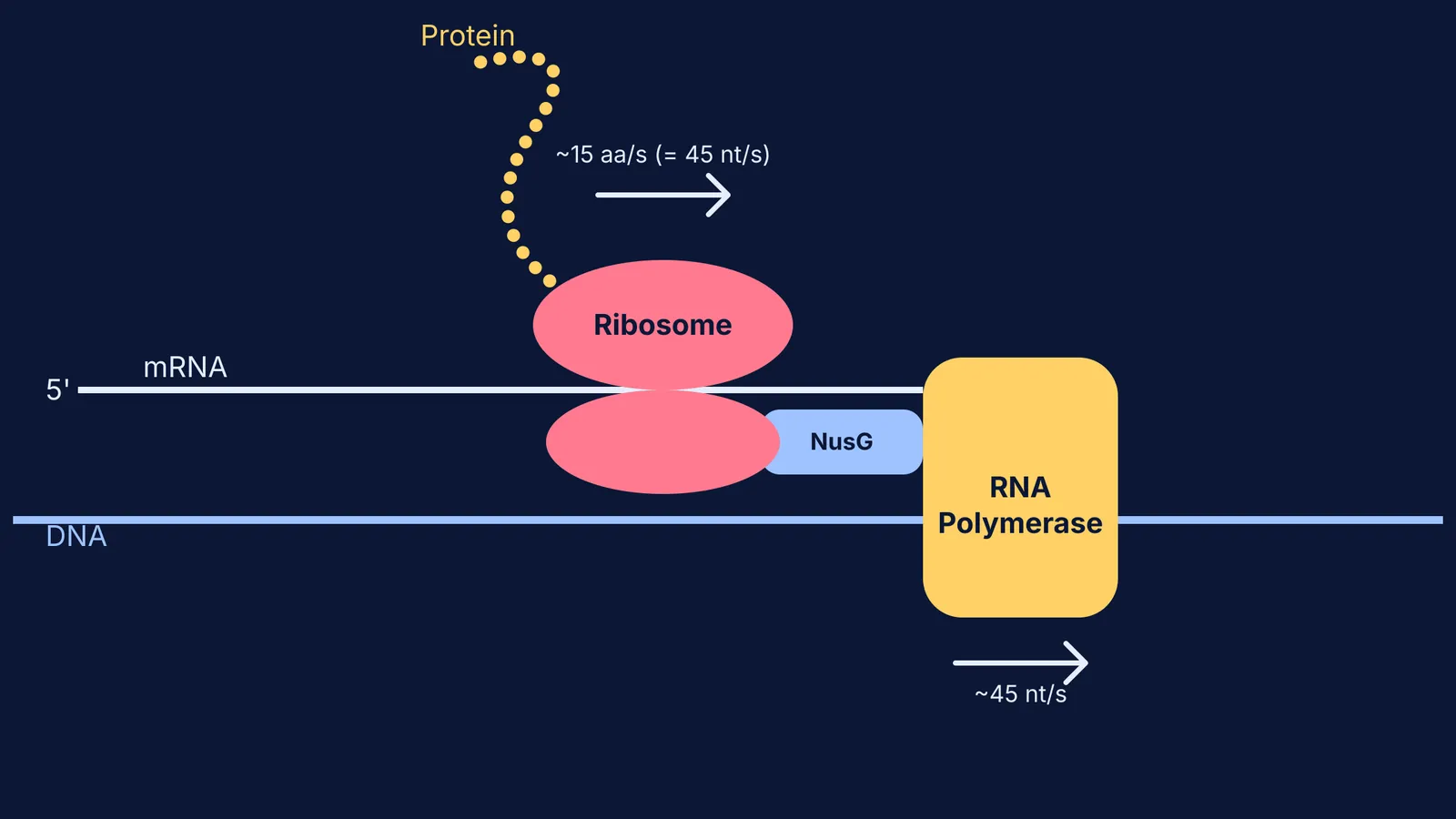
In *Escherichia coli*, RNA polymerase transcribes DNA at a rate of approximately 40 to 50 nucleotides per second (Yu et al., 2006). The bacterial ribosome synthesises proteins at a rate of about 15 amino acids per second. Because every amino acid is coded by three nucleotides (one codon), the translation speed is exactly equivalent to 45 nucleotides per second.
This synchronized speed ensures the ribosome follows closely behind the RNAP, never falling too far back. In fact, research shows that the trailing ribosome actively controls the overall rate of transcription. By staying physically close, it prevents the RNA polymerase from spontaneous backtracking—a situation where the enzyme slides backwards on the DNA and pauses its work (Proshkin et al., 2010).
If you have concept gaps in how this central dogma machinery fits together, the Fermi Concept Library holds every concept in physics, chemistry, biology, mathematics and computing, each with its own lesson and its place in the map, so you can trace exactly how these enzymes interact.
What is the expressome?
For decades, biologists knew that transcription and translation happened at the same time, but they assumed the enzymes just happened to be near each other by chance. We now know they are physically connected.
This joint macromolecular machine is called the expressome (Kohler et al., 2017). High-resolution electron microscopy reveals that the mRNA exit channel of the RNA polymerase aligns directly with the mRNA entry site of the ribosome. This precise alignment allows the fragile transcript to pass directly from one machine to the other in a protected channel.
Often, this physical link is reinforced by a bridging protein. The transcription factor NusG acts as the coupling link between the two massive complexes. Its front (N-terminal) end binds securely to the RNA polymerase, while its back (C-terminal) end binds directly to a ribosomal protein known as S10 (Burmann et al., 2010).
This bridge is also a built-in security system for the bacteria. A cellular protein called Rho normally patrols the cytoplasm for naked mRNA; if it finds an exposed stretch, it climbs the RNA and terminates transcription early. Because the ribosome and Rho compete for the exact same binding spot on the NusG protein, a coupled ribosome physically blocks Rho from attaching, guaranteeing that transcription continues until the gene is completely read.
An exam prep checklist: Prokaryotes vs Eukaryotes
If you are studying for board exams or competitive tests like NEET-UG, questions on the central dogma frequently test your understanding of these differences. Use this quick checklist to catch the typical trick questions about gene expression:
Location: In prokaryotes, both processes happen together in the cytoplasm. In eukaryotes, transcription is strictly nuclear and translation is cytoplasmic.
Coupling: Simultaneous transcription and translation is possible *only* in prokaryotes. Eukaryotic transcription and translation are always separated in space and time.
RNA Processing: Prokaryotic mRNA requires no processing because there are no introns. Eukaryotic primary transcripts (hnRNA) must undergo capping, tailing and splicing before they become mature mRNA.
Initiation: Prokaryotic ribosomes can and do attach to the mRNA while it is still being actively transcribed from the DNA template.


