

On this page
This Class 10 chemistry question rewards reasoning over memorising. The answer is no, and one line of the reactivity series explains why.
Can copper sulphate solution be stored in an iron pot?
No. The rule that settles it is printed in the NCERT Class 10 Science chapter Metals and Non-metals: reactive metals can displace less reactive metals from their compounds in solution, and if metal A displaces metal B from its solution, A is more reactive than B.
In the same chapter's activity series (Table 3.2), iron sits above copper, so iron wins. If you pour copper sulphate solution into an iron pot, the pot itself becomes a reactant. It does not just hold the solution; it slowly eats into it.
Why does the solution turn green and the pot corrode?
NCERT's Chapter 1, Chemical Reactions and Equations, shows the same reaction on a small scale in Activity 1.9: iron nails are left in copper sulphate solution for about 20 minutes. The nails turn brownish and the blue colour of the solution fades. The equation is:
Fe(s) + CuSO₄(aq) → FeSO₄(aq) + Cu(s)
Read it as a swap. Iron atoms go into the solution as iron(II) ions, and copper ions come out as copper metal. In a pot, that means three things you could see:
The inside of the pot gets a reddish-brown coating of copper, the same brownish layer the nails get in the NCERT activity.
The iron wall thins and pits where it has dissolved, which is corrosion in the plain sense of the word.
The blue colour fades. The same NCERT chapter describes ferrous sulphate (iron(II) sulphate) crystals as green, so as blue copper ions are replaced by iron(II) ions, the solution drifts from blue towards green.
Would a zinc pot work instead?
No, for the same reason. NCERT Chapter 1 gives the zinc version right after the iron one, Zn(s) + CuSO₄(aq) → ZnSO₄(aq) + Cu(s), and states that zinc and lead are more reactive than copper (NCERT Chapter 1). In the activity series zinc sits above iron, so zinc displaces copper just as surely as iron does.
The same logic answers the reverse question too. NCERT Activity 3.12 puts a copper wire in iron sulphate solution next to an iron nail in copper sulphate solution (NCERT Chapter 3). Copper is below iron, so it cannot displace iron. A copper pot can hold iron sulphate solution; an iron pot cannot hold copper sulphate solution.
How do you check whether any metal pot is safe?
Use this three-step check for any "can X solution be stored in a Y vessel?" question:
Find the metal in the salt (copper in copper sulphate, silver in silver nitrate).
Find the container metal in the activity series: K, Na, Ca, Mg, Al, Zn, Fe, Pb, [H], Cu, Hg, Ag, Au, from most to least reactive (NCERT Table 3.2).
If the container metal is higher, the answer is no: it will be displaced into solution. If it is lower, or is the same metal as in the salt, it will not displace anything.
For copper sulphate, the series rules out aluminium, zinc, iron and lead pots. A non-metal container such as glass takes no part in a displacement reaction at all.
Worked example with electrode potentials
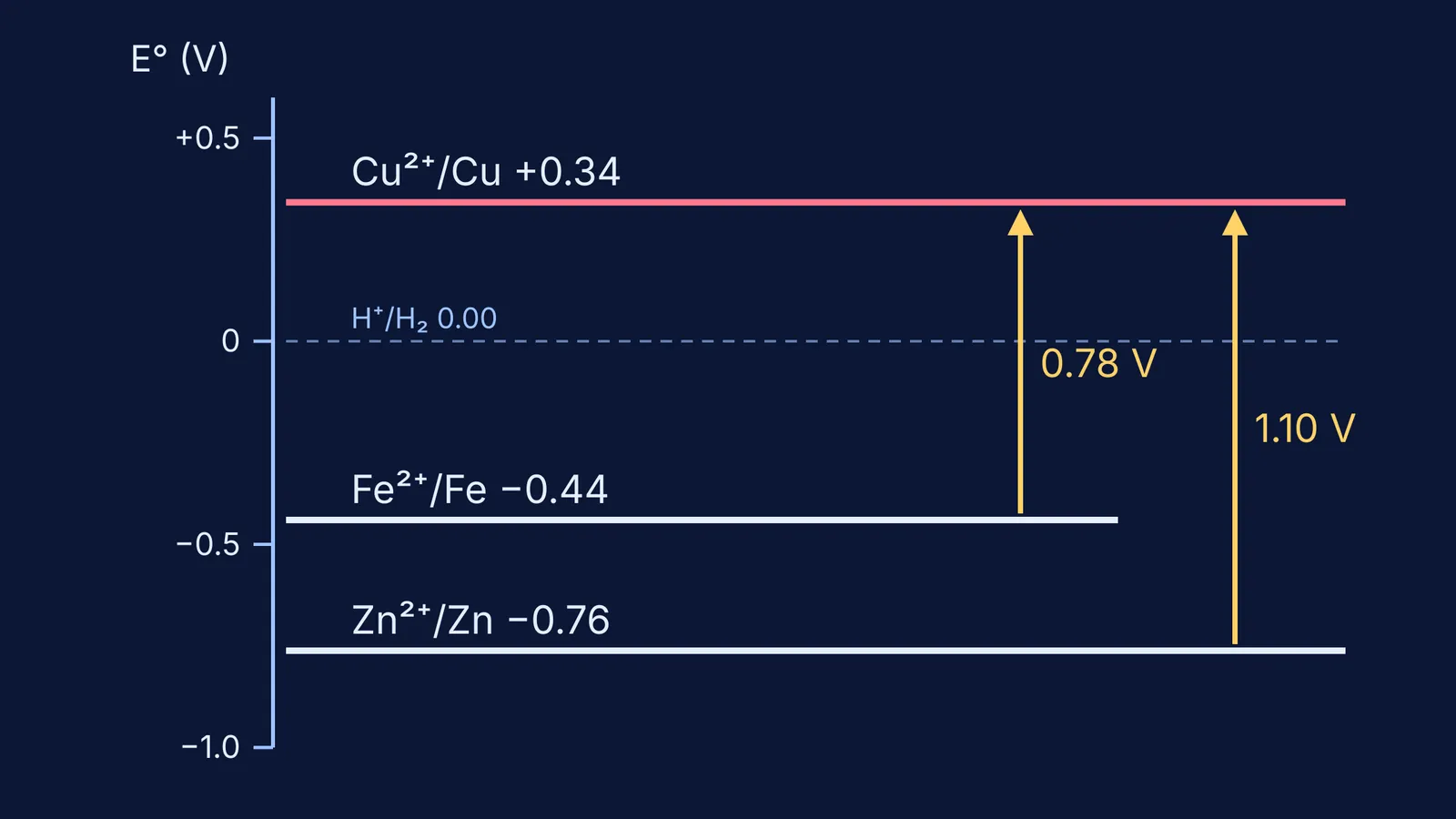
In Class 11 and 12 you meet the same idea as standard electrode potentials. A standard table of reduction potentials lists Cu²⁺/Cu at +0.3419 V, Fe²⁺/Fe at −0.44 V and Zn²⁺/Zn at −0.7618 V.
For iron in copper sulphate, the cell potential is E° = 0.34 − (−0.44) = +0.78 V. A positive value means the reaction is spontaneous under standard conditions, so the pot corrodes. For zinc, E° = 0.34 − (−0.76) = +1.10 V, an even larger driving force. That is the same 1.10 V you may recognise from the Daniell cell, which runs on exactly this zinc and copper sulphate reaction.
What should you write in a board exam answer?
A complete answer covers four parts: the verdict, the reason, the equation and the observation. For example:
"No, copper sulphate solution cannot be stored in an iron pot. Iron is more reactive than copper, so it displaces copper from copper sulphate solution: Fe + CuSO₄ → FeSO₄ + Cu. The iron pot corrodes, a reddish-brown layer of copper forms on it, and the blue solution turns greenish as iron(II) sulphate forms."
If the question names zinc, swap in Zn + CuSO₄ → ZnSO₄ + Cu and say zinc is more reactive than copper.
If you keep losing marks on questions like this because you mix up which metal displaces which, the Fermi Problem Library has worked problems with a step-by-step solver that explains the reasoning rather than printing an answer. If the gap is the idea of reactivity itself, the Fermi Concept Library gives each chemistry concept its own lesson and shows where it sits in the map.
Next time, find the two metals in the series first; the answer follows.


