

On this page
In Class 10 chemistry, heating copper powder in a china dish is the standard way to show how oxidation and reduction work. It is a simple experiment with a clear visual change: reddish-brown copper turns black as it reacts with the air, and can be turned back to brown just as easily.
Understanding this reaction is a key part of mastering chemical equations, as it illustrates how elements gain and lose oxygen. Here is what is happening chemically when the colour changes in the dish.
Why does copper powder turn black when heated?
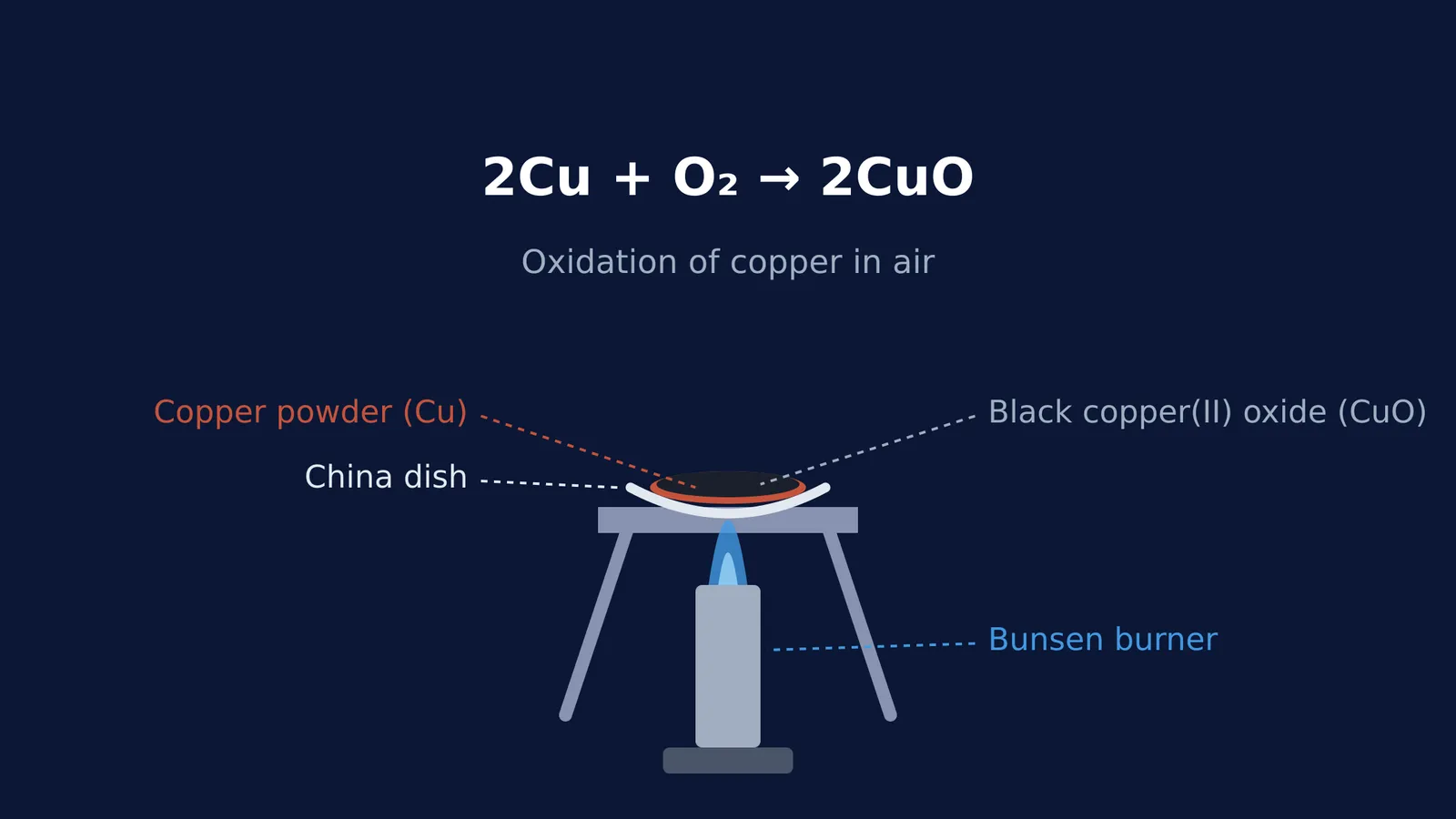
The standard laboratory setup involves placing a small amount of copper powder into a china dish. The dish is placed on a wire gauze over a tripod stand and heated with a Bunsen burner. The open dish ensures that there is a continuous supply of oxygen from the surrounding air.
Copper reacts with oxygen when heated in air at temperatures between 300–800 °C_oxide). This reaction produces copper(II) oxide (CuO), which is a black solid_oxide).
The chemical equation for this reaction is: 2Cu + O₂ → 2CuO
This is an oxidation reaction. Oxidation is defined as the gain of oxygen. Because oxygen is added to the copper atoms, the copper is oxidised to copper(II) oxide. The black coating you see in the china dish is this new oxide layer.
Because oxygen must physically touch the metal to react, only the exposed surface of the powder turns black at first. If you were to stir the powder while heating it, more of the unreacted reddish-brown copper underneath would be exposed to the oxygen, and that too would turn black.
If you need to review the definitions before moving on, the Concept Library contains every concept in physics, chemistry, biology, mathematics and computing, each with its own lesson and its place in the map.
How does hydrogen reduce copper oxide back to copper?
You can reverse the reaction and strip the oxygen away from the black powder. If you pass hydrogen gas (H₂) over the heated black copper(II) oxide, the black coating turns reddish-brown again.
The chemical equation for the reverse reaction is: CuO + H₂ → Cu + H₂O
Here, the copper(II) oxide is losing its oxygen to become pure copper metal_oxide) again, while water vapour is released as a byproduct. This loss of oxygen is called reduction.
What happens when oxidation and reduction occur in one step?
This second reaction is a complete oxidation-reduction, or redox, process. Both things happen at the same time:
The copper(II) oxide loses oxygen to become pure copper (it is reduced).
The hydrogen gas gains oxygen to become water vapour (it is oxidised).
Because one reactant gets oxidised while the other gets reduced, the overall reaction is classified as a redox reaction.
How do you track oxidising and reducing agents?
When looking at a chemical equation in an exam, use this checklist to work out what has happened and identify the chemical agents:
Oxidation: Look for the substance that has gained oxygen on the right side of the arrow.
Reduction: Look for the substance that has lost oxygen on the right side of the arrow.
Oxidising agent: This is the substance that gives away oxygen. In our example, CuO is the oxidising agent.
Reducing agent: This is the substance that takes the oxygen away. In our example, H₂ is the reducing agent.
A common mistake students make is naming the products on the right side of the equation (like Cu or H₂O) as the oxidising or reducing agents. You must always pick the agents from the reactants on the left side of the equation.
If you find it hard to keep track of electron transfers, oxygen shifts, and chemical agents across different reactions, the Fermi Problem Library has worked problems with a step-by-step solver that explains the reasoning rather than printing an answer.
Related reading:


