

On this page
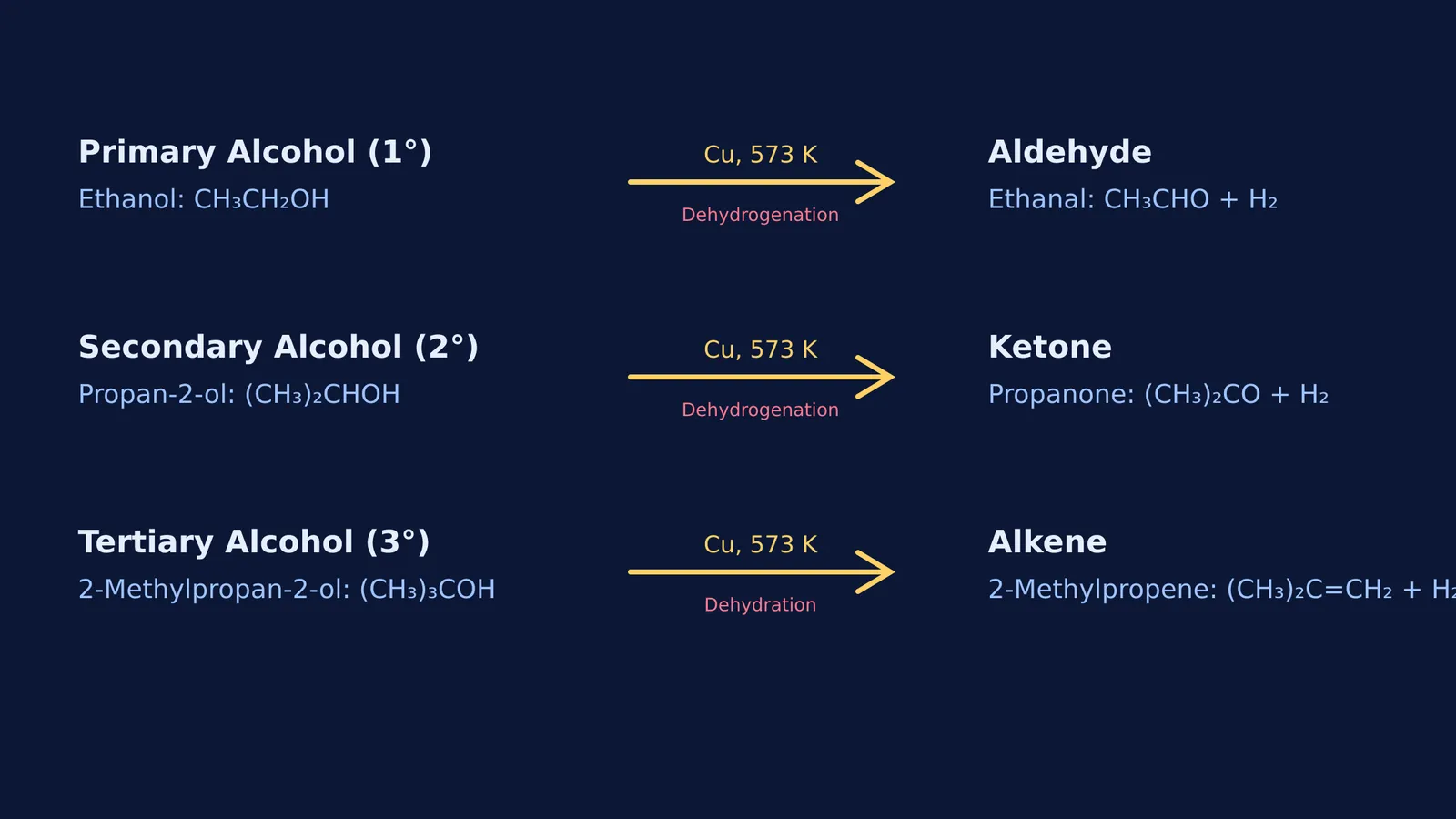
Passing the vapours of an alcohol over heated copper at 573 K (300 °C) is a classic chemical test used to distinguish between primary, secondary and tertiary alcohols in the NCERT Class 12 Chemistry curriculum. Because copper acts as a mild dehydrogenating catalyst at this temperature, the reaction that takes place depends entirely on the structure of the alcohol's carbon skeleton.
If you are preparing for exams like JEE Main or NEET-UG, this is a standard reaction you must know. The products differ because of the presence or absence of an alpha-hydrogen (the hydrogen atom attached to the carbon bearing the –OH group).
What are the primary, secondary and tertiary alcohol products?
When an alcohol meets copper at 573 K, it either loses hydrogen (dehydrogenation) or loses water (dehydration).
Primary alcohols (1°) undergo dehydrogenation to form aldehydes. For example, ethanol (CH₃CH₂OH) loses a molecule of H₂ to become ethanal (acetaldehyde).
Secondary alcohols (2°) undergo dehydrogenation to form ketones. Passing propan-2-ol (isopropyl alcohol) over the heated copper produces propanone (acetone) and H₂.
Tertiary alcohols (3°) undergo dehydration to form alkenes. Because the alpha-carbon in a tertiary alcohol like 2-methylpropan-2-ol (tert-butyl alcohol) has no hydrogen atoms to lose, it cannot undergo dehydrogenation. Instead, the heat forces it to lose a water molecule, forming 2-methylpropene (isobutylene).
Why do tertiary alcohols form alkenes?
Catalytic dehydrogenation over copper requires an alpha-hydrogen to form the H₂ molecule (removing one hydrogen from the oxygen and one from the adjacent carbon, as outlined in Wikipedia's dehydrogenation overview). A tertiary alcohol has three alkyl groups attached to the alpha-carbon, leaving no room for a hydrogen atom.
Unable to shed hydrogen, the tertiary alcohol undergoes a different high-temperature pathway: it loses the –OH group along with a hydrogen from a neighbouring beta-carbon. This elimination reaction releases a molecule of water and leaves behind a double bond, yielding an alkene.
How do you find the product in exam questions?
When you see "Cu, 573 K" in a reaction sequence problem, use this decision rule:
Locate the –OH group on the reactant.
Count the alkyl groups attached to that carbon.
If the count is 1 (primary), write an aldehyde.
If the count is 2 (secondary), write a ketone.
If the count is 3 (tertiary), draw a double bond to the most substituted adjacent carbon to form an alkene.
Seeing the mechanism with Fermi
If you find it hard to memorise organic chemistry reactions by rote, you are not alone. When you learn the underlying mechanisms—like why an alpha-hydrogen is strictly required for dehydrogenation—the reactions make sense without memorisation.
If you bring a reaction like this to Fermi's AI tutor, it will not just print the chemical equation. It will draw the molecular structure, show you where the bonds break, and ask you to predict the product. If you get stuck, it steps back and explains the mechanism on the board. You can also explore the Concept Library to see how this reaction fits into the wider map of alcohol chemistry, from hydroboration-oxidation to the dehydration of alcohols.
Understanding the "why" behind the products is the key to mastering organic chemistry.


