

On this page
Coordinate bonds turn up in Class 11 chemical bonding, in JEE Main questions on Lewis structures and again in Class 12 coordination compounds. Three slips come up again and again: picking the wrong donor, pointing the arrow the wrong way, and thinking the dative bond stays special after it forms. The four standard examples below cover all three.
What is a coordinate bond?
A coordinate bond (also called a dative covalent bond) is a covalent bond in which both shared electrons come from the same atom, as defined in Chemistry LibreTexts/Chemical_Bonding/Fundamentals_of_Chemical_Bonding/Coordinate_(Dative_Covalent)_Bonding).
In an ordinary covalent bond, each atom puts in one electron. In a coordinate bond, the donor puts in a whole lone pair and the acceptor puts in an empty orbital.
How do you find the donor and acceptor?
Ask three questions, in this order:
Which atom has a lone pair it can spare? That is your donor candidate (N in NH₃, O in H₂O).
Which atom or ion has no electrons, or fewer than an octet, to offer? That is your acceptor (H⁺ has no electrons at all; B in BF₃ has only six around it).
Does sharing the lone pair give the acceptor a stable arrangement? If yes, you have a coordinate bond.
Four worked examples
All four below are described in Chemguide's page on dative covalent bonding and the LibreTexts module linked above.
NH₄⁺ (ammonium ion)
Donor: N in NH₃, which has one lone pair.
Acceptor: H⁺, a bare proton with an empty 1s orbital.
How it forms: NH₃ + HCl → NH₄⁺ + Cl⁻. Only the hydrogen nucleus moves from chlorine to nitrogen, so nitrogen supplies both electrons of the new bond.
H₃O⁺ (hydronium ion)
Donor: O in H₂O, which has two lone pairs and uses one.
Acceptor: H⁺.
How it forms: H₂O + HCl → H₃O⁺ + Cl⁻. Chemguide points out that the "hydrogen ions" of acids in introductory chemistry are really hydroxonium (hydronium) ions.
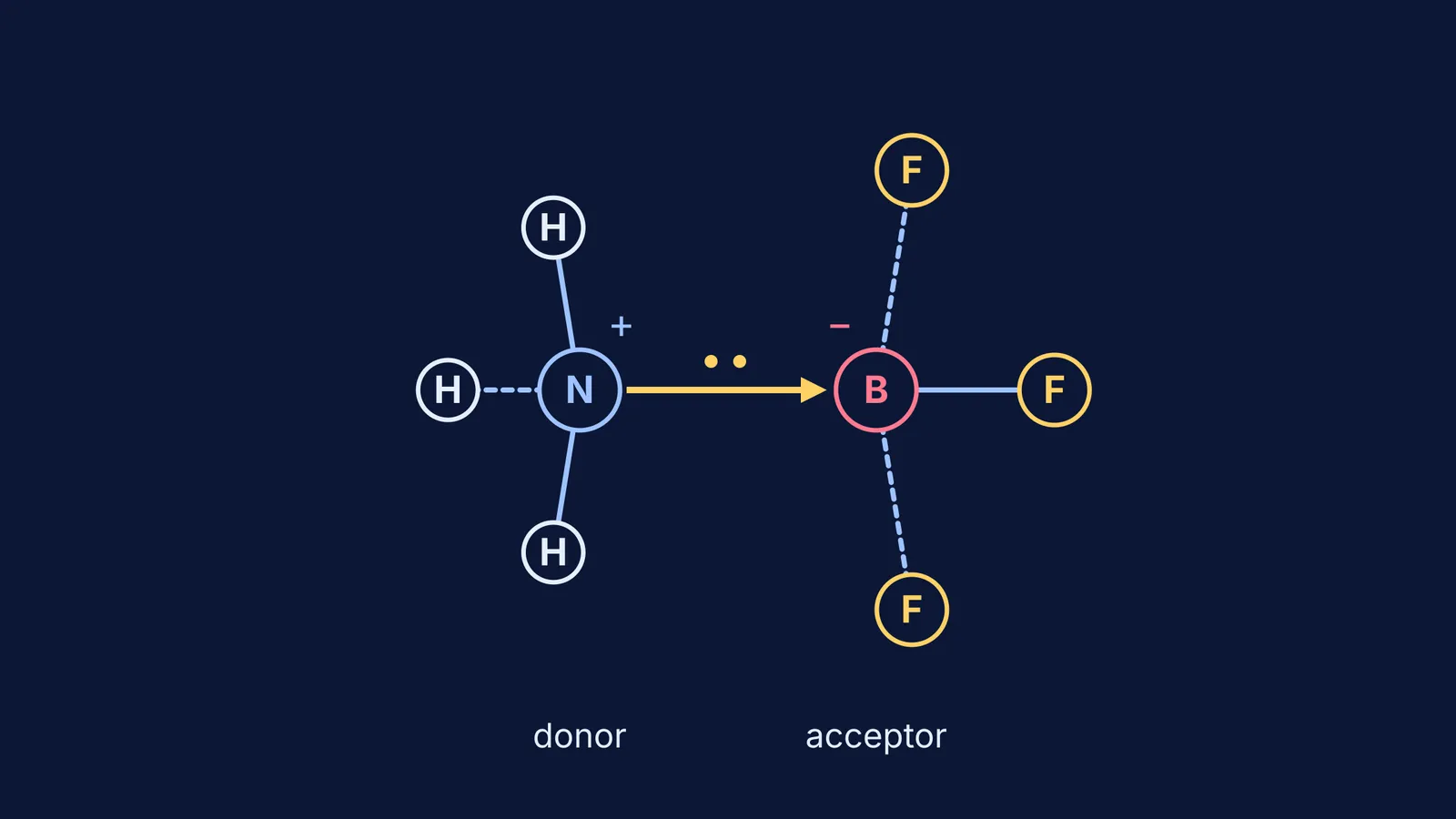
BF₃·NH₃ (ammonia–boron trifluoride adduct)
Donor: N in NH₃.
Acceptor: B in BF₃, which has only six electrons around it, two short of an octet.
Result: an N→B bond. The LibreTexts module notes that the nitrogen end of the bond becomes positive and boron becomes negative, because the electron pair has moved towards boron. Why boron accepts lone pairs at all is covered in our post on Lewis acidity of boron trihalides and back bonding.
CO (carbon monoxide)
Donor: O, which is the surprise.
Acceptor: C.
Result: Chemguide describes CO as two ordinary covalent bonds plus one coordinate bond that uses a lone pair on oxygen. This is the one that catches people out, because the more electronegative atom is the donor. To see where the charges land, work through formal charge and Lewis structures.
That second role is the start of the synergic bonding in metal carbonyls you meet in Class 12.
How do you draw the arrow in a coordinate bond?
In simple diagrams, a coordinate bond is shown as an arrow that points from the atom donating the lone pair to the atom accepting it (Chemguide).
NH₄⁺: H₃N→H⁺, then put square brackets round the whole ion with a + outside.
H₃O⁺: H₂O→H⁺, with the same brackets and charge.
BF₃·NH₃: H₃N→BF₃.
CO: draw C≡O with one of the three lines as an arrow pointing from O to C.
Quick check: the arrow's tail sits on the atom that had the lone pair. A tail on boron or H⁺ means it is backwards.
Why do the bonds look identical once formed?
Once the ammonium ion has formed, it is impossible to tell any difference between the dative covalent and the ordinary covalent bonds (Chemguide). Coordinate covalent bonds are as strong as other covalent bonds (Chemistry LibreTexts).
Electrons carry no label saying where they came from, so all four N–H bonds in NH₄⁺ are the same kind of shared pair. The positive charge does not sit on the "new" hydrogen either; it belongs to the whole ion, which is why you put it outside the brackets.
So the arrow records how the bond was made, not a different kind of bond. When a question asks how many coordinate bonds NH₄⁺ has, the answer is one: you are counting how the ion formed, not a bond that looks different.
A two-minute self-test
Cover the answers and name the donor, the acceptor and the arrow direction for each:
NH₄⁺ (N gives to H⁺; arrow N→H)
H₃O⁺ (O gives to H⁺; arrow O→H)
BF₃·NH₃ (N gives to B; arrow N→B)
CO (O gives to C; arrow O→C)
If any of these still feels shaky, the Fermi Concept Library gives each concept its own lesson and its place in the map. For practice, the Fermi Problem Library has worked problems with a step-by-step solver that explains the reasoning rather than printing an answer.


