

On this page
When students first learn continuity, the definition looks simple: a function f(x) is continuous at a point c if the limit as x approaches c equals f(c). But that standard formula assumes x can approach c from both sides. When a function is restricted to a closed interval [a, b], approaching the left endpoint a from the left requires testing numbers strictly less than a—numbers outside the function's domain. Demanding a two-sided limit at the boundaries would mean no function defined on a closed interval could ever be continuous.
What is continuity on a closed interval?
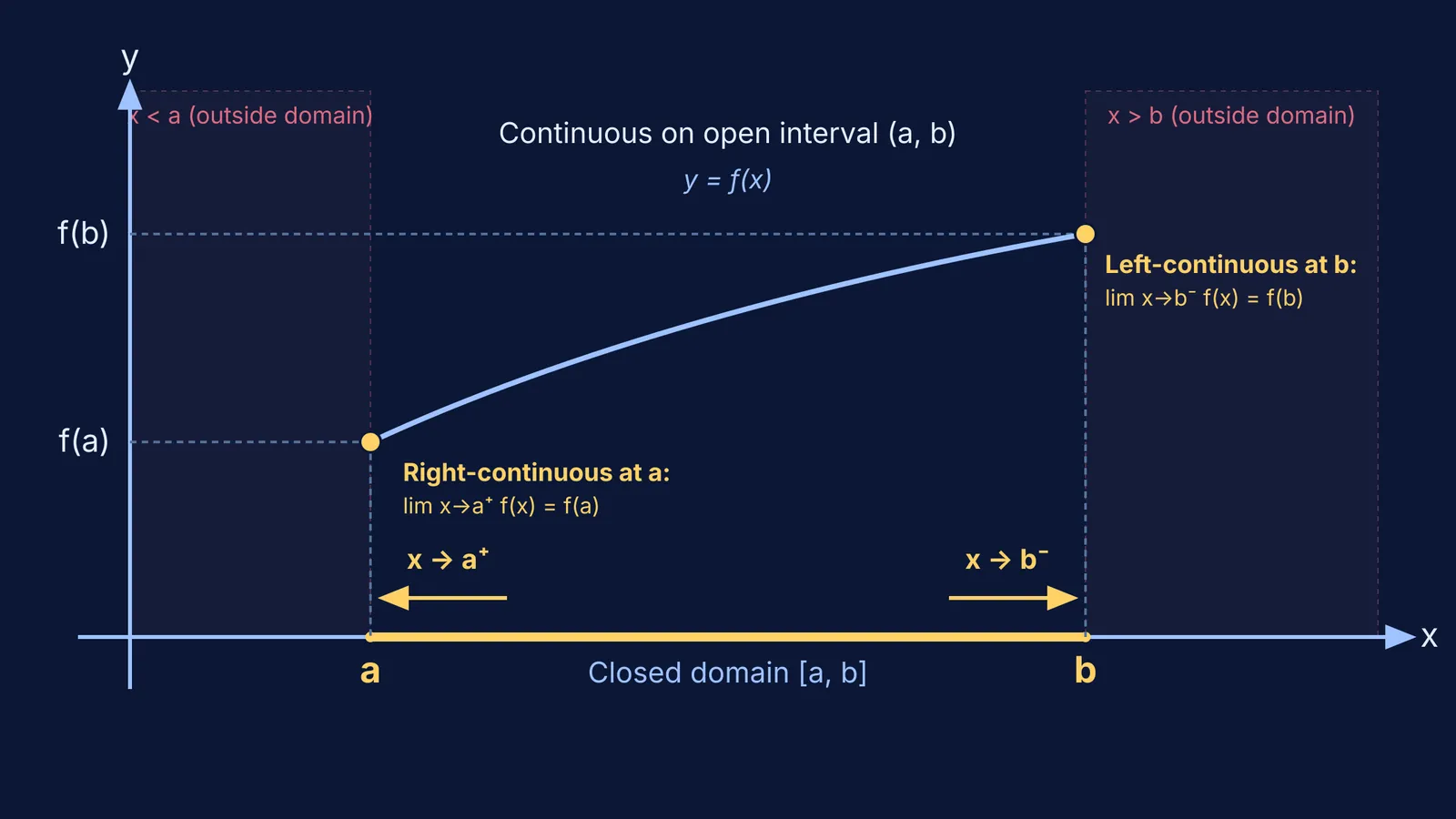
According to OpenStax Calculus Volume 1, extending continuity to a closed interval [a, b] requires three conditions:
The function f is continuous at every interior point in the open interval (a, b).
The function is continuous from the right at the left endpoint a: lim x→a⁺ f(x) = f(a).
The function is continuous from the left at the right endpoint b: lim x→b⁻ f(x) = f(b).
The NCERT Class 12 Mathematics curriculum presents this exact definition in Chapter 5. In real analysis, limits are evaluated strictly relative to the domain. Because [a, b] contains no points to the left of a or to the right of b, the only valid paths of approach are from within the interval: rightward from a and leftward from b.
Why do calculus students stumble at endpoints?
Informal mental models often clash with formal definitions. In an investigation in Educational Studies in Mathematics (DOI: 10.1007/BF00305619), researchers David Tall and Shlomo Vinner showed that students frequently rely on a "concept image"—such as drawing a curve without lifting the pencil—that conflicts with the formal "concept definition."
When students learn that continuity requires matching left and right limits, they often treat two-sided limits as mandatory everywhere. At an endpoint, they may search for values outside the domain and conclude that a function like f(x) = √(4 - x²) on [-2, 2] is discontinuous at x = -2 simply because √(4 - x²) is undefined for x < -2. Others confuse continuity with differentiability, assuming that an undefined boundary slope rules out continuity.
To help students untangle these distinctions, the Fermi Concept Library covers every concept in mathematics, each with its own lesson and its place in the map. For targeted practice, the Fermi Problem Library provides worked problems with a step-by-step solver that explains the reasoning rather than printing an answer.
Why does the endpoint rule matter for core theorems?
One-sided endpoint continuity is the essential condition behind the main existence theorems in calculus:
The Intermediate Value Theorem: As discussed in our article on Bernard Bolzano's 1817 intermediate value theorem, if f is continuous on [a, b], it attains every value between f(a) and f(b). If right-continuity failed at a—for instance, if f(a) = 0 but values jumped to 3 immediately to the right—the curve would skip every value between 0 and 3.
The Extreme Value Theorem: Proven by Karl Weierstrass, this theorem guarantees that a continuous function on [a, b] attains an absolute maximum and minimum. As shown in our guide on finding absolute extrema on a closed interval, without endpoint continuity, an infimum or supremum at the boundary might never be achieved.
Rolle's and the Mean Value Theorem: As formulated in OpenStax Calculus Volume 1, these theorems require continuity on [a, b], but differentiability only on (a, b). Boundary derivatives are unnecessary because the guaranteed tangent lies at an interior point c. Yet if endpoint continuity fails, the Extreme Value Theorem collapses, leaving Rolle's conclusion without proof.
How do you verify continuity on [a, b] in practice?
To verify continuity on a closed interval in board exams or JEE Main, use a three-step checklist:
Check the interior: Confirm f is continuous on (a, b) by verifying there are no undefined points or zero denominators.
Check the left endpoint: Evaluate lim x→a⁺ f(x) and verify it equals f(a).
Check the right endpoint: Evaluate lim x→b⁻ f(x) and verify it equals f(b).
Take f(x) = √(9 - x²) on [-3, 3]. Across (-3, 3), 9 - x² > 0, so f is continuous. At the left boundary, f(-3) = 0 and lim x→(-3)⁺ √(9 - x²) = 0. At the right boundary, f(3) = 0 and lim x→3⁻ √(9 - x²) = 0. The function is continuous on [-3, 3]. Even though its derivative f'(x) = -x/√(9 - x²) blows up at ±3, Rolle's theorem still applies and yields f'(0) = 0.
By contrast, if a piecewise function sets f(x) = x + 1 on (0, 2] with f(0) = 0, the right-hand limit as x approaches 0 from the right is 1, which does not equal f(0). That endpoint jump, explained in our guide on spotting removable and jump discontinuities, immediately breaks continuity on [0, 2].


