

On this page
In calculus, a function is continuous if you can draw its graph in one continuous sweep without lifting your pen. But many common functions, especially those written as fractions, have natural gaps or breaks in their domain.
Finding where a function fails to be continuous is a key part of sketching its graph and evaluating its limits.
What is a continuous function?
In mathematics, a continuous function is a function where a small variation in the input causes at most a small variation in the output, meaning there are no abrupt jumps in value 1. If a function is not continuous at a specific point in its domain, it has a discontinuity there 2.
For functions defined by fractions, these discontinuities typically occur when the denominator is equal to zero. Division by zero is undefined, so the function simply cannot exist at that point. To learn more about identifying these gaps, see our guide on removable and jump discontinuities.
Where is tan x continuous?
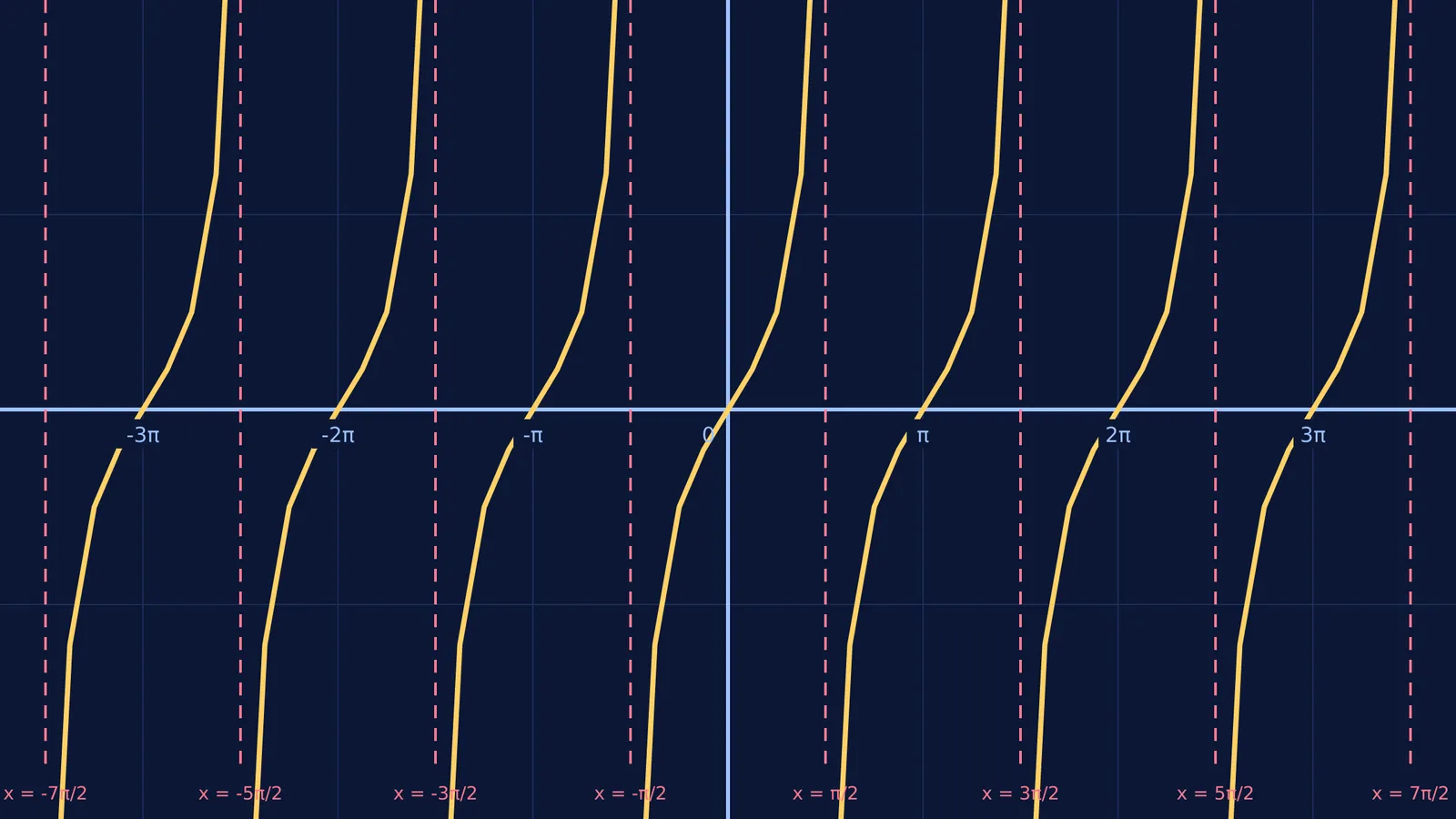
The tangent function is a classic example of a function with periodic discontinuities. Because the tangent of an angle is defined as the sine divided by the cosine, we write it as a fraction: tan x = sin x / cos x.
The function tan x is continuous everywhere except where its denominator, cos x, is zero. The cosine function equals zero at odd multiples of π/2, such as π/2, 3π/2, 5π/2, and their negative counterparts. Therefore, tan x fails to be continuous at x = (2n + 1)π/2 for any integer n.
At these exact points, the tangent function grows infinitely large in either the positive or negative direction. A vertical asymptote is a vertical line near which a function grows without bound 3. The graph of tan x is separated into infinitely many smooth branches, divided by vertical asymptotes at every odd multiple of π/2.
What about sec x, cot x and csc x?
The other trigonometric reciprocal functions follow the same rules based on their denominators.
Secant (sec x): Since sec x = 1 / cos x, it is also discontinuous wherever cos x = 0. Its discontinuities and vertical asymptotes occur at x = (2n + 1)π/2.
Cotangent (cot x): Defined as cos x / sin x, cotangent fails to be continuous where sin x = 0. The sine function is zero at integer multiples of π (0, π, 2π, etc.). So, cot x is discontinuous at x = nπ.
Cosecant (csc x): Since csc x = 1 / sin x, it shares its denominator with cotangent and is also discontinuous at x = nπ.
If you are trying to piece together how these trigonometric properties connect to the wider world of functions, the Fermi Concept Library contains every concept in physics, chemistry, biology, mathematics and computing, each with its own lesson and its place in the map.
How to find points of discontinuity in rational functions?
A rational function is any function that can be defined by a fraction where both the numerator and the denominator are polynomials 4.
Just like trigonometric functions, a rational function is discontinuous anywhere its denominator evaluates to zero. For example, the function f(x) = 1 / (x - 3) has a discontinuity at x = 3. Finding these points is often the first step when evaluating limits at infinity of rational functions.
However, not all zero denominators look the same on a graph. If the denominator is zero but the numerator is non-zero, the graph will have a vertical asymptote. If both the numerator and the denominator are zero at the same point (meaning they share a common factor), the function might have a "hole" instead of an asymptote. This is called a removable discontinuity. You can review how to handle these zero-over-zero cases in our overview of limits and continuity for JEE.
How do you find points of discontinuity?
When you are asked to find the points where a function fails to be continuous, follow this practical checklist:
Write the function as a fraction: If it is a trigonometric function like tangent or secant, rewrite it in terms of sine and cosine.
Set the denominator to zero: Create a new equation by taking only the denominator and setting it equal to zero.
Solve for x: The solutions to this equation are your points of discontinuity.
Check the numerator: Substitute your x-values back into the numerator. If the numerator is not zero, you have found a vertical asymptote. If it is zero, you likely have a removable discontinuity.
When you are practicing these steps, the Fermi Problem Library has worked problems with a step-by-step solver that explains the reasoning rather than printing an answer.


