

On this page
Matrices are a core part of the Class 12 mathematics syllabus, an exam for which 1,633,730 students registered in 2024 (CBSE). The first step to solving any matrix problem is understanding its notation and how to build one from a given algebraic rule.
What does aij mean in a matrix?
A matrix is an ordered rectangular array of numbers or functions. Each position in that grid needs an address, which we write as a subscript: a_ij.
In this notation:
i stands for the row number, counting from the top down.
j stands for the column number, counting from left to right.
So, a_12 is the element in the first row and second column, while a_21 is the element in the second row and first column.
When dealing with a square matrix, the number of rows equals the number of columns. For rectangular matrices, like a 2 × 3 matrix, the row and column counts differ, making it even more important to track your position carefully.
Why do students swap i and j?
When you are under pressure in an exam, it is easy to swap the row and column indices. Students often read a_12 and look at the second row, first column instead. This mistake immediately derails the rest of the calculation.
If a question asks you to construct a matrix of order 2 × 3, that means the matrix has 2 rows and 3 columns. The row index i will go up to 2, and the column index j will go up to 3.
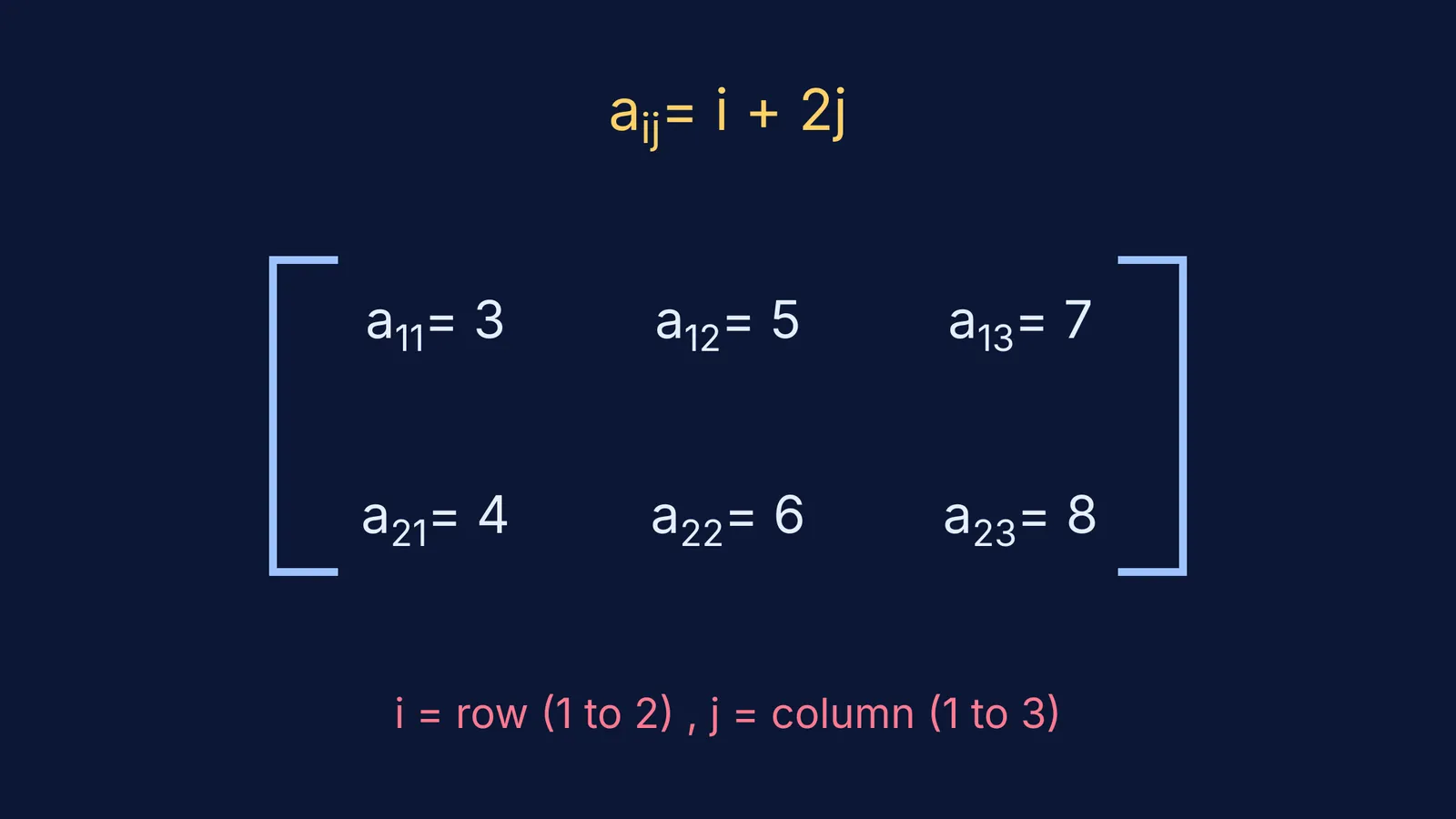
How do you construct a matrix where aij = i + 2j?
Let us build a 2 × 3 matrix step by step using the rule a_ij = i + 2j.
Since it is a 2 × 3 matrix, we need to find six elements: a_11, a_12, a_13 a_21, a_22, a_23
Row 1 (where i = 1):
First column (j = 1): a_11 = 1 + 2(1) = 1 + 2 = 3
Second column (j = 2): a_12 = 1 + 2(2) = 1 + 4 = 5
Third column (j = 3): a_13 = 1 + 2(3) = 1 + 6 = 7
Row 2 (where i = 2):
First column (j = 1): a_21 = 2 + 2(1) = 2 + 2 = 4
Second column (j = 2): a_22 = 2 + 2(2) = 2 + 4 = 6
Third column (j = 3): a_23 = 2 + 2(3) = 2 + 6 = 8
Now, place these numbers back into the grid format: Row 1: 3, 5, 7 Row 2: 4, 6, 8
You have successfully constructed the matrix.
What if the rule has a modulus or square?
Exam setters often test your attention to detail by using absolute values or squares in the rule. Let us look at a common variation: a_ij = |i - 2j|.
The straight vertical lines mean you take the absolute value, turning any negative result into a positive one. If we use this rule for the same 2 × 3 matrix, the calculation changes:
Row 1 (where i = 1):
a_11 = |1 - 2(1)| = |-1| = 1
a_12 = |1 - 2(2)| = |-3| = 3
a_13 = |1 - 2(3)| = |-5| = 5
Row 2 (where i = 2):
a_21 = |2 - 2(1)| = |0| = 0
a_22 = |2 - 2(2)| = |-2| = 2
a_23 = |2 - 2(3)| = |-4| = 4
The resulting matrix would have rows of (1, 3, 5) and (0, 2, 4). The absolute value ensures that distance-based rules never produce negative matrix elements.
How to check your matrix in an exam?
When you fill out a grid of numbers manually, a single arithmetic slip can cost you marks. Here is a quick way to verify your matrix before moving on to the next question.
Pick one element at random from your final grid, such as the number in the second row, third column (a_23).
Look back at the original rule given in the question: a_ij = i + 2j.
Plug in i = 2 and j = 3.
Calculate 2 + 2(3) = 8.
If the number 8 matches your grid, you are likely on the right track.
Testing the first and last elements is also a good habit. Since a_11 is usually the simplest calculation, checking the bottom-right corner (a_23 for a 2 × 3 matrix) tests the largest numbers in your grid and catches scaling errors.
How an AI tutor can help with matrix rules
Once you know how to build a matrix, you can move on to finding Aⁿ for a matrix by spotting the pattern or finding the area of a triangle using determinants.
If you are stuck on a more complicated rule, the Fermi Problem Library has worked problems with a step-by-step solver that explains the reasoning rather than printing an answer. For a refresher on what any mathematical symbol means, the Fermi Concept Library contains a lesson for every concept in mathematics and its place in the map.


