

On this page
The word conservative turns up in the Class 11 chapter on work, energy and power, then again in gravitation and electrostatics. Exam questions usually ask two things: is this force conservative, and if so, what is its potential energy? Here are the tests, why friction fails them, and worked examples.
What makes a force conservative?
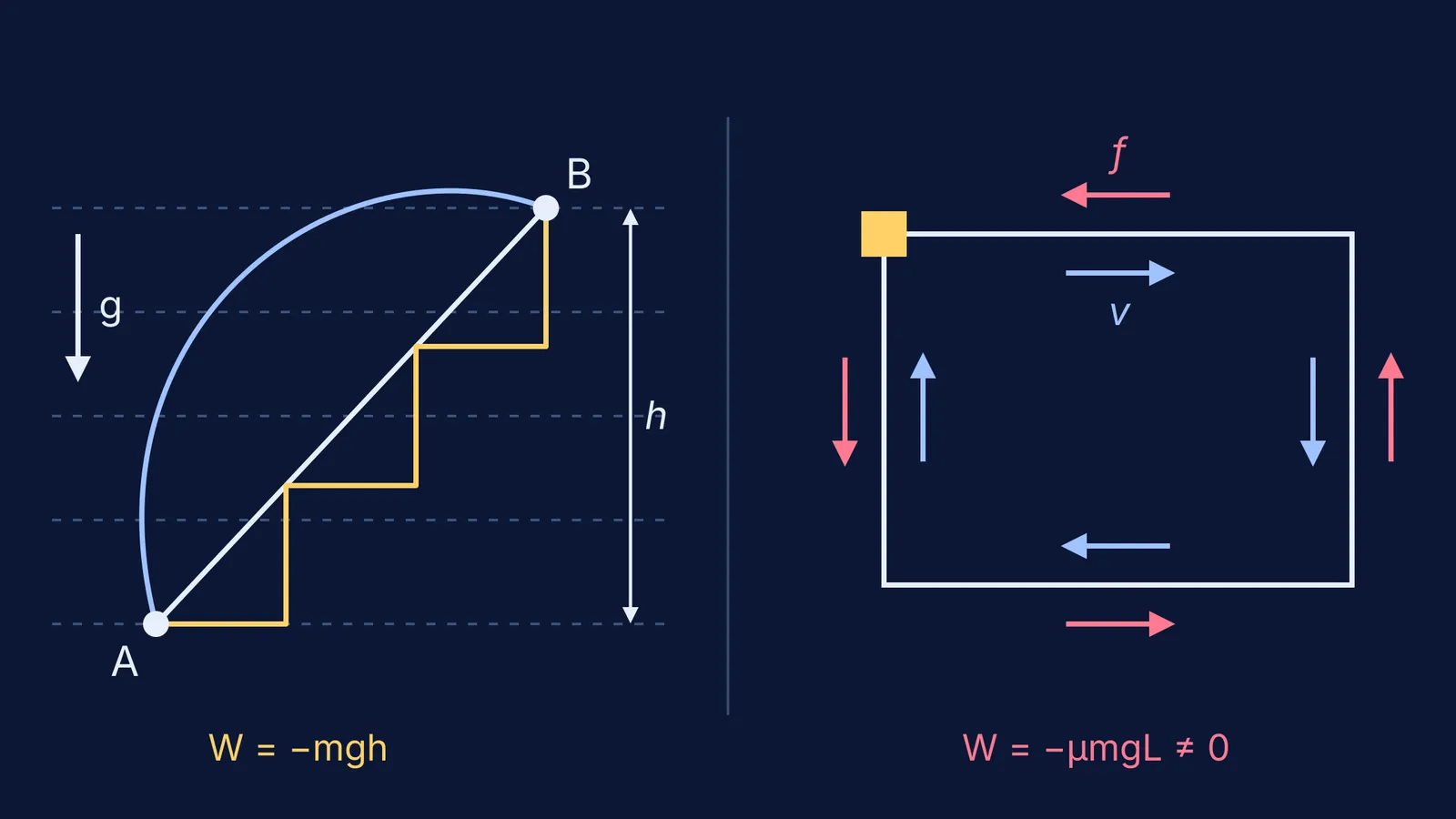
OpenStax University Physics gives the definition: the work done by a conservative force is the same for any path connecting two points. The same section gives an equivalent version: a force is conservative if the work it does around any closed path is zero.
These are one idea. If work depends only on where you start and finish, going from A to B and back to A must add up to zero. The NCERT Class 11 Physics textbook gives three definitions in Chapter 5: the force can be written as F = −dV/dx for some potential energy V(x), the work depends only on the end points, and the work done in a closed path is zero.
For the ideal spring, NCERT shows that the work done by the spring force in a cyclic process is zero.
How do you tell if a force is conservative?
The red-flag check. If the force always opposes the motion, as kinetic friction and air drag do, it is not conservative.
The cross-derivative test. For a two-dimensional force F = (Fx, Fy), OpenStax gives the condition ∂Fx/∂y = ∂Fy/∂x. If the derivatives differ, the force is not conservative. In three dimensions you check all three pairs, which is the same as saying the curl of F is zero.
The closed-loop test. Work out the work around one simple loop, such as a square or a circle. One loop with non-zero work proves the force is not conservative. One zero does not prove it is.
The potential test. If you can find U with F = −dU/dx (in 3D, F is minus the gradient of U), the force is conservative. In one dimension, any force that depends only on x passes.
Why is friction a non-conservative force?
Friction always points against your motion, so it does negative work on every step of every path and never gives that energy back.
Try it with numbers. You push a 2 kg box around a 3 m by 4 m rectangle on a floor with μk = 0.3, taking g = 9.8 m/s². Friction is μmg = 0.3 × 2 × 9.8 = 5.88 N. The perimeter is 14 m, so friction does −5.88 × 14 ≈ −82 J, even though the box ends where it started. That fails the closed-loop test.
It fails path independence too. To reach the opposite corner along two edges (7 m), friction does about −41 J; along the 5 m diagonal, about −29 J. Same start, same finish, different work.
Compare gravity: lift the same box 1.5 m by any route and gravity does −mgh = −2 × 9.8 × 1.5 = −29.4 J every time. For more practice with μ and the normal force, see our friction block problems guide.
How do you find potential energy from a given force?
Worked example: is F = (2xy, x²) newtons, with x and y in metres, conservative? If so, find U.
Cross-derivatives: ∂Fx/∂y = 2x and ∂Fy/∂x = 2x. They match, so the force passes.
Integrate Fx: since Fx = −∂U/∂x, U = −x²y + f(y), where f(y) depends on y alone.
Use Fy: −∂U/∂y = x² − f′(y). This must equal x², so f′(y) = 0 and f is a constant.
Answer: U = −x²y + C. Check: −∂U/∂x = 2xy and −∂U/∂y = x². Both match.
Now a force that fails: F = (y, −x), in the same units. Here ∂Fx/∂y = 1 but ∂Fy/∂x = −1. Go once anticlockwise around the unit circle and F·dr is −1 per radian, so the total work is −2π J, about −6.3 J. There is no potential energy to find.
In one dimension it is a single integral. For F = 3 − 2x, U = −∫F dx = x² − 3x + C. Our guide to potential energy curves and equilibrium shows how to read stability off U's graph. For more worked problems, the Fermi Problem Library has a step-by-step solver that explains the reasoning rather than printing an answer.
A checklist for exam questions
Does the force always oppose motion, like friction or drag? Then it is non-conservative.
Is it a function of position only? Run the cross-derivative test.
Do the derivatives match? Integrate one component, then fix the leftover function with the other.
Check U by differentiating it back. Sign slips are easy to make here.
Need a speed? Use conservation of mechanical energy if only conservative forces do work; otherwise use the work-energy theorem and include the work done by friction.
If gradients or partial derivatives still feel shaky, the Fermi Concept Library gives each concept its own lesson, so you can fill the gap before your next mock test.


