

On this page
The question of finding n when three consecutive binomial coefficients are in the ratio 1:2:3 is a classic problem in algebra and exam preparation.
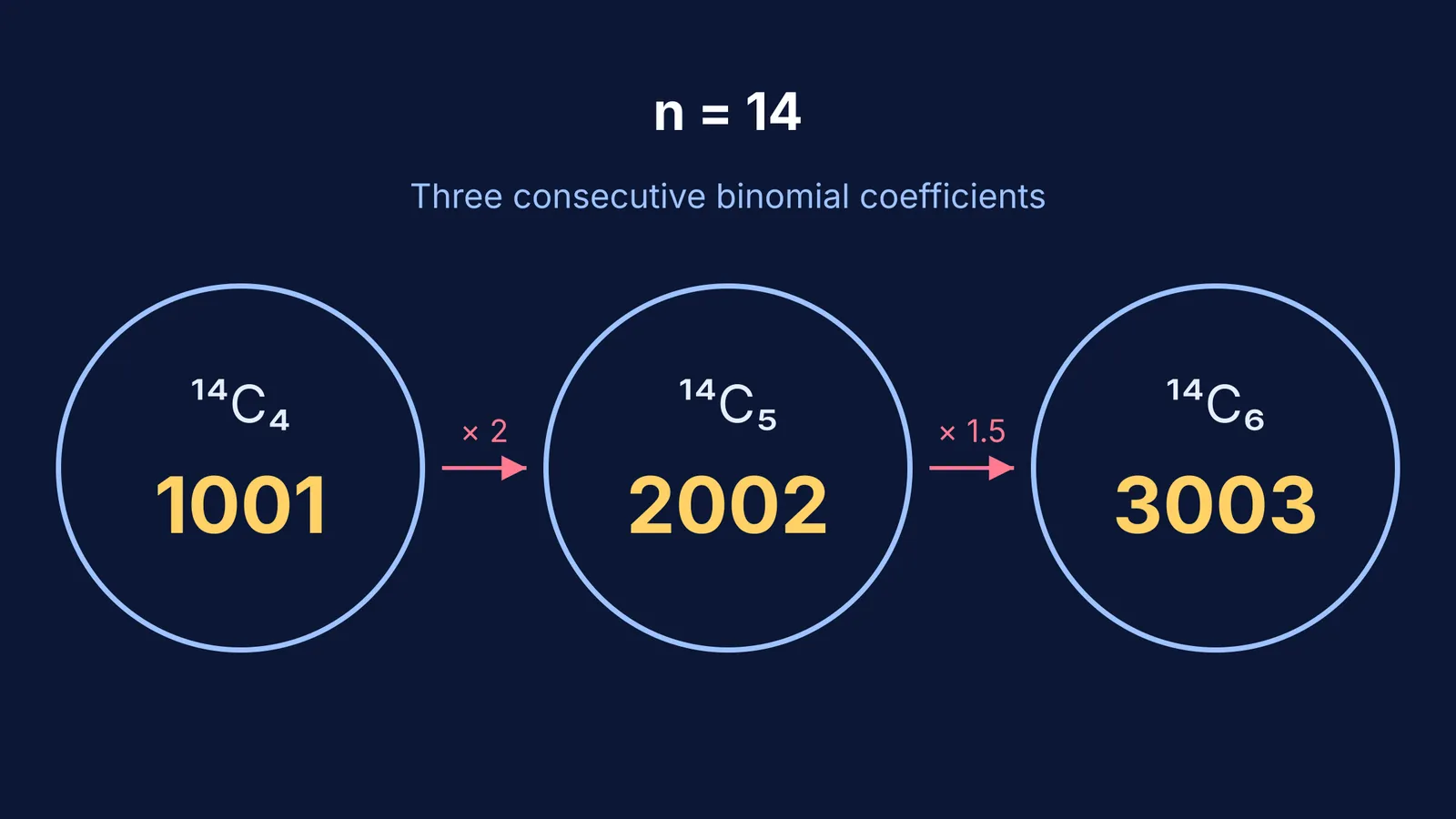
According to a well-known solution discussed on Math StackExchange, the unique value of n that satisfies this condition is 14, and the coefficients are ¹⁴C₄, ¹⁴C₅, and ¹⁴C₆.
How to use the consecutive coefficients formula?
When dealing with consecutive binomial coefficients, expanding them into factorials—like n! / (r! × (n-r)!)—takes time and easily leads to cancellation mistakes. If you try to divide ⁿC_r by ⁿC_{r-1} by writing out all the factorials, you will spend several minutes just simplifying the fraction.
Instead, always use the ratio formula for consecutive coefficients: ⁿC_r / ⁿC_{r-1} = (n - r + 1) / r
This formula is the fastest way to relate two neighbouring terms in Pascal's triangle. To remember it easily, notice that the denominator on the right side is simply r, which matches the index of the top coefficient on the left. The numerator is just n minus the denominator, plus 1. By avoiding messy factorial expansions and instead using a single ratio identity, you can turn a complicated problem into two simple linear equations—a trick that is just as useful here as it is when solving sums of binomial coefficients.
What is the value of n when the ratio is 1:2:3?
To find n, you set up the three coefficients and apply the ratio formula twice.
Let the three consecutive coefficients be ⁿC_{r-1}, ⁿC_r, and ⁿC_{r+1}. The problem states their ratio is 1 : 2 : 3.
Step 1: Set up the first equation (ratio 1:2)
Take the first two coefficients, which are in the ratio 1 to 2. ⁿC_r / ⁿC_{r-1} = 2 / 1 = 2
Apply the ratio formula directly: (n - r + 1) / r = 2 n - r + 1 = 2r n - 3r + 1 = 0 (Equation 1)
Step 2: Set up the second equation (ratio 2:3)
Now take the second and third coefficients, which are in the ratio 2 to 3. ⁿC_{r+1} / ⁿC_r = 3 / 2
Here, we need to substitute (r + 1) in place of r in our standard ratio formula. (n - (r + 1) + 1) / (r + 1) = 3 / 2 (n - r - 1 + 1) / (r + 1) = 3 / 2 (n - r) / (r + 1) = 3 / 2
Cross-multiply to clear the fractions and simplify: 2(n - r) = 3(r + 1) 2n - 2r = 3r + 3 2n - 5r - 3 = 0 (Equation 2)
Step 3: Solve the simultaneous equations
You now have two linear equations. From Equation 1, express n in terms of r: n = 3r - 1
Substitute this expression for n into Equation 2: 2(3r - 1) - 5r - 3 = 0 6r - 2 - 5r - 3 = 0 r - 5 = 0 r = 5
Now plug r = 5 back into the expression for n: n = 3(5) - 1 n = 15 - 1 n = 14
The value of n is 14.
You can verify this result by calculating the specific coefficients:
¹⁴C₄ = 1001
¹⁴C₅ = 2002
¹⁴C₆ = 3003
The ratio 1001 : 2002 : 3003 simplifies exactly to 1 : 2 : 3, confirming that our values for n and r are correct.
Where do students go wrong?
A common mistake in exams is assigning the three consecutive coefficients to ⁿC_r, ⁿC_{r+1}, and ⁿC_{r+2}. While this is mathematically valid, it makes the index numbers larger and much more complicated to substitute into the ratio formula. It is exactly like the mistake students make in progressions; choosing ⁿC_{r-1}, ⁿC_r, and ⁿC_{r+1} keeps the algebra cleaner and reduces the chance of making a sign error during the heat of an exam, much like why we choose symmetric terms when solving for three numbers in AP or GP.
If you get stuck on combinations or algebraic setup questions like this, you can bring them to the Fermi Problem Library. It has worked problems with a step-by-step solver that explains the reasoning rather than printing an answer, helping you see how to use the ratio formula for any set of binomial coefficients.


