

On this page
It is one of the most common shortcuts in high-school mathematics: if an equation has a root like 2 + √3, you immediately write down 2 − √3 as the second root. But this rule is not universal. It only works under specific conditions that exams like JEE Main and NEET-UG love to test.
If you assume roots always come in pairs without checking the coefficients of the equation, you will eventually walk into a trap. Here is exactly when you can trust the conjugate shortcut, and when it breaks down.
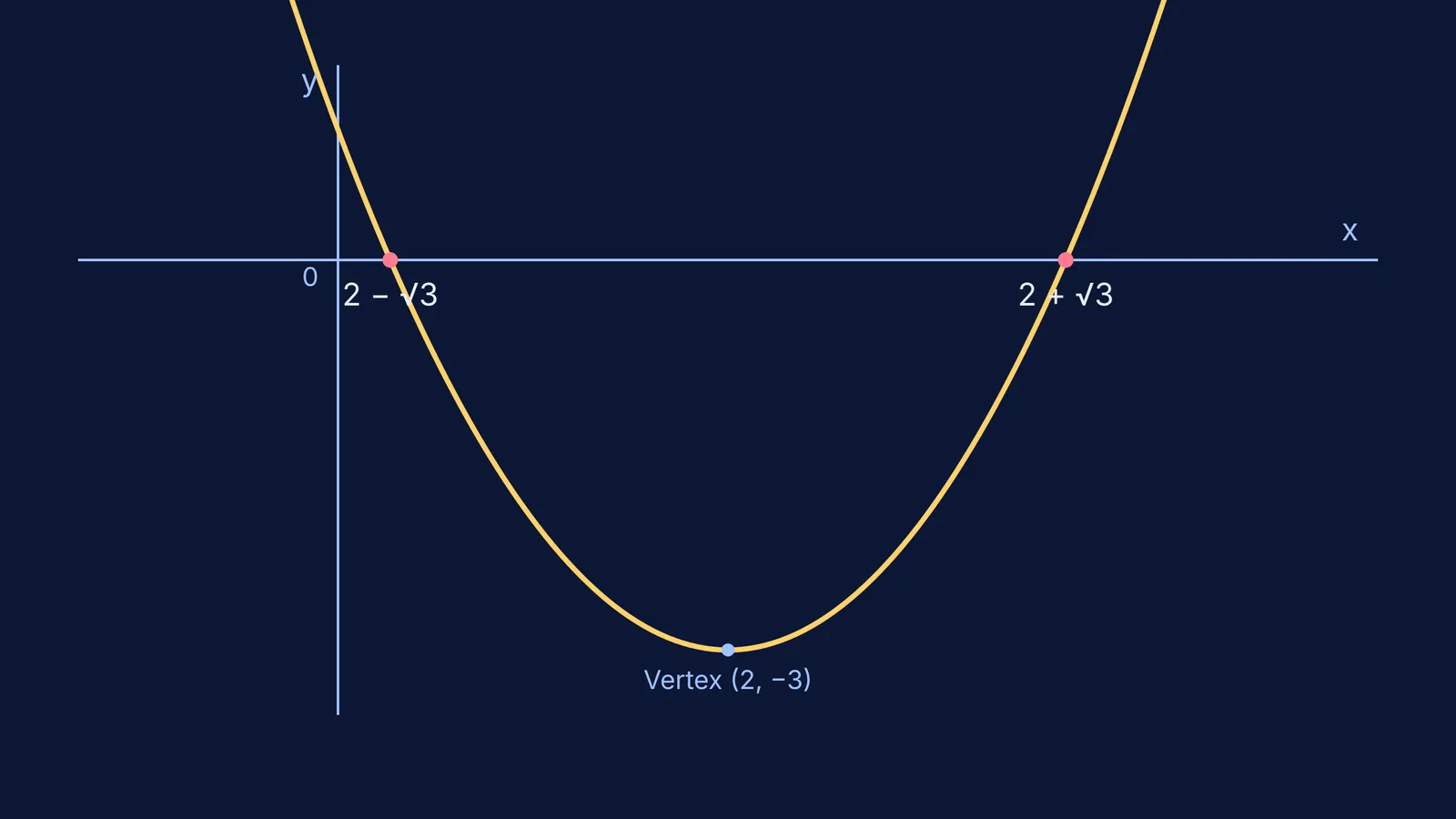
If one root is 2 plus root 3 find the quadratic?
To find a quadratic equation from a single irrational root, you must first confirm a crucial detail in the question: does the equation have rational coefficients?
If the question states the coefficients are rational numbers (integers or fractions), then the irrational roots must come in conjugate pairs.
Root 1: 2 + √3
Root 2: 2 − √3
From these two roots, finding the quadratic is straightforward. A quadratic equation takes the form x² − (Sum of roots)x + (Product of roots) = 0.
Sum of roots: (2 + √3) + (2 − √3) = 4
Product of roots: (2 + √3)(2 − √3) = 2² − (√3)² = 4 − 3 = 1
The required quadratic equation is x² − 4x + 1 = 0. This is the only quadratic equation with rational coefficients that has 2 + √3 as a root. Any other polynomial with this root and rational coefficients would have to be a multiple of this quadratic expression.
Why do irrational roots come in conjugate pairs?
To understand why this happens, look at the quadratic formula used to solve ax² + bx + c = 0: x = (−b ± √(b² − 4ac)) / 2a
If the constants a, b, and c are rational numbers, the ± symbol guarantees that the square root part (if it is irrational) will be added for one root and subtracted for the other. The rational part, −b / 2a, remains identical for both roots.
This is formally known as the irrational conjugate root theorem. If a polynomial has rational coefficients, an irrational root like a + √b guarantees a matching root at a − √b. The underlying mathematical structure forces this symmetry because rational operations cannot cancel out a single irrational term without its conjugate pair.
What if the coefficients are not rational?
Here is the trap. If the question does not guarantee rational coefficients, the roots do not have to be conjugates. A polynomial can easily have a mix of rational and irrational roots, or multiple irrational roots that are entirely unrelated to each other.
Consider a quadratic equation built from the roots 2 + √3 and 1: (x − (2 + √3))(x − 1) = 0 x² − (3 + √3)x + (2 + √3) = 0
In this equation, one root is 2 + √3. However, the other root is just 1. They are not conjugates. Notice that the coefficients in this equation—such as −(3 + √3)—are irrational numbers. The ± symmetry of the quadratic formula only creates conjugate pairs if the a, b, and c values do not introduce their own irrational numbers.
Missing this detail is a common mistake when tackling advanced problems. If you find yourself stuck on algebraic conditions, the Fermi Problem Library allows you to practice with an AI tutor that explains the underlying reasoning instead of just printing an answer.
Do complex roots pair up only when coefficients are real?
Yes. The rules for complex numbers are identical to the rules for irrational numbers.
The complex conjugate root theorem states that if a polynomial has real coefficients and a complex number a + bi is a root, then its conjugate a − bi is also a root (Wikipedia). This means complex roots of such polynomials always occur in pairs.
But if the coefficients themselves are complex, this guarantee vanishes. Let's build a quadratic with roots i and 2i: (x − i)(x − 2i) = 0 x² − 3ix − 2 = 0
One root is i, but the other is 2i, not −i. Because the middle coefficient −3i is a complex number, the conjugate root theorem does not apply. The symmetry is broken by the presence of an imaginary unit directly in the coefficients of the polynomial. If you need to trace the logic of polynomials further, the Fermi Concept Library gives each concept in mathematics its own lesson.
To review related ideas, see When is ax² + bx + c positive for all x?, When two quadratics share a root, or Quadratic word problems in Class 10.


