

On this page
When you study conic sections, the hyperbola stands out because it has two separate branches and a pair of asymptotes. Every hyperbola also has a twin: its conjugate hyperbola.
These two curves are intertwined geometrically and algebraically. The most famous property linking them is their eccentricities. If a hyperbola has an eccentricity e₁ and its conjugate has an eccentricity e₂, they are related by the equation 1/e₁² + 1/e₂² = 1 1.
What is a conjugate hyperbola?
For a standard hyperbola defined by the equation x²/a² − y²/b² = 1, its conjugate hyperbola is defined as y²/b² − x²/a² = 1 1.
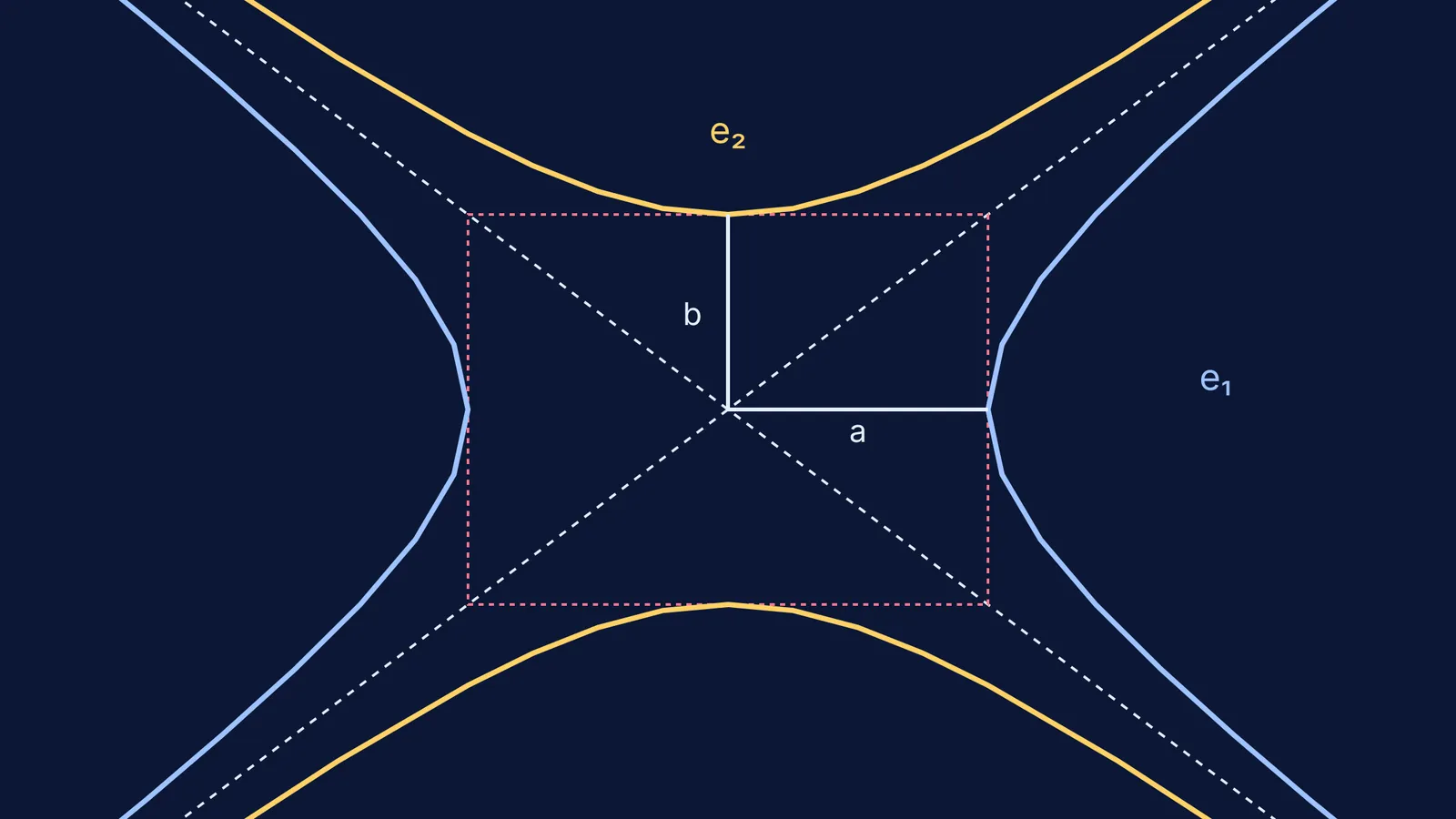
Geometrically, the conjugate hyperbola is formed by swapping the roles of the transverse and conjugate axes.
The original hyperbola opens left and right, with its transverse axis of length 2a along the x-axis and its conjugate axis of length 2b along the y-axis.
The conjugate hyperbola opens up and down. Its transverse axis has length 2b along the y-axis, and its conjugate axis has length 2a along the x-axis.
Despite this swap, the two hyperbolas share the same center and the exact same pair of asymptotes, given by the lines y = ±(b/a)x. The asymptotes act as boundary lines that neither hyperbola ever crosses. While the primary hyperbola lies in the left and right regions defined by these intersecting lines, the conjugate hyperbola occupies the top and bottom regions. They fit together perfectly, enclosing a shared central rectangle of dimensions 2a by 2b. This geometry also means their latus rectum lengths use the swapped constants, becoming 2b²/a for the first and 2a²/b for the second.
What is the eccentricity relation of conjugate hyperbolas?
The eccentricity of a hyperbola measures how much the conic section deviates from being circular 2). For any hyperbola, the eccentricity is always greater than 1 2).
Because the conjugate hyperbola is built from the same constants a and b, their eccentricities balance each other. The relationship between the two is:
1/e₁² + 1/e₂² = 1
This equation has an interesting consequence. Because 1/e₁² and 1/e₂² must add up to exactly 1, if one eccentricity is very close to 1 (meaning the hyperbola is very "tight" around its axis), the other must be very large (meaning the conjugate hyperbola is very wide).
To see this in action, imagine a problem where the eccentricity of a hyperbola is given as 5/4. To find the eccentricity of its conjugate, you apply the formula:
1/(5/4)² + 1/e₂² = 1
16/25 + 1/e₂² = 1
1/e₂² = 1 − 16/25 = 9/25
e₂² = 25/9, which means e₂ = 5/3.
Notice how both 1.25 and 1.67 are greater than 1, proving they are valid hyperbolas.
If the hyperbola is rectangular, meaning a = b, then the two hyperbolas are identical in shape, just rotated by 90 degrees. In this special case, the eccentricity of a rectangular hyperbola is exactly √2 2). Both e₁ and e₂ equal √2, and their inverse squares (1/2 + 1/2) perfectly sum to 1.
How to derive the 1/e₁² + 1/e₂² = 1 relation
The proof of this relationship is straightforward coordinate geometry, relying entirely on the standard definitions of eccentricity.
Take the primary hyperbola x²/a² − y²/b² = 1. Its eccentricity e₁ is calculated using the relation e₁² = 1 + b²/a².
Find a common denominator to rewrite this as e₁² = (a² + b²) / a².
Take the reciprocal to get 1/e₁² = a² / (a² + b²).
Now take the conjugate hyperbola y²/b² − x²/a² = 1. Its eccentricity e₂ swaps the roles of a and b, so e₂² = 1 + a²/b².
Rewrite this as e₂² = (b² + a²) / b².
Take the reciprocal to get 1/e₂² = b² / (a² + b²).
Add the two reciprocals together: 1/e₁² + 1/e₂² = a² / (a² + b²) + b² / (a² + b²).
Combine the numerators over the common denominator: (a² + b²) / (a² + b²) = 1.
This neat algebraic trick frequently appears in JEE mathematics alongside concepts like the focal distances of an ellipse.
Where to practice hyperbola problems
When equations get heavy, it helps to step back and visualise the curves. Knowing how changing the constants a and b stretches or flattens a hyperbola makes problems intuitive rather than just a memory test. Connecting the formula to the graph is the quickest way to build real intuition for the exam.
If you are struggling to map equations to shapes in coordinate geometry, the Fermi Concept Library can help you build the visual intuition you need. When you are ready to test that understanding with exam-level questions, the Fermi Problem Library offers worked problems with a step-by-step solver that explains the reasoning. Fermi's AI tutor holds a line of reasoning across a session, noticing where you are stuck and drawing the figure for you so you can see exactly how the geometry works.


