

On this page
With standard calculus problems appearing frequently in competitive exams like JEE Main, scoring well on them is essential for securing a top rank. Among the most common applications of derivatives is finding the dimensions that maximise or minimise a geometric shape under a specific constraint.
A classic example from the Class 12 NCERT Mathematics textbook asks for the semi-vertical angle of a right circular cone that has the maximum volume for a fixed slant height. The answer is always tan⁻¹√2. Whether you are preparing for board exams or competitive entrance tests, understanding the logical steps behind this derivation is more useful than just memorising the final angle.
Here is how you derive it in two different ways.
How do you set up the cone variables using trigonometry?
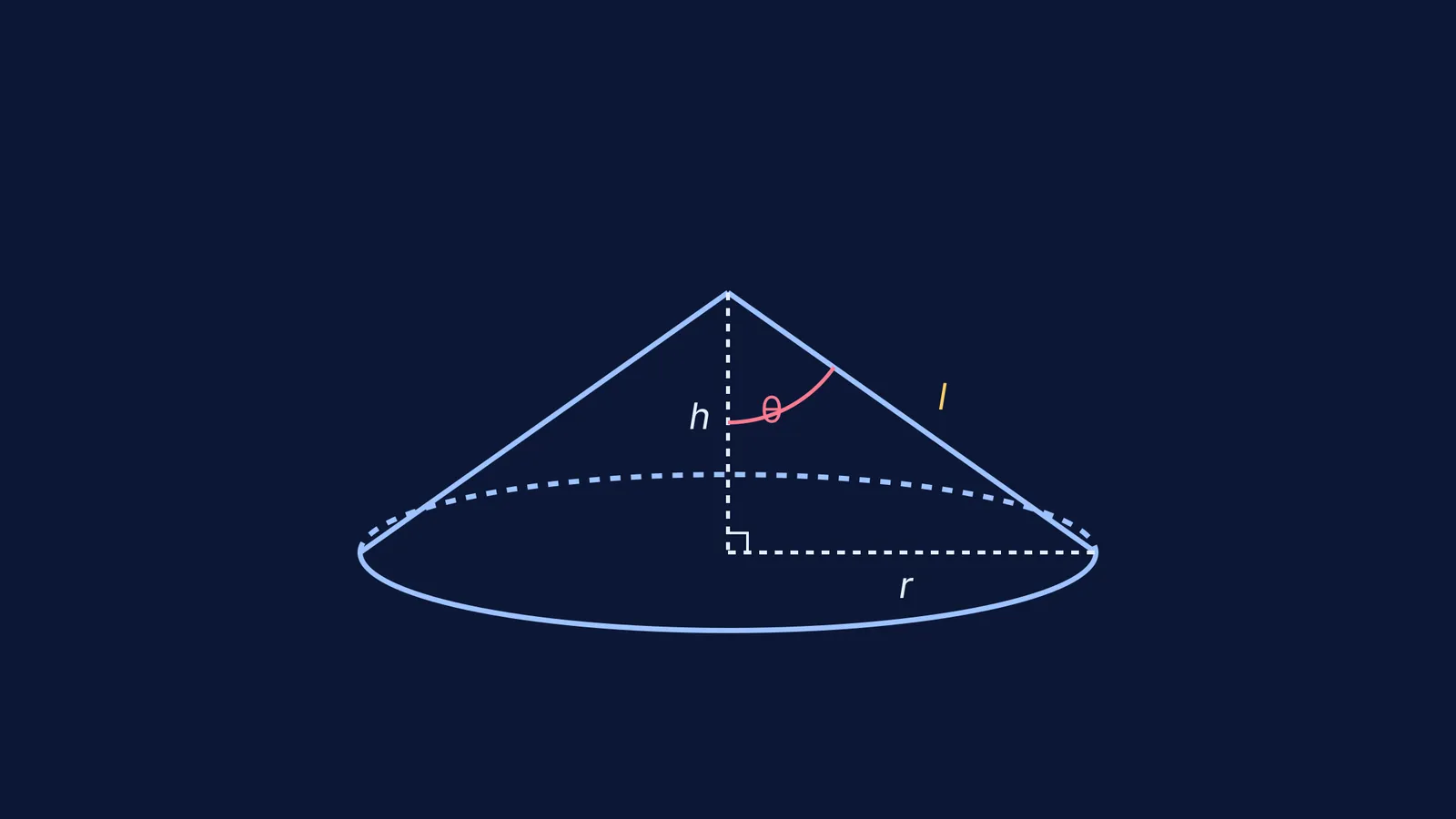
When you picture a right circular cone, a vertical cross-section through its centre forms a right-angled triangle bounded by three lengths:
The radius of the base, r
The vertical height, h
The slant height, l (which the problem states is constant)
The angle between the vertical height and the slant height is the semi-vertical angle, θ.
Using basic trigonometry on this triangle, we can write the radius and height in terms of the constant slant height and the variable angle:
r = l sin θ
h = l cos θ
The formula for the volume of a cone is: V = (1/3)πr²h
How to write the volume in terms of the semi-vertical angle?
To maximise the volume, we must write the volume equation in terms of a single variable. Since l is a fixed constant, we substitute our trigonometric expressions for r and h to express V purely as a function of the angle θ:
V = (1/3)π (l sin θ)² (l cos θ) V = (1/3)πl³ sin² θ cos θ
Now we have a clear function that we can differentiate with respect to our single variable, θ.
How do you differentiate to find the maximum volume?
To find the maximum volume, we differentiate V with respect to θ and set the derivative to zero. Because l is constant, the term (1/3)πl³ acts as a constant multiplier that we can keep on the outside. We apply the product rule to the variable part, sin² θ cos θ:
dV/dθ = (1/3)πl³ [ 2 sin θ cos θ × cos θ + sin² θ × (-sin θ) ] dV/dθ = (1/3)πl³ [ 2 sin θ cos² θ - sin³ θ ]
Setting dV/dθ = 0 to locate the turning point: (1/3)πl³ sin θ (2 cos² θ - sin² θ) = 0
For a real, three-dimensional cone, the angle θ cannot be 0, so sin θ is not zero. This allows us to divide the equation by sin θ: 2 cos² θ - sin² θ = 0 2 cos² θ = sin² θ
Dividing both sides by cos² θ gives: tan² θ = 2 tan θ = √2 θ = tan⁻¹√2
Can you solve for the maximum volume using height instead?
If you prefer not to use trigonometry, you can also solve this problem algebraically by writing the volume purely in terms of the height h.
From Pythagoras' theorem, the three sides relate as r² + h² = l². This rearranges neatly to r² = l² - h². You can substitute this directly into the volume formula without ever involving θ:
V = (1/3)π (l² - h²) h = (1/3)π (l²h - h³)
Differentiate V with respect to the variable h (keeping l constant): dV/dh = (1/3)π (l² - 3h²)
Setting dV/dh = 0 to find the maximum yields: l² = 3h² h = l/√3
We can now find the radius r at this maximum point: r² = l² - (l²/3) = 2l²/3 r = l√(2/3)
Finally, you can find the semi-vertical angle using tan θ = r/h. When you divide l√(2/3) by l/√3, the l and the √3 terms cancel out, leaving you with exactly √2. Both paths lead reliably to the same result.
Calculus applications like these require setting up the geometry properly before doing any algebra. If you want to see exactly how to approach other tricky optimization proofs, the Fermi Problem Library has worked problems with a step-by-step solver that explains the reasoning rather than printing an answer. For a deeper review of finding an Absolute maximum and minimum on a closed interval, or exploring other Applications of derivatives: maxima, minima and rates of change, browse the Concept Library to strengthen your fundamentals.


