

On this page
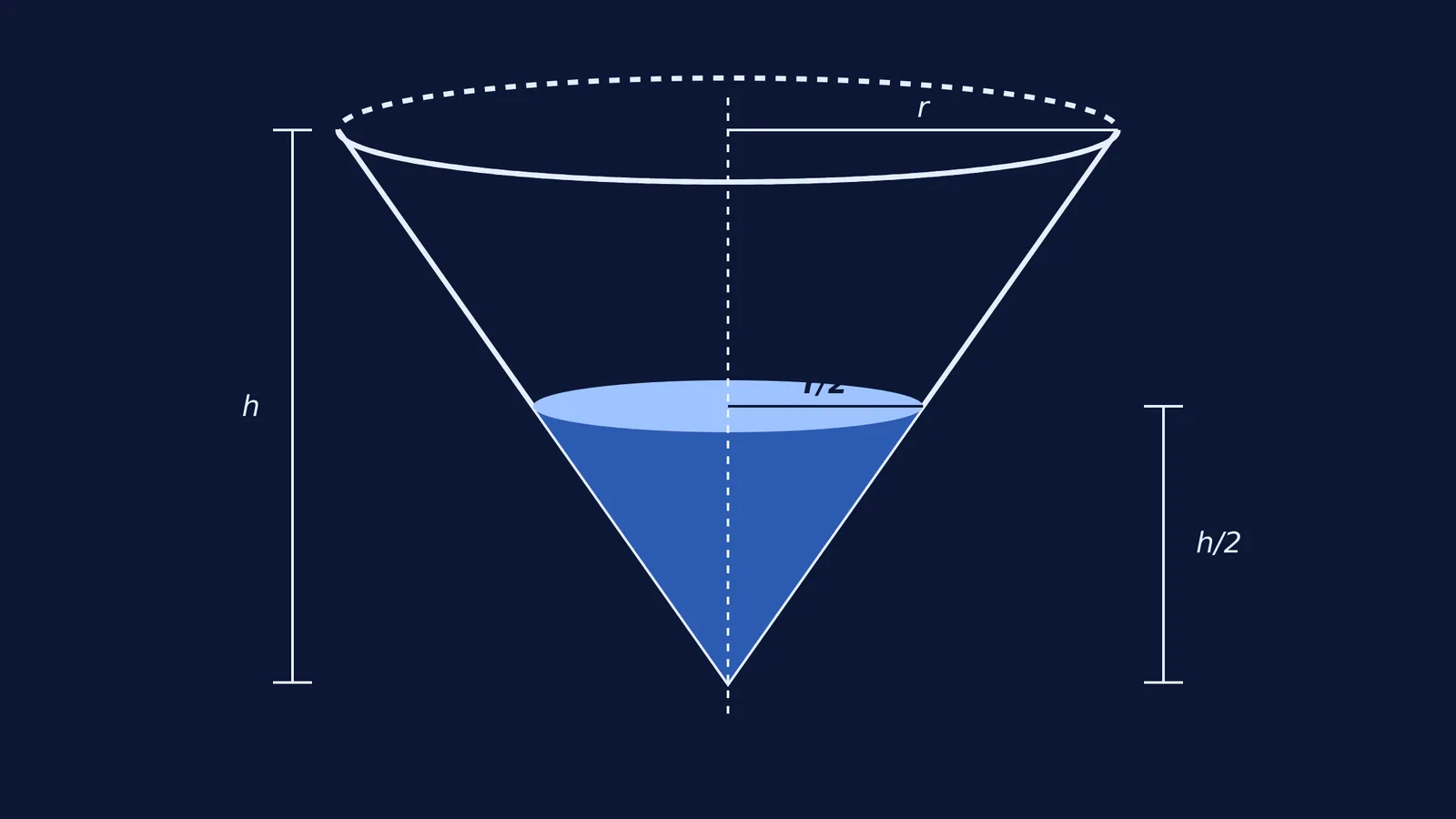
If you fill a conical glass to exactly half its depth, it feels like you have poured a fair half-measure of water. But if you measure it, the glass holds just one-eighth of its total capacity.
This surprising fact is a classic problem in geometry, physics and entrance exams like the JEE. To truly understand why it happens, we have to look past our everyday intuition and look closely at the mathematics of how three-dimensional shapes scale.
Why do we fall for the illusion of linearity?
When we scale something up or down, our brains instinctively assume everything changes by the same amount. If a line is twice as long, we expect it to take twice as much ink to draw. If a glass is half as tall, we expect it to hold half as much water. Researchers call this the "illusion of linearity." A seminal 1998 study by De Bock and colleagues found that this bias is incredibly strong in secondary school students, who overwhelmingly apply simple linear scaling to area and volume problems De Bock et al., 1998.
But volume does not scale linearly. Because it is a three-dimensional property, any change to a shape's overall size scales its volume by the cube of that change.
Why does half the height mean 1/8 the volume?
To see why the volume shrinks so quickly, we look at the formula for the volume of a cone:
V = (1/3)πr²h
When you fill an inverted cone-shaped glass to half its height, the water itself forms a smaller cone. Because the sides of the glass are straight and uniform, this smaller volume of liquid is perfectly proportional—or mathematically "similar"—to the shape of the full glass.
Because the two cones are similar, cutting the height in half also cuts the radius of the liquid surface in half. Let's plug those new, halved dimensions (h/2 and r/2) into the formula:
New Volume = (1/3) × π × (r/2)² × (h/2)
Square the new radius: (r/2)² becomes r²/4.
Multiply the fractions: 1/4 × 1/2 = 1/8.
New Volume = 1/8 × [(1/3)πr²h]
The liquid takes up exactly 1/8 of the full glass. To fill the glass to half its volume, you would need to pour water to roughly four-fifths of its height.
How can you use this scaling rule in your exams?
This scaling rule is a favourite trick in competitive exams. You will see it in math problems about frustums (cones with the top cut off), in physics questions about the center of mass of a liquid, and in chemistry problems involving conical funnels.
Here is a practical framework to avoid the linearity trap:
Check the shape: Are you dealing with similar figures? (If you pour water into a straight cylinder, the radius stays the same, so volume *does* scale linearly with height).
Identify the scale factor: Find the ratio of the new dimension to the old dimension (e.g., 1/2).
Apply the power: Raise the scale factor to the power of 1 for length, 2 for area, and 3 for volume.
Multiply: Multiply the original value by your new scaled factor.
If you struggle to spot these proportional relationships during practice, the Fermi Problem Library has worked problems with a step-by-step solver that explains the underlying reasoning. Fermi's AI tutor holds a line of reasoning across a session and notices where you are stuck, so if you fall for the illusion of linearity in a complex physics problem, it can gently step in to draw the figure and check your understanding as it goes.
Mastering these scaling rules gives you an immediate advantage. It stops you making fundamental geometry errors, and it gives you a fast way to eliminate wrong answers—which is exactly why some JEE aspirants plateau when they rely purely on rote formulas. Once you see the cube rule clearly, a dimensional analysis check becomes second nature.


