

On this page
Make two cups of chai with the same amount of water. Put one spoon of tea leaves in the first and two in the second. The second comes out darker and stronger. You have just made a dilute solution and a concentrated one.
What is the difference between a concentrated and a dilute solution?
The NCERT Grade 8 science textbook, Curiosity, Chapter 9: The Amazing World of Solutes, Solvents, and Solutions, starts with the parts. The substance that dissolves is the solute, the liquid it dissolves in is the solvent, and together they form a solution.
Concentration is the amount of solute present in a fixed quantity of solution or solvent, according to NCERT Curiosity Chapter 9.
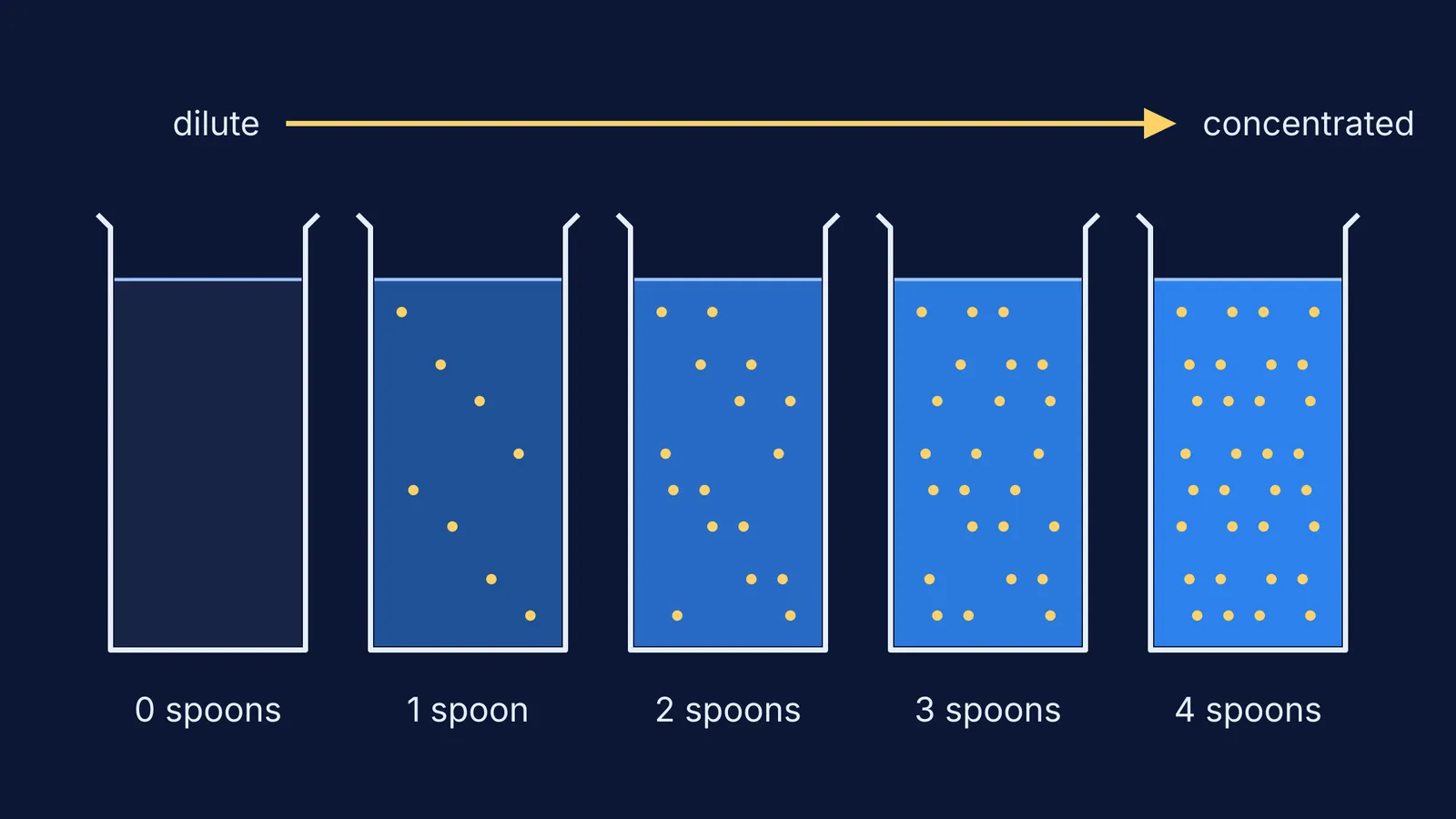
A dilute solution has less solute in that fixed quantity, and a concentrated solution has more. The chapter adds that the two are relative terms: the solution made with one spoon of salt is dilute compared with one made with two or more spoons. By the same logic, that one-spoon solution would count as concentrated next to a half-spoon one.
Concentrated: more solute in the same solvent, so a stronger taste or deeper colour.
Dilute: less solute in the same solvent, so a weaker taste or paler colour.
To dilute: add solvent. The solute stays the same and spreads through more liquid.
To concentrate: add solute, or boil off some solvent.
How can you check concentration at home with tea and lemonade?
You need only a kitchen, and a grown-up nearby for the hot water.
Tea (colour check). Brew one weak and one strong cup with the same water. The darker cup is more concentrated. Now pour half the strong cup into an empty one and top it up with plain water. It turns lighter: you did not remove any tea, you spread it through more water. That is dilution.
Lemonade (taste check). Take two glasses with equal water and lemon juice. Stir one spoon of sugar into the first and three into the second. The second tastes sweeter: more solute, same solvent. Food is fine to taste; never taste anything in a school lab.
How do you compare two solutions when the amounts are different?
Curiosity asks a sharp question: which is more concentrated, 2 spoons of salt in 100 mL of water or 4 spoons of salt in 50 mL? (NCERT Chapter 9). Counting spoons alone misleads you. Use three steps:
Write down the solute and the solvent for each: A is 2 spoons in 100 mL, and B is 4 spoons in 50 mL.
Scale both to the same amount of solvent. A stays at 2 spoons per 100 mL. B is 4 spoons in 50 mL, which is 8 spoons per 100 mL.
Compare: B has 8 spoons per 100 mL against 2 for A, so B is four times as concentrated.
Try one: Riya stirs 3 spoons of sugar into 300 mL of lemonade; Arjun stirs 2 spoons into 150 mL. Per 100 mL, Riya has 1 spoon and Arjun about 1.3, so Arjun's glass is sweeter even though Riya used more sugar.
Why does copper sulphate solution get paler when you add water?
Copper sulphate gives a blue solution, so you can see concentration. The Beer-Lambert law says a solution's absorbance, a measure of how strongly it absorbs light, is directly proportional to its concentration (LibreTexts Chemistry/Spectroscopy/Electronic_Spectroscopy/Electronic_Spectroscopy_Basics/The_Beer-Lambert_Law)). More dissolved copper sulphate means higher absorbance, so you see a deeper blue. Add water and the same copper sulphate is spread through more liquid, so the blue fades.
The Royal Society of Chemistry's colorimetry practical uses exactly this idea. Students mix 8, 6, 4, 2 and 0 cm3 of copper(II) sulfate solution with 2, 4, 6, 8 and 10 cm3 of water, then match an unknown solution to the closest shade. The same page labels copper(II) sulfate solution harmful and dangerous for the environment, and requires eye protection, so do this check only in your school lab with your teacher.
Quick checklist before your test
Name the solute and the solvent in every question.
Same amount of solvent? The one with more solute is more concentrated.
Different amounts? Scale both to per 100 mL before comparing.
Adding water dilutes, but the amount of solute stays the same.
Concentrated and saturated mean different things.
Colour is a fair check only when the solute is coloured.
If solute, solubility and saturated still blur together, the Fermi Concept Library gives each chemistry concept its own lesson and its place in the map. For the numbers, the Fermi Problem Library has worked problems with a step-by-step solver that explains the reasoning rather than printing an answer.
Next time someone makes chai, ask for one weak cup and one strong cup, and explain the difference out loud.


