

On this page
When you first encounter the complex plane, a common question is whether a number like z₁ = 3 + 4i is greater than z₂ = 1 + 2i. While you can measure and compare their distances from the origin, the numbers themselves cannot be placed in a greater-than or less-than order.
Complex numbers cannot form an ordered field because assigning a positive or negative value to the imaginary unit i inevitably breaks the rules of basic arithmetic. If you are preparing for JEE or studying advanced mathematics, understanding why this happens is a core conceptual step.
Why can real numbers be ordered?
Real numbers form what mathematicians call an ordered field. This means you can arrange all real numbers on a continuous line from smallest to largest, and this ordering works perfectly with the standard rules of addition and multiplication.
In any ordered field, the square of a non-zero number is always positive. For example, 3 × 3 = 9, and (−3) × (−3) = 9. Because this rule holds true across the entire number line, you can safely write inequalities like x² > 0 for any non-zero real number x. The complex numbers are a field—meaning you can add, subtract, multiply and divide them just as you would with real fractions—but they lack this compatible ordering.
Why can't complex numbers be compared?
The fundamental problem lies with the imaginary unit i, which is defined by the property i² = −1.
Suppose, for a moment, that complex numbers could be ordered just like real numbers. If that were true, i would have to fall into one of three categories: it must be positive (i > 0), negative (i < 0), or zero (i = 0).
Since 0 × 0 = 0, not −1, i cannot be 0. This leaves two possibilities, and both lead to a mathematical contradiction:
If you assume i > 0: Multiplying both sides of an inequality by a positive number keeps the inequality the same. Multiplying both sides of i > 0 by the positive number i gives i × i > 0 × i, which simplifies to i² > 0. Since i² = −1, this implies −1 > 0. Because −1 is not greater than 0, this assumption fails.
If you assume i < 0: Adding −i to both sides gives 0 < −i, meaning −i is a positive number. Multiplying the positive number −i by itself must yield a positive result: (−i) × (−i) > 0. The negative signs cancel out, leaving i² > 0. Substituting the definition of i² gives −1 > 0, leading to a second contradiction.
Because every possible case breaks the established rules of arithmetic, complex numbers cannot have a greater-than or less-than ordering.
How do you solve equations if complex numbers cannot be compared?
When an exam problem presents an equation like z² + |z| = 0, you cannot solve it using standard real-number inequalities. Instead, a reliable method is to replace z with x + iy and compare the real and imaginary parts separately.
Because two complex numbers are only equal if their real parts are exactly equal and their imaginary parts are exactly equal, one complex equation splits into two simultaneous real equations. You can see this method in action when solving equations in complex numbers by putting z = x + iy.
This split works because you are converting the unorderable complex number into two independent real numbers, x and y, which can be manipulated and compared using standard algebra.
How can you compare complex numbers using their modulus?
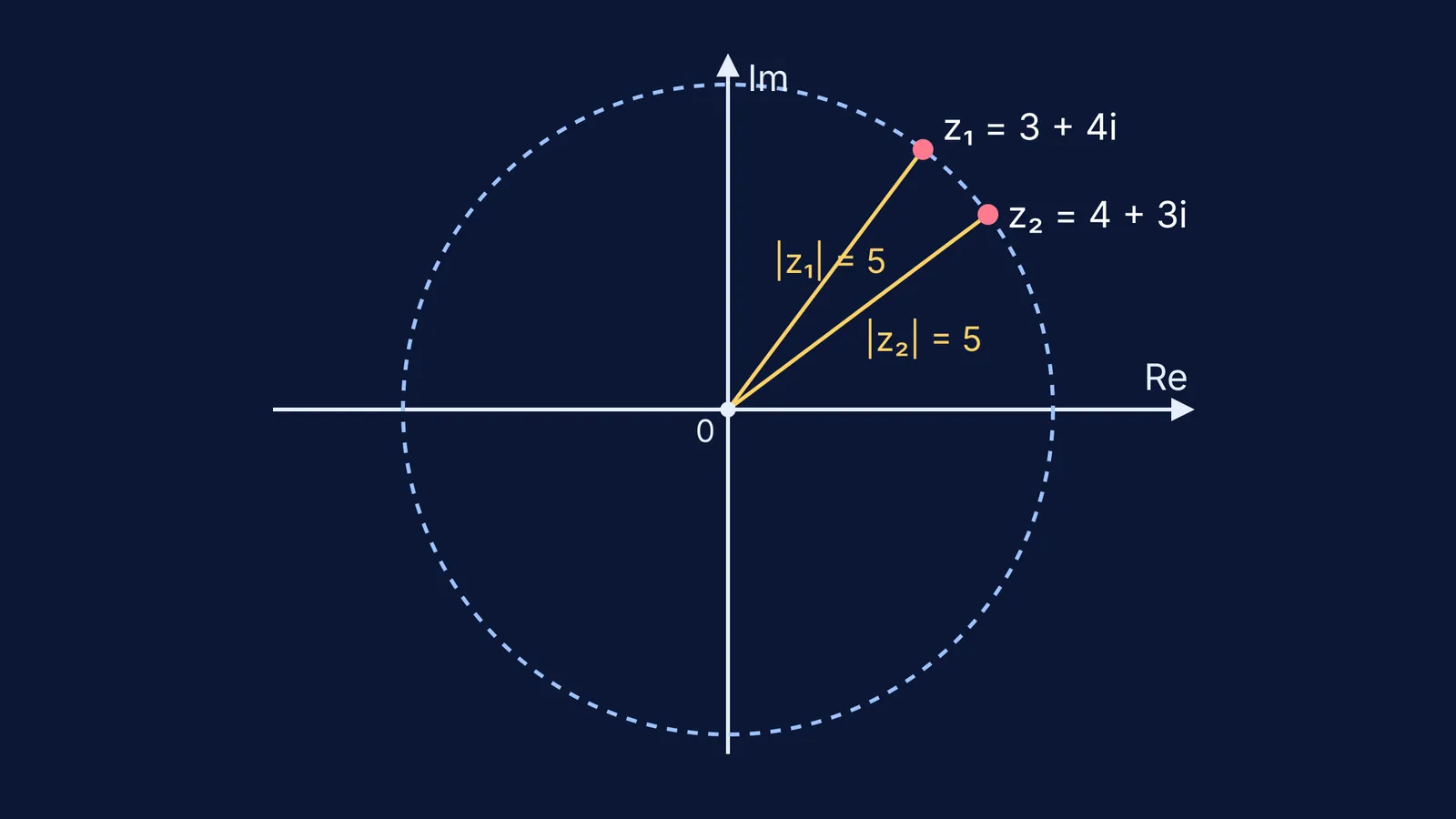
Because you cannot compare the values of complex numbers directly, you compare their moduli instead. The modulus, written as |z|, is a real number representing the straight-line distance from the origin to the point on the complex plane.
For example, 3 + 4i and 4 + 3i cannot be ordered, but both have a modulus of 5. You can safely compare moduli because they are real numbers, which is why exam questions often ask you to find the greatest or least value of |z| under certain geometric conditions. You can see how this geometry works by exploring the triangle inequality for complex numbers.
When you need to fully specify a complex number without an x and y coordinate, you use both its modulus and its angle from the positive real axis. Mastering how to find arg z in each quadrant is the next vital step in applying this geometry.
If you are struggling to picture these relationships or keep track of the algebra, the Fermi Concept Library holds a complete map of complex numbers, each with its own lesson. When you need to put the theory into practice, the Fermi Problem Library offers worked problems with a step-by-step solver that explains the reasoning rather than printing an answer.


