

On this page
Translating the long, complicated name of a coordination compound back into its concise chemical formula can feel like decoding a secret message. However, the process is entirely logical once you know the rules for assembling the pieces and balancing the charges. A coordination entity is a complex architecture where a central metal ion acts as a hub, and surrounding molecules or ions bind to it through coordinate covalent bonds. By picking apart the IUPAC name, you can reconstruct this architecture exactly.
What are the parts of the formula?
A coordination compound consists of two primary zones: the coordination sphere and the ionization sphere. The coordination sphere is the core structure—the central metal atom or ion surrounded by attached molecules or ions called ligands. The formula of this core structure is always enclosed in square brackets. Any ions needed to balance the electrical charge of the complex sit in the ionization sphere, outside these brackets.
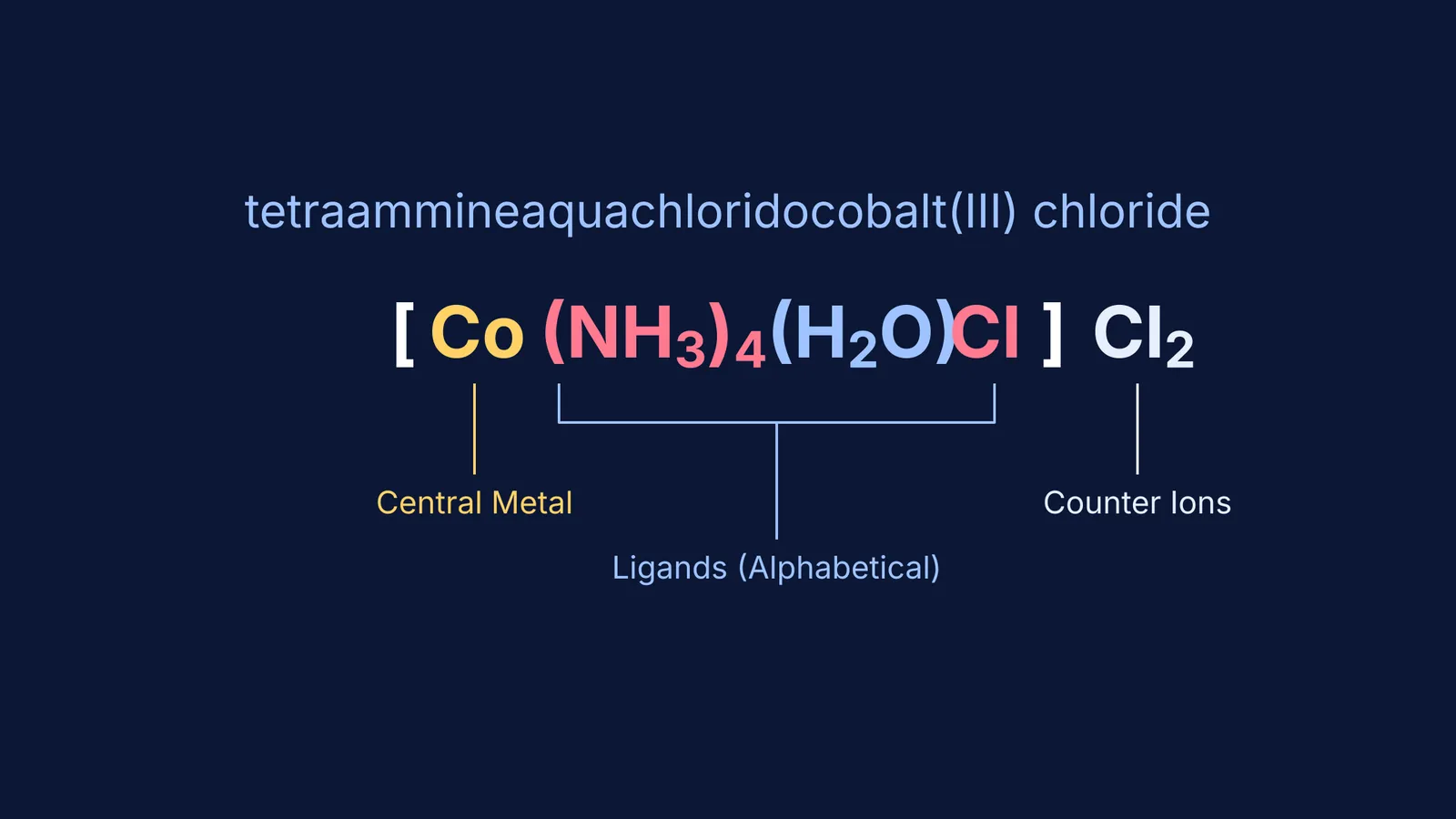
For example, consider the classic compound tetraammineaquachloridocobalt(III) chloride.
Central Metal: The name ends with "cobalt(III)", which tells us the central hub is cobalt (Co) bearing an oxidation state of +3.
Ligands: The prefixes and names before the metal identify the attached groups. "Tetraammine" means there are four ammonia (NH₃) molecules. "Aqua" specifies one water (H₂O) molecule. "Chlorido" refers to a single chloride (Cl⁻) ion attached directly to the metal.
Counter Ions: The "chloride" sitting separately at the very end of the name represents the counter ions (Cl⁻) located outside the complex, floating in the ionization sphere to balance the overall electrical charge.
How do you order the ligands in the formula?
When writing the chemical formula inside the square brackets, the symbol for the central metal always goes first. After the metal, you must list the ligands. But what order do they go in? This is where many students lose marks in exams due to a subtle difference between strict global standards and local textbook conventions.
According to the strict IUPAC 2005 Recommendations (specifically rule IR-9.2.3.1), ligands within the formula should be listed alphabetically based on their chemical symbols, regardless of their charge 1. Under this strict global rule, the formula for our cobalt example would list the Cl symbol, then H₂O, followed by NH₃.
Following the NCERT convention for our cobalt complex, we compare the ligand names:
ammine (NH₃) starts with 'am'.
aqua (H₂O) starts with 'aq'.
chlorido (Cl) starts with 'ch'.
Based on alphabetical order by name, ammine comes first, aqua second, and chlorido third. Therefore, the order inside the brackets is (NH₃)₄ followed by (H₂O) followed by Cl. Note that polyatomic ligands (like ammonia and water) must be enclosed in parentheses, and you should never leave any spaces between the symbols.
This gives us the coordination sphere: [Co(NH₃)₄(H₂O)Cl]
How do you balance the charges?
The final step in writing the formula is determining exactly how many counter ions you need outside the bracket. You find this by calculating the net charge of the entire coordination sphere.
To find the net charge, add the oxidation state of the metal to the total charges of all the ligands inside the brackets:
The central cobalt ion has an oxidation state of +3.
The four ammine ligands are neutral (a charge of 0).
The single aqua ligand is neutral (a charge of 0).
The single chlorido ligand carries a charge of -1.
Adding these values together: (+3) + (4 × 0) + (1 × 0) + (-1) = +2.
The complex ion has a net charge of +2. Because any stable chemical compound must be electrically neutral overall, you need counter ions to balance this positive charge. The counter ion specified at the end of the name is chloride (Cl⁻), which carries a -1 charge. To perfectly cancel out the +2 charge of the complex, you need exactly two chloride ions.
Bringing it all together gives us the final, complete formula: [Co(NH₃)₄(H₂O)Cl]Cl₂.
If you need to review the underlying definitions of oxidation states and ligand charges, the Fermi Concept Library explains them clearly. And when you are stuck on a complex name and cannot figure out how the charges balance out, the Fermi Problem Library provides a step-by-step solver that explains the reasoning rather than just printing an answer.
Once you have mastered these inorganic nomenclature rules, you might also want to review the rules for naming carbon compounds in Class 10 to keep your organic chemistry foundation strong. Furthermore, if you are curious about how these ligands interact electronically with the central metal, understanding how to calculate the average bond order from resonance is a highly recommended next step in your physical chemistry preparation.


