

On this page
Dissolve copper sulphate in water and you get a blue solution; drive the water off the crystals and you get a white powder. In complexes, the ligands help set the colour, and the colour you see is not the colour absorbed.
Why is copper sulphate solution blue?
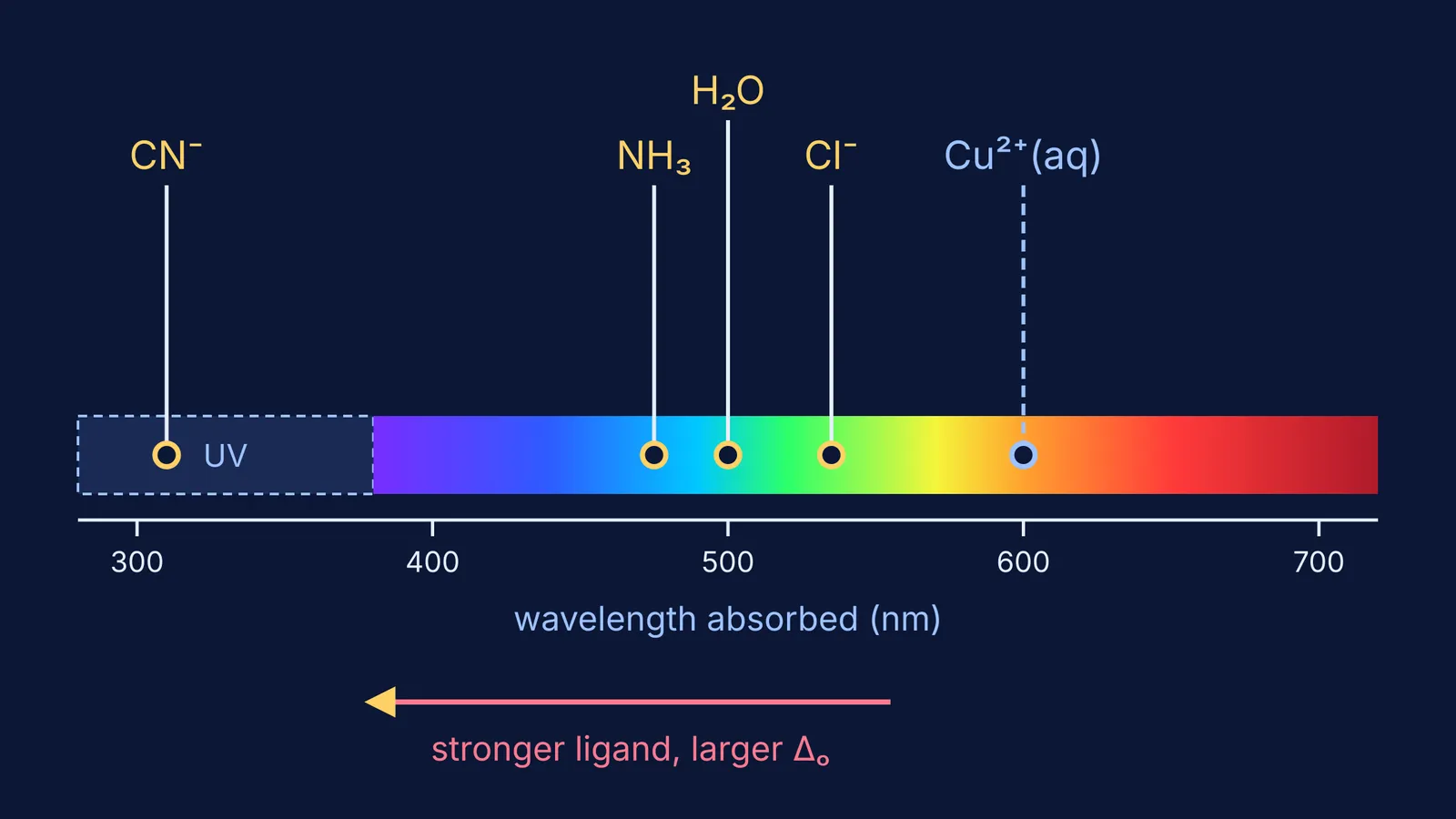
In water, Cu²⁺ is surrounded by water ligands. NCERT's Class 12 chemistry textbook lists the aqua complex of copper(II), written there as [Cu(H₂O)₄]²⁺, as absorbing light at 600 nm, which is red, so the solution looks blue (NCERT Class 12 Chemistry, Unit 5, Table 5.3).
The same chapter states the rule: the colour of a complex is complementary to the colour it absorbs. It also notes that anhydrous CuSO₄ is white but CuSO₄·5H₂O is blue, and explains that in the absence of ligands, crystal field splitting does not occur.
Read the colour wheel from absorbed to seen. These pairs come from the same NCERT table:
absorbs yellow (535 nm), looks violet
absorbs blue (475 nm), looks yellow-orange
absorbs red (600 nm), looks blue
absorbs only ultraviolet (310 nm), looks pale yellow
How does Δo decide which wavelength is absorbed?
In an octahedral complex, the six ligands split the five d orbitals into a lower set of three (t₂g) and a higher set of two (eg), and the energy gap between them is the crystal field splitting, written Δo (NCERT Class 12 Chemistry, Unit 5). Light is absorbed when its photon energy matches the jump of an electron from t₂g to eg, a d–d transition.
Here is a worked example. NCERT explains that [Ti(H₂O)₆]³⁺ is a d¹ complex that absorbs blue-green light, moving its single electron from t₂g to eg, so it appears violet; its Table 5.3 puts the absorption at 498 nm. Turn that wavelength into energy per mole with E = N_A·h·c/λ, using the exact CODATA values of the Planck constant, the speed of light and the Avogadro constant:
N_A·h·c = (6.022 × 10²³ mol⁻¹)(6.626 × 10⁻³⁴ J s)(2.998 × 10⁸ m s⁻¹) ≈ 0.1196 J m mol⁻¹.
Divide by λ = 498 × 10⁻⁹ m to get E ≈ 2.40 × 10⁵ J mol⁻¹.
So Δo for [Ti(H₂O)₆]³⁺ is about 240 kJ mol⁻¹.
The same sum for copper's 600 nm gives about 199 kJ mol⁻¹. Shorter wavelength absorbed means larger splitting, and that one sentence is what ranking questions test.
Why are Zn²⁺ and Sc³⁺ colourless?
A d–d transition needs an electron in a lower d orbital and a vacancy in a higher one. Sc³⁺ is 3d⁰, so there is no d electron to excite; Zn²⁺ is 3d¹⁰, so the eg set is already full. NCERT's table of aquated first-row ions lists Sc³⁺, Ti⁴⁺ (also 3d⁰) and Zn²⁺ as colourless, while Ti³⁺ (3d¹) is purple and Cu²⁺ (3d⁹) is blue (NCERT Class 12 Chemistry, Unit 4, Table 4.8).
For the d¹⁰ story, see why zinc, cadmium and mercury are not called transition elements.
How do you rank complexes by colour from the ligand?
NCERT gives the spectrochemical series, an experimentally determined order of ligands by increasing field strength: I⁻ < Br⁻ < SCN⁻ < Cl⁻ < S²⁻ < F⁻ < OH⁻ < C₂O₄²⁻ < H₂O < NCS⁻ < edta⁴⁻ < NH₃ < en < CN⁻ < CO (NCERT Class 12 Chemistry, Unit 5). A stronger ligand gives a larger Δo, so the complex absorbs a shorter wavelength.
The cobalt(III) rows of NCERT's Table 5.3 show the series at work, with energies worked out as above:
[CoCl(NH₃)₅]²⁺ absorbs 535 nm (yellow) and looks violet: about 224 kJ mol⁻¹.
[Co(NH₃)₅(H₂O)]³⁺ absorbs 500 nm (blue-green) and looks red: about 239 kJ mol⁻¹.
[Co(NH₃)₆]³⁺ absorbs 475 nm (blue) and looks yellow-orange: about 252 kJ mol⁻¹.
[Co(CN)₆]³⁻ absorbs 310 nm, in the ultraviolet, and looks pale yellow: about 386 kJ mol⁻¹.
Cl⁻ < H₂O < NH₃ < CN⁻: the absorbed wavelength falls in the order the series predicts. NCERT's nickel example runs the same way. As ethane-1,2-diamine (en) replaces water around Ni²⁺, the solution goes from green to pale blue, then blue/purple, then violet. Our guide to denticity, ambidentate ligands and the chelate effect explains why en binds so firmly.
Use these four steps for any "arrange in order of wavelength absorbed" question:
Check that the metal, its oxidation state and the geometry are the same in every option; if not, the series alone cannot decide.
Place each ligand on the spectrochemical series.
Stronger field means larger Δo, higher energy and a shorter wavelength absorbed.
Only then, if asked, turn the absorbed colour into the observed colour with its complementary pair.
If the splitting itself feels shaky, the Fermi Concept Library has a lesson for each chemistry concept, so you can revisit crystal field theory first. For practice, the Fermi Problem Library has worked problems with a step-by-step solver that explains the reasoning rather than printing an answer.
Next, read coordination compounds: naming, isomerism and crystal field basics.


