

On this page
If event A is winning a coin toss and event B is drawing an ace with replacement, those two outcomes are independent. One does not affect the probability of the other. Intuition says that if A and B are independent, then not-A and not-B must also be independent. If winning the toss does not change your chance of drawing an ace, then losing the toss should not change your chance of not drawing an ace.
In probability theory, we do not just rely on intuition. We prove it. If A and B are independent events, it is a formal mathematical identity that their complements, A′ and B′, are also independent).
Here is how the proof works, and how you can use this property to solve "neither occurs" questions in exams like JEE Main and NEET-UG.
What does independence mean mathematically?
Two events, A and B, are independent if and only if the probability of both happening is the product of their individual probabilities):
P(A ∩ B) = P(A)P(B)
The complement of an event A, written as A′ or Aᶜ, is the event that A does not happen. Since an event must either happen or not happen, their probabilities add up to 1:
P(A′) = 1 − P(A)
To answer the question of whether complements are independent, we have to prove three things:
A and B′ are independent: P(A ∩ B′) = P(A)P(B′)
A′ and B are independent: P(A′ ∩ B) = P(A′)P(B)
A′ and B′ are independent: P(A′ ∩ B′) = P(A′)P(B′)
How do you prove that A and B′ are independent?
Let us start by proving that if A and B are independent, then A and B′ are also independent.
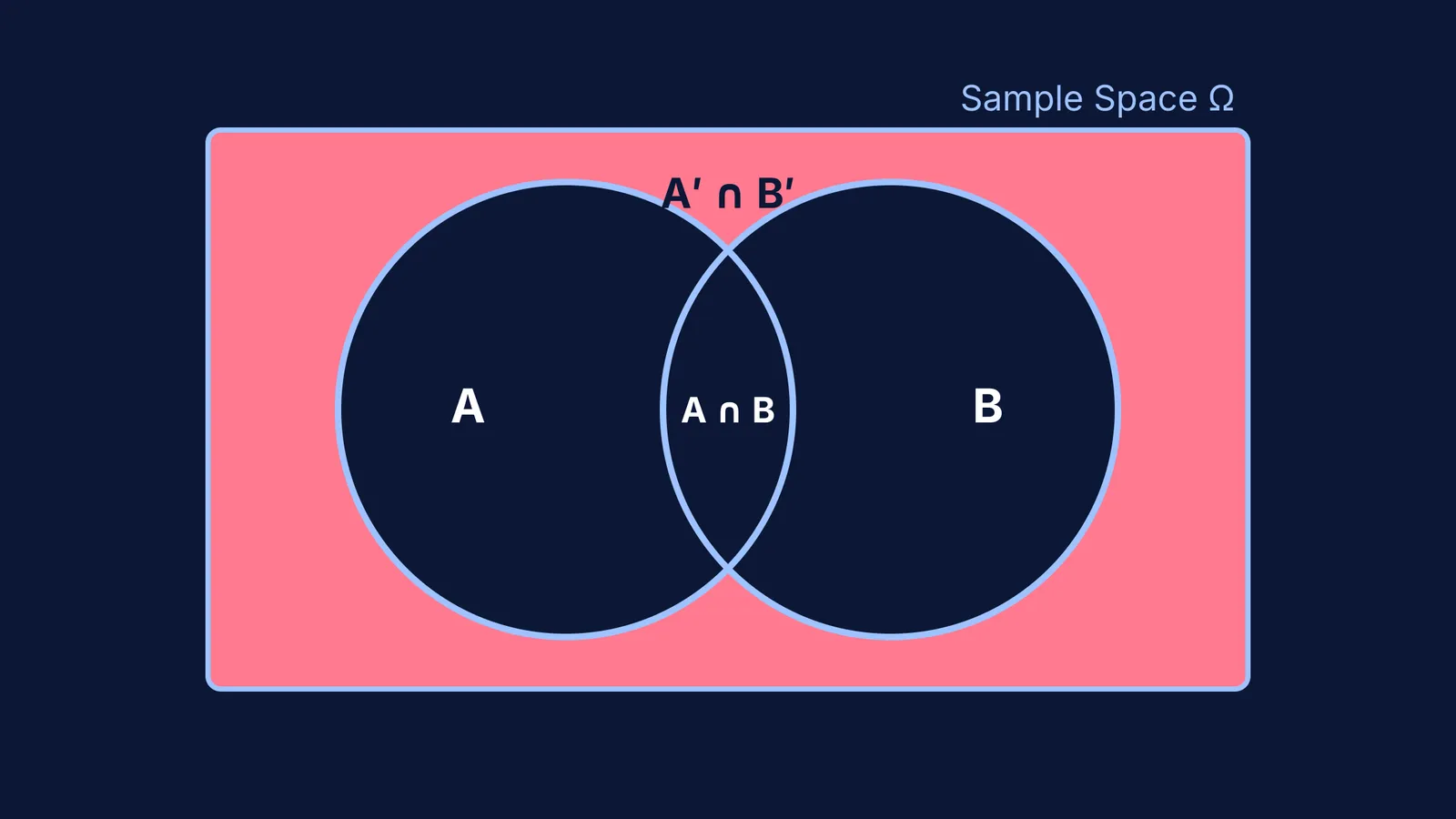
Think of event A as being made up of two mutually exclusive pieces:
The times A happens and B happens too (A ∩ B).
The times A happens and B does not happen (A ∩ B′).
Because these two pieces do not overlap, their probabilities add up to the total probability of A. When dealing with complex intersections, such as three-set Venn problems, breaking the total probability into these non-overlapping pieces is the safest approach.
P(A) = P(A ∩ B) + P(A ∩ B′)
Rearrange this to solve for the intersection of A and B′:
P(A ∩ B′) = P(A) − P(A ∩ B)
Now, substitute the definition of independence for A and B, which gives P(A ∩ B) = P(A)P(B):
P(A ∩ B′) = P(A) − P(A)P(B)
Factor out P(A):
P(A ∩ B′) = P(A)(1 − P(B))
Finally, use the complement rule, where 1 − P(B) equals P(B′):
P(A ∩ B′) = P(A)P(B′)
This proves that A and B′ are independent. By reversing the letters, the exact same steps prove that A′ and B are independent.
Are complements of independent events also independent?
To prove that the complements of both events are independent, we have to show that P(A′ ∩ B′) = P(A′)P(B′). This proof uses De Morgan's laws and the formula for the union of two events.
De Morgan's law states that the intersection of two complements is the complement of their union:
A′ ∩ B′ = (A ∪ B)′
The probability of this complement is 1 minus the probability of the union:
P(A′ ∩ B′) = 1 − P(A ∪ B)
Next, substitute the general addition rule for the union, P(A ∪ B) = P(A) + P(B) − P(A ∩ B):
P(A′ ∩ B′) = 1 − [P(A) + P(B) − P(A ∩ B)]
P(A′ ∩ B′) = 1 − P(A) − P(B) + P(A ∩ B)
Since we are given that A and B are independent, replace P(A ∩ B) with P(A)P(B):
P(A′ ∩ B′) = 1 − P(A) − P(B) + P(A)P(B)
Now, group the terms to factor the expression:
P(A′ ∩ B′) = (1 − P(A)) − P(B)(1 − P(A))
P(A′ ∩ B′) = (1 − P(A))(1 − P(B))
Since 1 − P(A) is P(A′) and 1 − P(B) is P(B′), we have our final result:
P(A′ ∩ B′) = P(A′)P(B′)
This completes the proof. If both original events are independent, their complements are entirely independent of one another.
How is this used in "neither occurs" probability questions?
In exams like JEE Main, probability questions often ask for the chance that a system fails, or that neither of two events happens.
For example, imagine a spacecraft with two independent communication systems. System A has a probability of 0.9 of working (P(A) = 0.9), and System B has a probability of 0.8 of working (P(B) = 0.8). What is the probability that communication fails entirely?
For communication to fail, neither system can work. We need the probability of A′ and B′ occurring at the same time: P(A′ ∩ B′).
Since the systems are independent, we now know that their complements are also independent. This means we can just multiply the probabilities of their failures:
P(A′) = 1 − 0.9 = 0.1
P(B′) = 1 − 0.8 = 0.2
P(A′ ∩ B′) = P(A′) × P(B′) = 0.1 × 0.2 = 0.02
There is a probability of 0.02 that both systems fail. If you aren't sure how to start a problem like this, the Fermi Problem Library has worked problems with a step-by-step solver that explains the reasoning rather than printing an answer.
A checklist for independence problems
When you see the word "independent" in a probability question:
Write down the product rule instantly: P(A ∩ B) = P(A)P(B). This is almost always the key to the solution.
Check for "at least one" or "neither": If the question asks for the probability that neither occurs, you are looking for P(A′ ∩ B′). You can safely calculate this as P(A′)P(B′).
Convert if needed: You might also need to convert odds in favour and odds against into probabilities before multiplying.
Remember the union shortcut: If a question asks for the probability that at least one event occurs, that is P(A ∪ B). The fastest way to find it is often to use complements: P(A ∪ B) = 1 − P(A′ ∩ B′).
Knowing that complements of independent events are also independent allows you to swap between looking at successes and failures without having to prove the relationship every time. If you need a refresher on these axioms, the Fermi Concept Library has every concept in physics, chemistry, biology, mathematics and computing, each with its own lesson and its place in the map.


