

On this page
Fractions are the first numbers we meet that represent relationships rather than counts. A 2012 longitudinal study (Siegler et al., 2012) tracking students in the United States and the United Kingdom found that a 10-year-old's knowledge of fractions and division is the strongest predictor of their high school algebra achievement. This predictive power remains significant even after accounting for IQ and family income. Mastery of fractions at this stage acts as a gatekeeper to higher-level mathematics.
If you are looking at two fractions in Class 6 and need to know which is larger, there are three main ways to check. Knowing when to use each method saves time and stops mistakes before they become ingrained habits.
How do you compare fractions by cross multiplication?
Cross multiplication is the fastest method when you only have two fractions to compare. It works by bringing both fractions to an invisible common denominator and comparing their numerators.
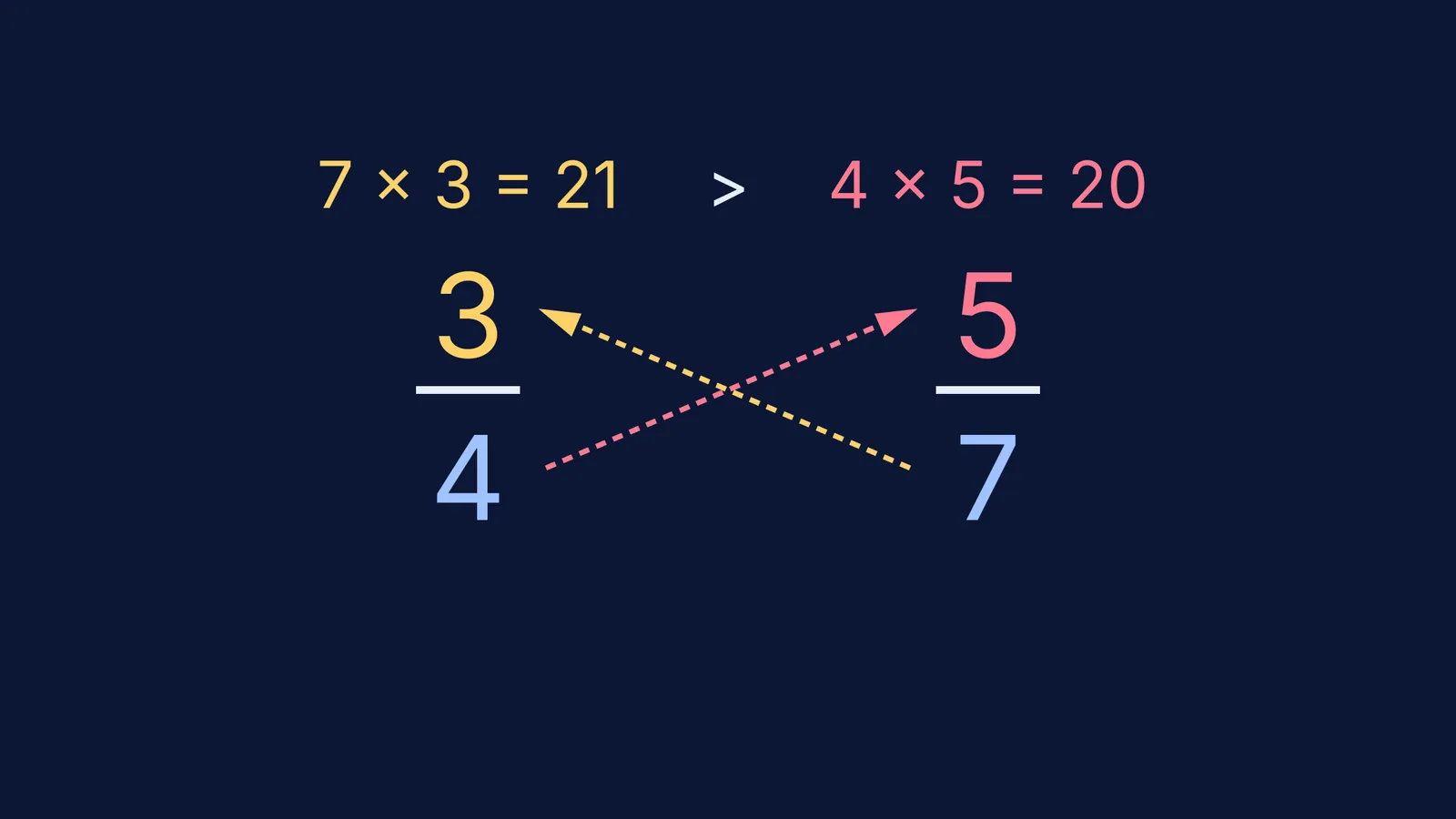
To compare 3/4 and 5/7, follow these simple steps:
Multiply the denominator of the second fraction by the numerator of the first fraction. Here, 7 × 3 = 21. Write 21 above the 3/4.
Multiply the denominator of the first fraction by the numerator of the second fraction. Here, 4 × 5 = 20. Write 20 above the 5/7.
Compare the two products. Because 21 is greater than 20, the first fraction is greater. Therefore, 3/4 is greater than 5/7.
The cross products are exactly what the numerators would be if you wrote both fractions over their common denominator of 28 (which gives 21/28 and 20/28). This trick is reliable, but relying on it exclusively can hide the meaning of the numbers. If you need step-by-step help practicing these fundamentals without losing track of the concepts, the Fermi Problem Library explains the reasoning rather than just printing an answer.
When is comparing by a common denominator better?
Cross multiplication falls apart when you have more than two fractions, or when the numbers are large enough that the multiplication is slow. For example, comparing 7/12, 5/8 and 2/3 with cross products takes three separate comparisons, which leaves plenty of room for arithmetic errors.
Instead, find the lowest common multiple (LCM) of the denominators.
The denominators are 12, 8 and 3. Their lowest common multiple is 24.
Convert each fraction to twenty-fourths by multiplying the top and bottom by the same number:
7/12 = (7 × 2) / (12 × 2) = 14/24
5/8 = (5 × 3) / (8 × 3) = 15/24
2/3 = (2 × 8) / (3 × 8) = 16/24
Now that the pieces are the same size, you simply compare the numerators: 14 < 15 < 16, which means 7/12 < 5/8 < 2/3. This method builds essential algebra skills and is the foundation of working with fractions in Class 7, where you must have common denominators to add and subtract equations.
How do you use 1/2 as a benchmark to compare fractions?
Sometimes you do not need to multiply anything at all. A powerful mental math strategy is to use simple benchmark fractions, usually 1/2, to judge the size of others.
If you are asked to compare 4/9 and 5/8, check them against 1/2:
Look at 4/9. Half of 9 is 4.5, so 4/9 is slightly less than 1/2.
Look at 5/8. Half of 8 is 4, so 5/8 is strictly greater than 1/2.
Therefore, 4/9 must be smaller than 5/8.
Benchmarks train the number sense that the 2012 study identified as so valuable. When a student spots that 9/10 is almost 1, while 1/8 is close to 0, they are estimating relationships exactly as they will need to in physics and chemistry later on. If a student has concept gaps in this kind of numerical estimation, Fermi's AI tutor can work out what they already know and build a plan for the session to review it, so they sit down to a clear next step.
How do you choose a method for ordering three fractions?
To order three fractions efficiently, combine the methods. Use a checklist to choose the most efficient path rather than rushing straight into arithmetic:
Check the numerators and denominators. Are the numerators the same? If so, the fraction with the larger denominator is the smaller piece (e.g., 2/7 < 2/5).
Check against 1/2. Does one fraction sit on the opposite side of 1/2 from the others? If so, you only need to calculate for the remaining ones.
Count the fractions. If there are only two fractions, use cross multiplication for speed.
Find the LCM. If there are three or more fractions and benchmarks do not separate them, find a common denominator and scale the numerators.
Understanding why these rules work makes the transition to algebra much smoother. You can explore more about equivalent fractions and visual models in our detailed guide to fractions in Class 6.


