

On this page
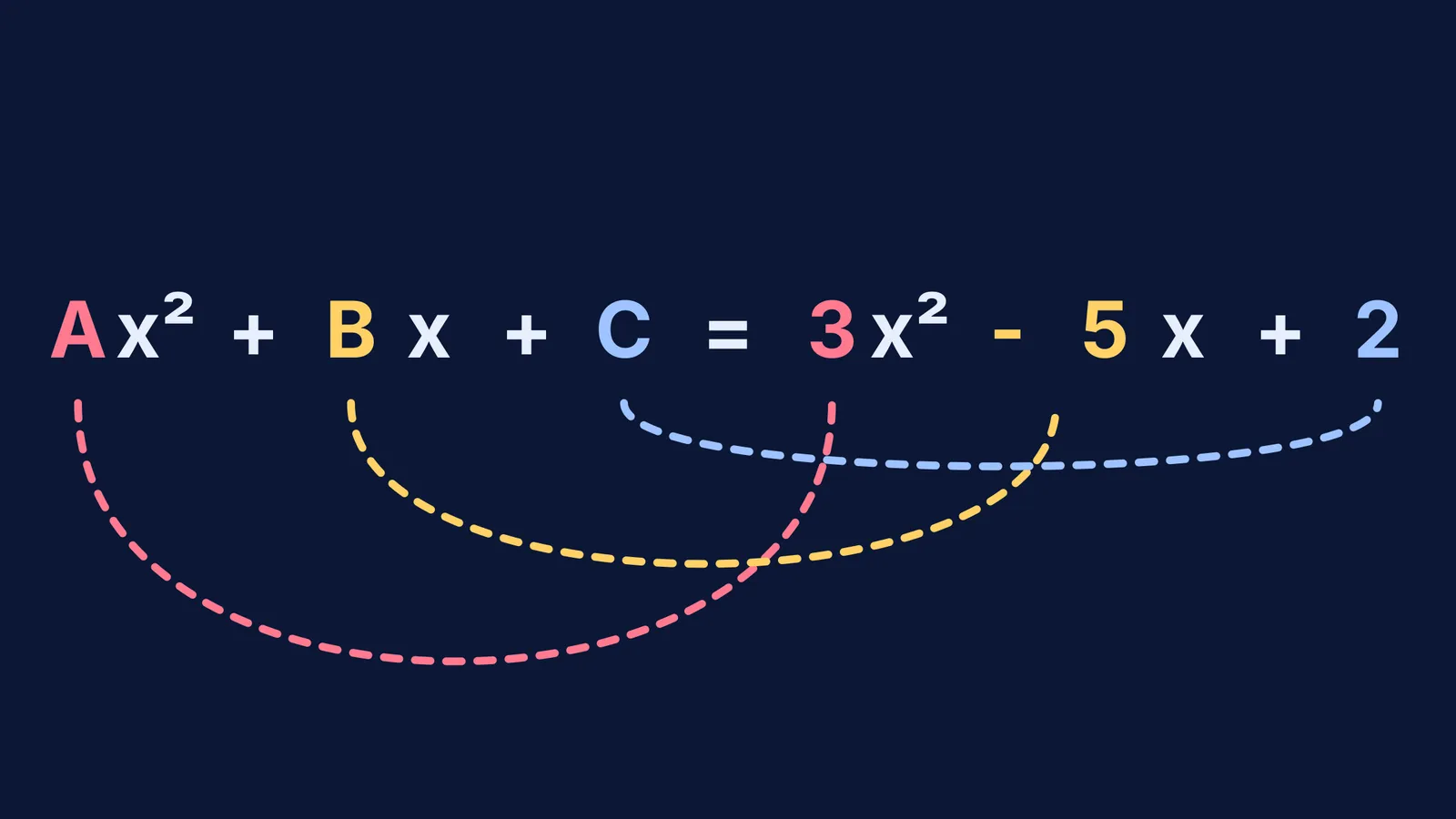
When you have an equation like A x² + B x + C = 3 x² - 5 x + 2 that is true for every value of x, it is not just a regular equation you solve for x. It is an identity. The polynomial identity theorem states that two expressions are identical precisely when their corresponding coefficients are equal for each different power of the variable 1.
This means you can read off the answers directly: A = 3, B = -5, and C = 2.
Equating coefficients is a reliable way to find unknown constants in algebra. While you might first meet it when breaking algebraic fractions into parts, the method is a useful tool for factoring, expanding, and proving identities across mathematics. Unlike counting roots by curve intersections, this method yields exact numerical values for the unknown constants when an identity is known.
What is the polynomial identity theorem?
A polynomial is an expression made of variables and coefficients, like 4 x³ - 2 x + 7. The polynomial identity theorem tells us that if two polynomials of degree n are equal for more than n distinct values of x, they are exactly the same polynomial.
In practice, if an equation is given as an identity—meaning it holds for all x—you do not need to substitute numbers to find the unknowns. You can simply gather the terms with the same powers of x on both sides and set their coefficients equal to each other.
Which is better: comparing coefficients or substituting values?
Consider the identity: 2 x + 5 = A(x - 1) + B(x + 2)
There are two main ways to find A and B.
1. Substituting values You can pick clever values of x to make parts of the equation disappear. If you set x = 1, the A term vanishes: 2(1) + 5 = A(0) + B(1 + 2) 7 = 3 B, so B = 7/3.
If you set x = -2, the B term vanishes, giving A = -1/3.
2. Equating coefficients Instead of picking values, expand the right side: 2 x + 5 = A x - A + B x + 2 B
Group the x terms and the constant terms together: 2 x + 5 = (A + B)x + (-A + 2 B)
Now, match the coefficients of x: 2 = A + B
And match the constants (the terms without x): 5 = -A + 2 B
This gives you a system of linear equations. Substituting values is often faster, but equating coefficients works every time—even when there are no "clever" numbers to plug in that will make brackets disappear. In exams like JEE Main, students often face complex identities where the Fermi Problem Library will walk you through equating coefficients step by step.
How do you find constants in a factorization?
Equating coefficients is especially useful when you need to factor a polynomial and you already know one of the factors.
Suppose you know that (x - 3) is a factor of x³ - 4 x² + x + 6. You can find the remaining quadratic factor by setting up an identity: x³ - 4 x² + x + 6 = (x - 3)(x² + B x + C)
Notice that the x² coefficient inside the bracket must be 1, because x × x² = x³.
Expand the right side: x³ + B x² + C x - 3 x² - 3 B x - 3 C
Group the powers of x: x³ + (B - 3)x² + (C - 3 B)x - 3 C
Now, compare this with the original polynomial x³ - 4 x² + x + 6.
Compare the x² coefficients: -4 = B - 3 B = -1
Compare the constants: 6 = -3 C C = -2
So the remaining factor is x² - x - 2. You can check your work by comparing the x coefficients: does 1 = C - 3 B? Yes, 1 = -2 - 3(-1). The coefficients match perfectly.
Can you complete the square by comparing coefficients?
You can also use this method to rewrite expressions into a desired form, such as completing the square—which is crucial when testing when ax² + bx + c is positive for all x.
Suppose you want to write 2 x² + 12 x + 23 in the vertex form a(x - h)² + k.
Set up the identity: 2 x² + 12 x + 23 = a(x - h)² + k
Expand the right side: a(x² - 2 h x + h²) + k a x² - 2 a h x + a h² + k
Now, equate the coefficients from both sides.
The x² coefficient:
2 = a
The x coefficient:
12 = -2 a h Since a = 2, this becomes 12 = -4 h, so h = -3.
The constant term:
23 = a h² + k Substitute a = 2 and h = -3: 23 = 2(-3)² + k 23 = 18 + k k = 5
The expression is 2(x + 3)² + 5. By setting up an identity and matching terms, you turn algebra problems into a simple checklist. You can explore more algebraic techniques and their underlying concepts in the Fermi Concept Library.


