

On this page
Competitive exams like JEE often test the intersection of sequences. If you try to list out all the common terms in two arithmetic progressions, you will waste valuable time.
An Arithmetic Progression (AP) is a sequence where the difference between consecutive terms is constant. Finding the number of common terms requires just three steps: spotting the first match, calculating the new difference, and setting an upper limit.
How do you find the first common term?
There is no magic formula to find the very first number that belongs to both sequences. The quickest method is to write out the first few terms of the progression with the larger common difference, and then do the same for the other progression until you spot a match.
Consider two sequences:
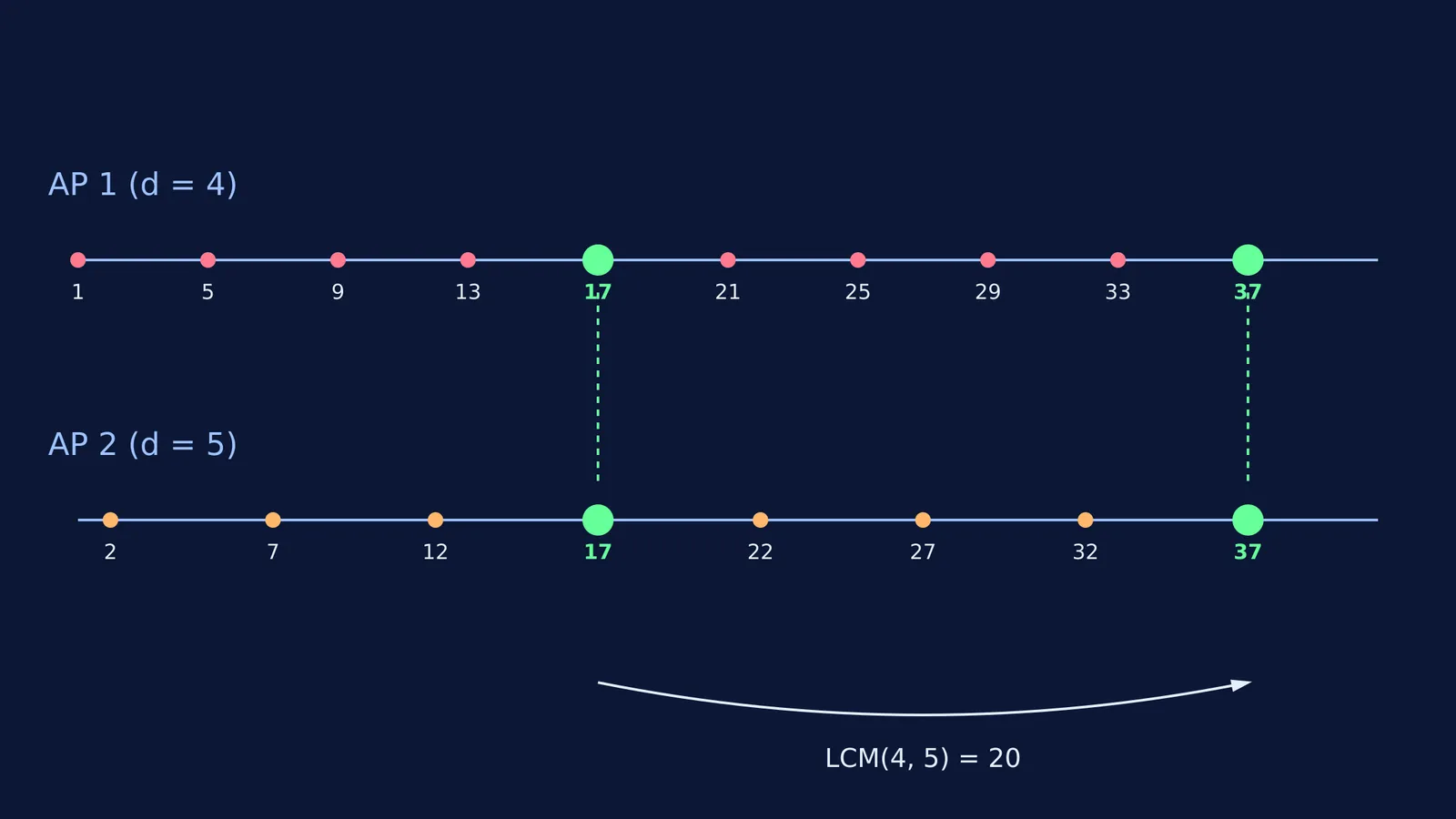
AP 1: 1, 5, 9, 13, 17, 21 (common difference is 4)
AP 2: 2, 7, 12, 17, 22 (common difference is 5)
By expanding both, we see that the first common term is 17. Once you have this anchor, you do not need to list any more terms manually.
If you prefer to solve it algebraically, you can equate the general terms: 1 + (p - 1) × 4 = 2 + (q - 1) × 5, which simplifies to 4p = 5q. Since 4 and 5 share no common factors, the smallest solution is p = 5 and q = 4. Plugging p = 5 into the first sequence gives 1 + 4 × 4 = 17.
What is the common difference of two APs?
The intersection of two arithmetic progressions creates a third arithmetic progression. Its common difference is simply the least common multiple (LCM) of the common differences of the original two sequences.
In our example, AP 1 jumps by 4 and AP 2 jumps by 5. The new sequence of shared terms will jump by the LCM of 4 and 5, which is 20.
Starting from the first common term (17) and adding the new difference (20), the common terms will be 17, 37, 57, 77, and so on.
If you often hit a blank page when setting up these sequences, the Fermi Problem Library has worked problems with a step-by-step solver that explains the reasoning rather than printing an answer.
Why does the LCM method work?
A common term is a number reached by taking steps of 4 in the first sequence and steps of 5 in the second. To jump to the next common term, your distance must be a perfect multiple of both 4 and 5. The smallest such distance is their LCM. If the common differences were 4 and 6, their LCM would be 12. Multiplying them gives 24, which would cause you to skip half the shared terms. Always use the LCM to capture every number.
How many common terms are there?
To count the total number of shared terms, you must find where the sequences stop. The new sequence cannot grow larger than the smallest last term of the two original progressions.
Suppose AP 1 has 100 terms. Its last term is L₁ = 1 + 99 × 4 = 397. Suppose AP 2 has 60 terms. Its last term is L₂ = 2 + 59 × 5 = 297.
The common sequence must stop at or before 297, because AP 2 ends there. Any term larger than 297 might appear in AP 1, but it cannot appear in AP 2. We set up an inequality for the n-th term of our new sequence: 17 + (n - 1) × 20 ≤ 297
Now, solve for n: (n - 1) × 20 ≤ 280 n - 1 ≤ 14 n ≤ 15
There are exactly 15 common terms. Much like inserting arithmetic and geometric means between two numbers, finding the intersection is just a matter of structuring a fresh sequence. If you are reviewing sequence tricks, you might also look at recovering aₙ from a formula for Sₙ.


