

On this page
When you first start studying organic chemistry, you will quickly notice that the smallest and most frequently used carboxylic acids are almost never called by their systematic names. Instead of methanoic or ethanoic acid, textbooks, teachers, and exams refer to formic and acetic acid.
Understanding where these traditional names come from makes them much easier to memorise. Furthermore, mastering the common naming system is essential because it introduces the Greek lettering (α, β, γ) used to describe substituents and reaction sites across all of organic chemistry.
What are the common names of carboxylic acids?
The common names of carboxylic acids often derive from the natural sources where they were first discovered or isolated (Wikipedia). These names were established long before the modern rules of chemical nomenclature were invented, yet they remain so widespread that they are accepted as preferred names today.
The first four straight-chain carboxylic acids are the most important to commit to memory:
Formic acid (1 carbon): The simplest carboxylic acid gets its name from *formica*, the Latin word for ant (Wikipedia). It was originally distilled from the bodies of red ants and is the compound responsible for the sting of an ant bite.
Acetic acid (2 carbons): This name comes from *acetum*, the Latin word for vinegar. Acetic acid is the primary active ingredient in vinegar, giving it its characteristic sour taste and pungent smell.
Propionic acid (3 carbons): Derived from the Greek words *protos* (first) and *pion* (fat), propionic acid was named because it was the smallest acid to exhibit the physical properties of heavier fatty acids.
Butyric acid (4 carbons): The four-carbon acid takes its name from *butyrum*, which is Latin for butter (Wikipedia). It is the compound responsible for the highly unpleasant odor of rancid butter.
Beyond these four, you will also encounter valeric acid (5 carbons, from the valerian plant) and caproic acid (6 carbons, from *caper*, the Latin word for goat, due to its farmyard smell).
How are Greek letters used in carboxylic acids?
When chemists use common names for carboxylic acids, they do not use numbers to indicate the position of a substituent group on the carbon chain. Instead, they use the Greek alphabet.
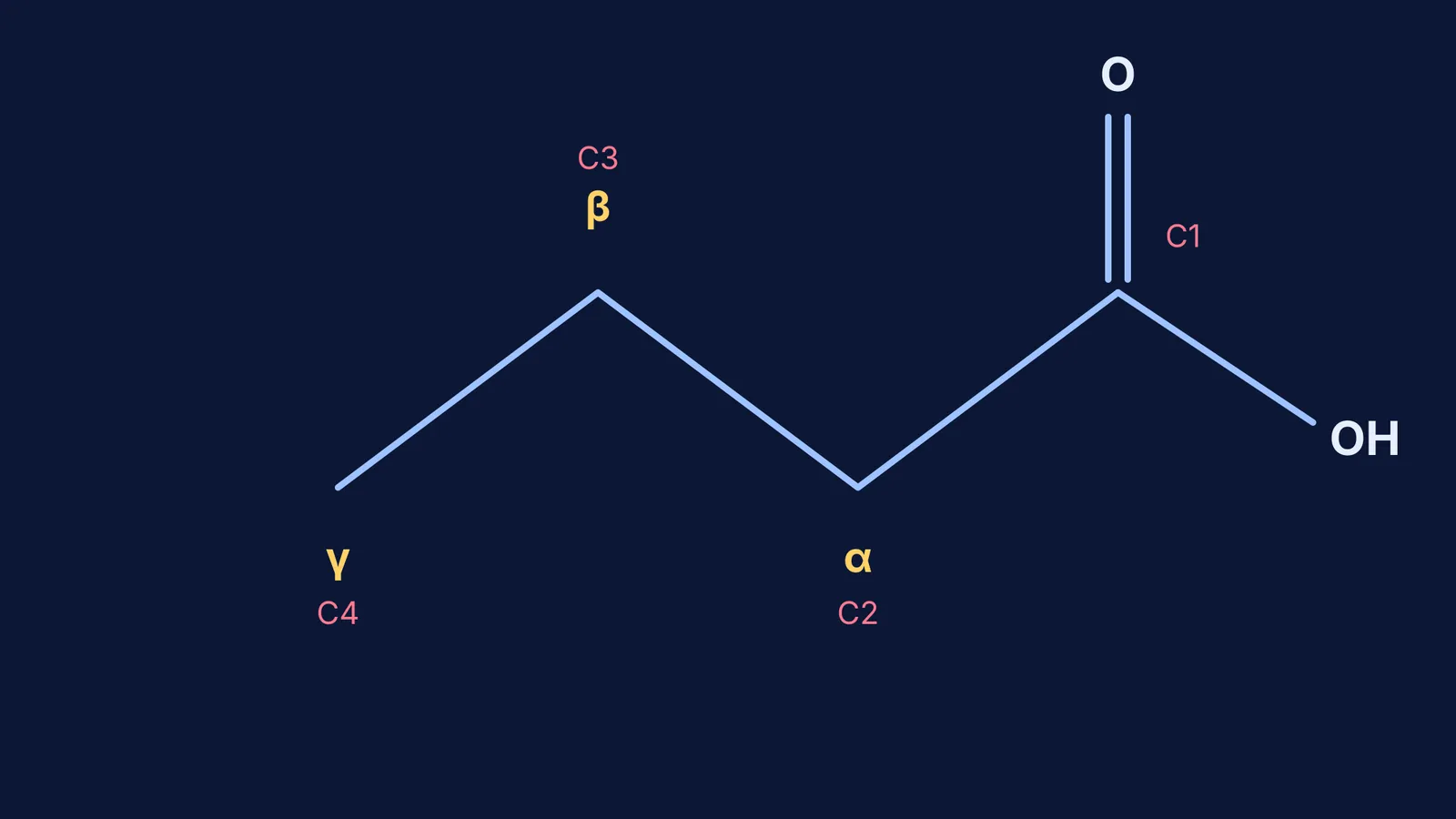
Crucially, the Greek lettering system starts counting from a different place than the modern IUPAC system. In the common nomenclature, Greek letters (α, β, γ, δ) are often used to locate substituents relative to the carboxyl carbon (Wikipedia).
The rules for assigning Greek letters are strictly positional:
The carbon atom directly attached to the carboxyl group is the alpha (α) carbon.
The next carbon down the chain is the beta (β) carbon.
The third carbon away from the carboxyl group is the gamma (γ) carbon.
Because the carboxyl carbon itself is not assigned a Greek letter, the α-carbon corresponds to C2 in the systematic IUPAC nomenclature.
This lettering system is the basis for naming many biochemical compounds and specific organic reactions. For example, the Hell-Volhard-Zelinsky reaction: alpha-halogenation of acids specifically targets this α-carbon to attach a halogen. Another famous example is γ-aminobutyric acid (GABA), a vital neurotransmitter in the human brain, where the amine group is attached to the third carbon away from the carboxyl group.
How do common names compare to IUPAC rules?
It is important to be able to switch comfortably between common names and systematic rules.
Under IUPAC rules, you identify the longest continuous carbon chain that includes the –COOH group. You then replace the parent alkane's "-e" ending with the suffix "-oic acid". If you are naming carbon compounds in Class 10, one of the first rules you learn is that the carboxyl carbon is always assigned as position 1.
This means that butyric acid and butanoic acid are exactly the same molecule. If you attach a hydroxyl group to the α-carbon of propionic acid, you get α-hydroxypropionic acid—better known as lactic acid. In the IUPAC system, this exact same molecule is 2-hydroxypropanoic acid.
The Fermi Concept Library holds every concept in physics, chemistry, biology, mathematics and computing, making it a reliable place to review both common and IUPAC nomenclature rules side by side. If you get stuck trying to identify the correct carbon for an elimination or substitution reaction, the Fermi Problem Library has worked problems with a step-by-step solver that explains the reasoning rather than printing an answer.
Finally, remember that these naming conventions extend to derivatives like esters and salts. In the Fischer esterification: mechanism and how to push the equilibrium, reacting acetic acid with ethanol produces ethyl acetate. If you use the IUPAC name ethanoic acid instead, the product is called ethyl ethanoate.


