

On this page
When forming a committee under constraints, certain candidates cannot be selected simultaneously. A classic problem in combinatorics asks: in how many ways can you select a committee of r members from n candidates if two particular individuals refuse to serve together? Students frequently try to build valid committees candidate by candidate, but this constructive path often leads to overcounting. The cleanest, fastest approach is complementary counting: calculate total unrestricted combinations and subtract the forbidden selections where both individuals appear.
Why is complementary counting the fastest way to solve refusal conditions?
Counting what you do not want is often far simpler than enumerating every valid combination. According to the CBSE Senior Secondary Mathematics Curriculum, selection problems evaluate unordered groups using combinations:
ⁿCᵣ = n! / (r! × (n − r)!)
When two candidates—say Person A and Person B—refuse to serve together, the only invalid outcome is a committee containing both of them. Every other combination is permitted.
To count the invalid selections, pre-assign both Person A and Person B to the committee. With 2 spots filled, you select the remaining (r − 2) members from the remaining (n − 2) candidates. The number of forbidden committees is therefore ⁿ⁻²Cᵣ₋₂.
Subtracting these forbidden cases from total selections gives the master formula:
Valid Selections = ⁿCᵣ − ⁿ⁻²Cᵣ₋₂
This single subtraction condenses the refusal condition into two standard binomial coefficients. The Fermi Problem Library has worked problems with a step-by-step solver that explains the reasoning rather than printing an answer, allowing students to test constraints step by step.
How do you verify the answer using direct mutually exclusive cases?
Under exam pressure, verifying your calculation with an alternate method builds certainty. You can cross-check by partitioning all valid committees into three mutually exclusive scenarios:
Neither Person A nor Person B is selected: Both candidates are removed. You choose all r members from the remaining (n − 2) people, giving ⁿ⁻²Cᵣ ways.
Person A is selected, Person B is excluded: Person A takes 1 seat while Person B is excluded. You choose (r − 1) members from the remaining (n − 2) people, giving ⁿ⁻²Cᵣ₋₁ ways.
Person B is selected, Person A is excluded: By symmetry, Person B takes 1 seat and Person A is excluded, giving ⁿ⁻²Cᵣ₋₁ ways.
Summing these three disjoint cases gives:
Valid Selections = ⁿ⁻²Cᵣ + 2 × ⁿ⁻²Cᵣ₋₁
This additive result equals the complementary subtraction formula. By Pascal's identity, ⁿCᵣ = ⁿ⁻²Cᵣ + 2 × ⁿ⁻²Cᵣ₋₁ + ⁿ⁻²Cᵣ₋₂. Subtracting ⁿ⁻²Cᵣ₋₂ confirms both methods yield identical counts. The Fermi Concept Library covers every concept in physics, chemistry, biology, mathematics and computing, each with its own lesson and its place in the map.
How does this work on a standard exam problem?
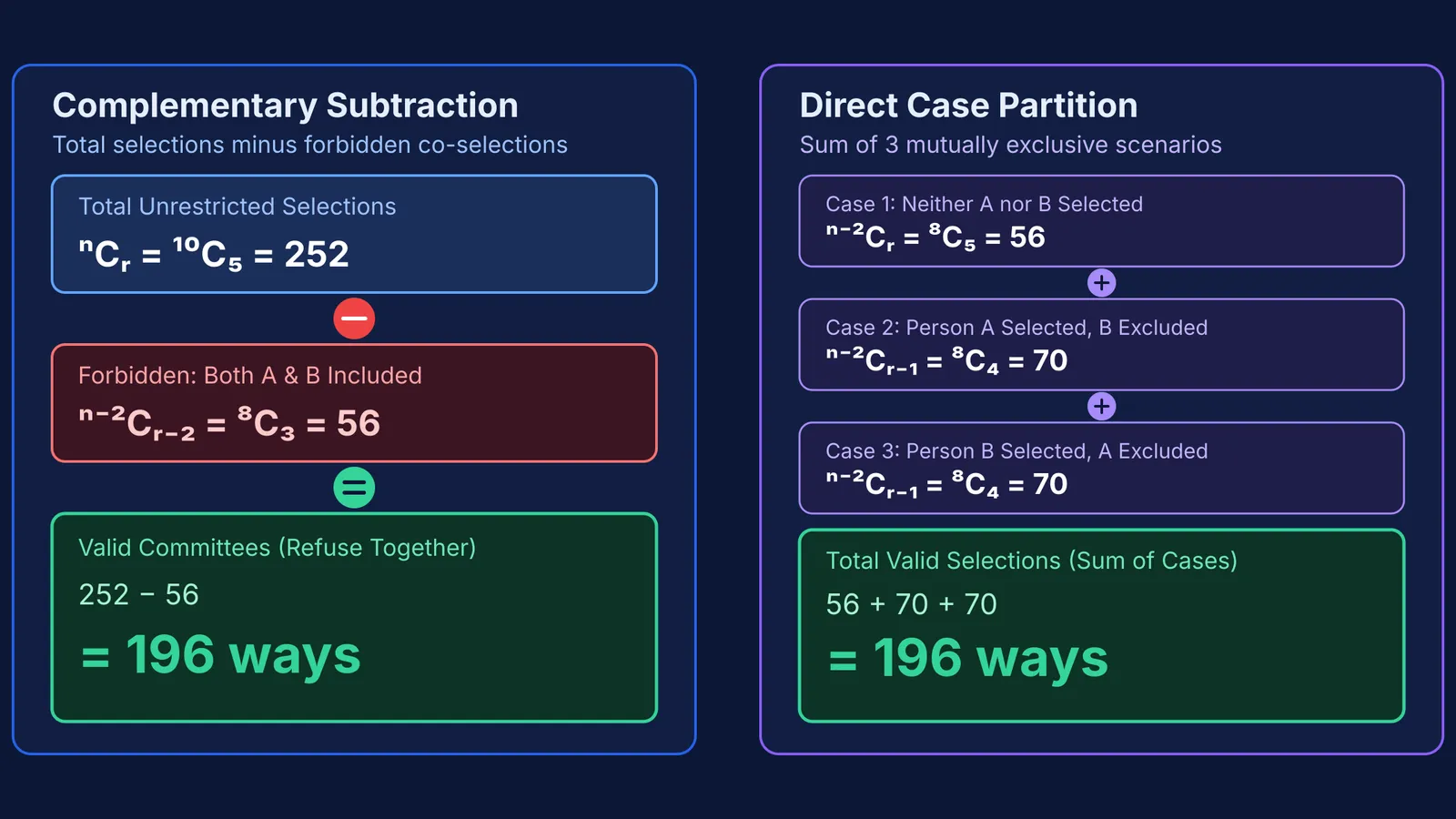
Consider choosing a 5-member committee from 10 candidates where two members refuse to serve together:
Complementary method:
Total unrestricted: ¹⁰C₅ = 252
Forbidden (both included): ⁸C₃ = 56
Valid selections: 252 − 56 = 196
Direct case check:
Neither included: ⁸C₅ = 56
Only Person A: ⁸C₄ = 70
Only Person B: ⁸C₄ = 70
Sum: 56 + 70 + 70 = 196
Now examine a multi-group question from NCERT Exemplar Problems: choosing a committee of 6 from 10 men and 7 women with at least 3 men and 2 women, where two particular women refuse to serve together.
Total unrestricted selections:
3 men and 3 women: ¹⁰C₃ × ⁷C₃ = 120 × 35 = 4,200
4 men and 2 women: ¹⁰C₄ × ⁷C₂ = 210 × 21 = 4,410
Unrestricted total = 4,200 + 4,410 = 8,610
Forbidden selections (both conflicting women included):
3 men and 3 women (2 fixed women + 1 more): ¹⁰C₃ × ⁵C₁ = 120 × 5 = 600
4 men and 2 women (both fixed women): ¹⁰C₄ × ⁵C₀ = 210 × 1 = 210
Forbidden total = 600 + 210 = 810
Valid selections = 8,610 − 810 = 7,800
The direct case check confirms this total: excluding both women yields 3,300 ways (120 × ⁵C₃ + 210 × ⁵C₂), while including exactly one woman yields 4,500 ways (2 × 120 × ⁵C₂ + 2 × 210 × ⁵C₁), summing to 7,800.
What common counting traps lead to incorrect totals?
In research published in The Journal of Mathematical Behavior, Dr. Elise Lockwood demonstrated that students frequently struggle with constrained counting because they treat formulas as algebraic steps rather than models of concrete outcome sets. In refusal problems, three errors recur:
Sequential selection traps: Choosing one allowed candidate first and then drawing from the remaining pool often re-introduces the excluded person, causing hidden duplicates.
Confusing combinations with permutations: Examinations like the JEE Main Mathematics Examination test unordered groups; using permutations multiplies outcomes by redundant factorials. For ordered constraints, see the gap method for arrangements.
Overlooking boundary conditions: In multi-group selections with "at least" requirements, students frequently miss valid extreme partitions. Review our guide on selection problems with combinations, and see our framework for avoiding double counting in permutations and combinations.
Using complementary subtraction as your primary calculation and direct cases as your verification check ensures your solution is accurate and complete.


