

On this page
When you flip a fair coin, the outcome is either heads or tails. But when a coin is tossed three times, keeping track of every combination can get confusing. Questions about multiple coin tosses are a staple in school mathematics and entrance exams, testing your ability to build a sample space before you calculate a probability.
In this guide, we will list the 8 possible outcomes of a three-coin toss, explore why they happen, and walk through the most common exam questions: at least two heads, exactly one tail, and no heads.
What is the sample space for three coin tosses?
A sample space is simply a list of every possible result of an experiment. Each time you toss a coin, there are two possibilities (Heads or Tails). Because each toss is an independent event, you multiply the possibilities together: 2 × 2 × 2 = 2³ = 8 total outcomes.
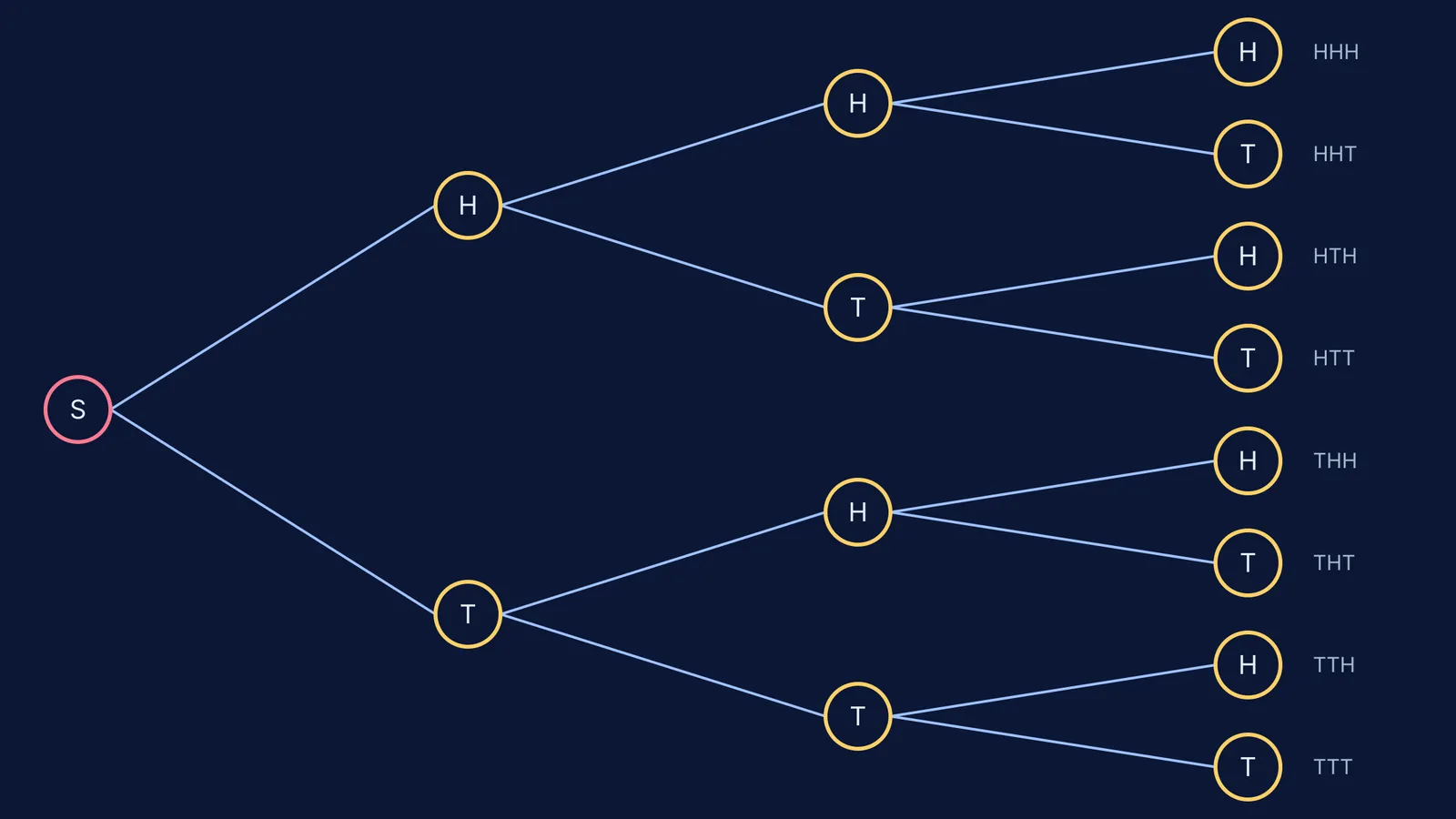
If we let H stand for Heads and T for Tails, the complete sample space for a coin tossed three times is:
HHH
HHT
HTH
HTT
THH
THT
TTH
TTT
A quick way to write this without missing any is to draw a probability tree, branching into two for each toss. If you are ever unsure where to start on a probability problem, mapping out the whole sample space is a solid first step. If you struggle with breaking down problems like this, the Fermi Concept Library offers step-by-step lessons on building sample spaces and calculating probabilities.
Are coin tosses perfectly random?
In standard maths problems, we assume a coin is perfectly fair, giving a 50/50 chance every time. But in the real world, physics gets in the way. A theoretical analysis published in *SIAM Review* by Stanford researchers found a slight dynamical bias: a tossed coin is likely to land on the same face it started on about 51% of the time.
For your exams, however, you can safely ignore air resistance and precession. Unless a question explicitly mentions a "biased coin", you should treat every outcome in the sample space as equally likely. Because there are 8 equally likely outcomes, the probability of any single specific sequence (like HTH) is exactly 1/8.
How to find the probability of at least two heads?
"At least" and "at most" are the most common traps in probability questions. "At least two heads" means the outcome must contain two heads, or three heads, but not fewer.
First, look at the sample space.
Pick out the outcomes with exactly two heads: HHT, HTH, and THH.
Pick out the outcomes with three heads: HHH.
Count them up: there are 4 favourable outcomes.
The probability is the number of favourable outcomes divided by the total outcomes: 4/8, which simplifies to 1/2.
What is the probability of exactly one tail?
This question asks for a very specific condition. You are looking for outcomes that have one tail and, by definition, two heads.
Scanning the list, the outcomes with exactly one tail are HHT, HTH, and THH.
There are 3 favourable outcomes out of the total 8. So, the probability of exactly one tail is 3/8. Notice that this is the same group of outcomes as "exactly two heads" — just phrased differently.
If you are practising these wordings and get stuck on how they change the counting, a tool like Fermi's AI tutor can work out what you already know and build a plan for the session, catching small misinterpretations before they turn into exam mistakes.
What is the probability of getting no heads?
Getting "no heads" across three tosses means getting a tail on the first toss, a tail on the second, and a tail on the third.
There is only one outcome in our sample space that fits this description: TTT.
Because there is 1 favourable outcome out of 8, the probability is 1/8. You can also calculate this using the multiplication rule for independent events: the chance of a tail is 1/2, so the chance of three tails in a row is (1/2) × (1/2) × (1/2) = 1/8.
Mastering these basic counting rules opens the door to more complex exam topics. If you want to see how these methods apply to drawing cards or pulling marbles from a bag, read our guide on with and without replacement probability problems. And if a question asks for the "odds" instead of the probability, check out how to calculate odds in favour and odds against.


