

On this page
In the systematic qualitative analysis of cations, identifying a specific metal ion is a process of elimination followed by a final, unambiguous proof. Cobalt belongs to Group IV of the cation scheme, alongside nickel, manganese, and zinc. These metals are precipitated as sulphides by passing hydrogen sulphide gas through an ammoniacal solution. After filtering out the black cobalt sulphide (CoS) precipitate, the next step is to dissolve it in aqua regia. This gives you a clear solution containing cobalt(II) ions, ready for testing. Because nickel also forms a black sulphide and behaves similarly, you need a highly specific test to prove that you are looking at cobalt. The ammonium thiocyanate test_thiocyanate), followed by an organic extraction, is a reliable way to do this.
What happens during the thiocyanate test?
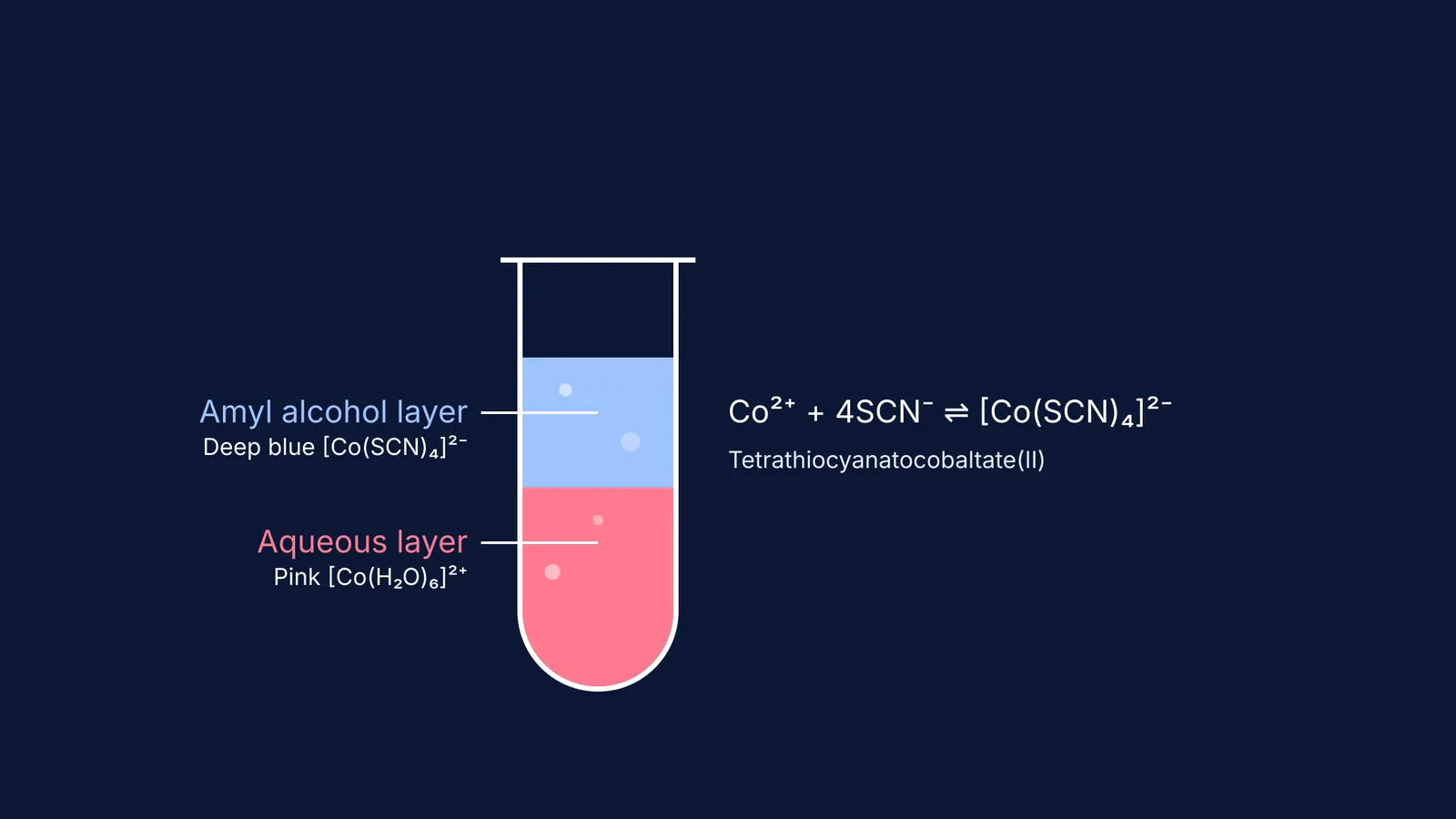
When you add solid ammonium thiocyanate (NH₄SCN) to the aqueous cobalt(II) solution, a substitution reaction begins. The SCN⁻ ions act as ligands, displacing the water molecules that naturally hydrate the cobalt ion. This forms the tetrathiocyanatocobaltate(II) complex:
Co²⁺ + 4 SCN⁻ ⇌ [Co(SCN)₄]²⁻
In an aqueous solution, this chemical equilibrium heavily favours the left side. The cobalt remains as the pink hexaaquacobalt(II) complex, [Co(H₂O)₆]²⁺. Water is a highly polar solvent that easily disrupts the tetrahedral [Co(SCN)₄]²⁻ complex. Because of this, adding thiocyanate alone to water often results in a faint pink or pale blue colour that is hard to read confidently, especially if the cobalt concentration is low. To make the colour distinct, you need an environment where the blue complex is stable.
Why do we add amyl alcohol?
Amyl alcohol (or isoamyl alcohol) is a weakly polar organic solvent that does not mix with water. The blue [Co(SCN)₄]²⁻ complex, particularly when paired with ammonium ions to form the neutral salt (NH₄)₂[Co(SCN)₄], is significantly more stable and highly soluble in the organic phase than in water.
When you add a few millilitres of amyl alcohol to the test tube and shake it vigorously, you perform a solvent extraction. The blue complex leaves the hostile aqueous environment and dissolves into the organic solvent. Because amyl alcohol has a lower density than water, it floats to the top as a separate layer. As the complex is pulled into the alcohol, Le Chatelier's principle drives the equilibrium further to the right, converting more of the pink cobalt ions into the blue complex.
How do you handle interference from iron?
If you are reviewing qualitative analysis for your exams, the Fermi Concept Library contains every concept in physics, chemistry, biology, mathematics and computing, each with its own lesson and its place in the map. This can help you trace the logic of these complex formations and how to troubleshoot them. One crucial detail you will find is that iron(III) ions are a major source of interference in this test.
If iron (Fe³⁺) is present in your original sample, it also reacts with the thiocyanate ions. Instead of turning blue, iron forms a deep blood-red complex, [Fe(SCN)₃]. This intense red colour easily overpowers and masks the blue of the cobalt complex. To solve this, chemists use a masking agent. By adding a small amount of solid sodium fluoride (NaF) or ammonium fluoride to the solution before the thiocyanate, you can neutralise the iron. The fluoride ions bind tightly to the iron(III), forming the highly stable and colourless hexafluoroferrate(III) complex, [FeF₆]³⁻. This traps the iron, preventing it from reacting with the thiocyanate and leaving the blue cobalt layer clearly visible.
A step-by-step framework for the confirmatory test
When performing the test in the laboratory, following a precise sequence ensures that the chemical equilibria work in your favour. Keep this checklist in mind:
Dissolve the precipitate: Treat the black Group IV precipitate with aqua regia, evaporate it to dryness to remove excess acid, and extract the residue with a small volume of water.
Mask the interferences: If you suspect iron is present, add a pinch of solid sodium fluoride or ammonium fluoride.
Add the complexing agent: Add a few crystals of solid ammonium thiocyanate to the solution. A high concentration of thiocyanate helps drive the initial equilibrium forward.
Extract the complex: Add a few millilitres of amyl alcohol to the mixture.
Shake and settle: Shake the test tube vigorously to maximize the surface area between the two liquids, then let it stand. A rich blue colour in the upper organic layer confirms the presence of cobalt.
If you are reviewing other analysis techniques, you might also find our guides on ICSE analytical chemistry: NaOH and NH4OH tests for metal ions and Lassaigne's test: detecting nitrogen, sulphur and halogens helpful.


