

On this page
Ask for the circle that touches both axes and passes through (2, 1), and the correct answer is two equations. Many students write one. The reason is a quadratic.
What is the equation of a circle touching both coordinate axes?
A circle is all points in a plane at a fixed distance r (the radius) from a given point (h, k) (the centre), and its standard form is (x − h)² + (y − k)² = r², as OpenStax Intermediate Algebra 2e sets out. The same chapter gives the general form x² + y² + ax + by + c = 0.
A circle touches an axis when the distance from its centre to that axis equals the radius. The distance from (h, k) to the x-axis is |k|, and to the y-axis it is |h|. So:
Touches the x-axis: |k| = r, so (x − h)² + (y − k)² = k².
Touches the y-axis: |h| = r, so (x − h)² + (y − k)² = h².
Touches both axes: |h| = |k| = r, so the centre is (±r, ±r).
The signs tell you the quadrant. Radius 3 gives four circles:
First quadrant: (x − 3)² + (y − 3)² = 9
Second quadrant: (x + 3)² + (y − 3)² = 9
Third quadrant: (x + 3)² + (y + 3)² = 9
Fourth quadrant: (x − 3)² + (y + 3)² = 9
Why are there two circles through a given point?
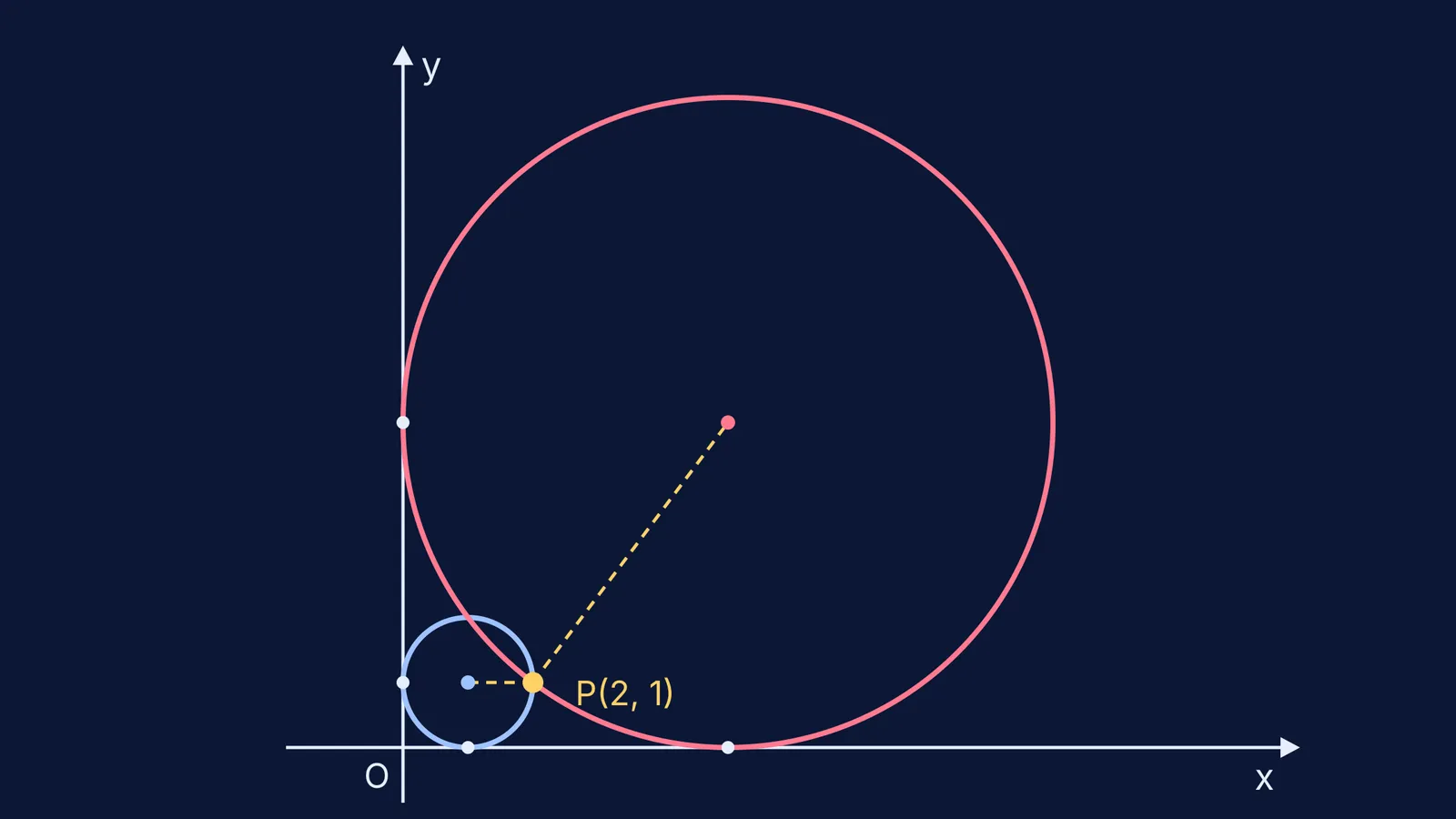
Find the circle that touches both axes and passes through P(2, 1).
P is in the first quadrant, so the centre is (r, r).
The distance from centre to P is r: (2 − r)² + (1 − r)² = r².
Multiply out: 4 − 4r + r² + 1 − 2r + r² = r², which gives r² − 6r + 5 = 0.
Factorise: (r − 1)(r − 5) = 0, so r = 1 or r = 5.
Both radii are positive, so both count: (x − 1)² + (y − 1)² = 1 and (x − 5)² + (y − 5)² = 25.
Check: (2 − 1)² + (1 − 1)² = 1, and (2 − 5)² + (1 − 5)² = 9 + 16 = 25.
This is no coincidence. For any point (p, q) with p and q positive, the condition becomes r² − 2(p + q)r + (p² + q²) = 0. Its discriminant is 4(p + q)² − 4(p² + q²) = 8pq, which is positive whenever the point is off the axes, so there are always two circles. If the point is on an axis, pq = 0 and the two circles become one.
How do you find a circle that touches one axis and passes through a point?
Touching one axis is one condition, so you need another, often the radius: radius 5, touches the x-axis, passes through (1, 2).
The point is above the x-axis, so the centre is too: (h, 5).
(1 − h)² + (2 − 5)² = 25, so (1 − h)² = 16.
1 − h = ±4, so h = −3 or h = 5.
Two circles again: (x + 3)² + (y − 5)² = 25 and (x − 5)² + (y − 5)² = 25. The second also touches the y-axis; it is the larger circle through P(2, 1).
What should you check before writing the final answer?
Mark the quadrant of every given point.
Write the centre with matching signs: (±r, ±r) for both axes, (h, ±r) for the x-axis, (±r, k) for the y-axis.
Solve the quadratic completely and keep every root that gives a positive radius.
Put the point back into each final equation.
Count your answers: both axes plus a point off the axes means two circles.
If step 3 is where your answers go wrong, the Fermi Problem Library has worked problems with a step-by-step solver that explains the reasoning rather than printing an answer. If the gap is why touching means distance equals radius, the Fermi Concept Library gives each concept its own lesson.
How does this connect to other circle problems?
Turning each condition into an equation is also how you find the centre and radius of a circle through three given points, and it carries over to tangents, chords and families of circles in coordinate geometry. For pacing these questions, read our approach to the JEE Main mathematics paper.
When "touches both axes" gives you one circle, look for the root you dropped.


