

On this page
Coordinate geometry questions often give you the two ends of a diameter instead of the centre and radius. You can work out the midpoint and radius first, or write the answer in one line.
What is the diameter form of a circle's equation?
Let A(x₁, y₁) and B(x₂, y₂) be the ends of a diameter. Then the circle is:
(x − x₁)(x − x₂) + (y − y₁)(y − y₂) = 0
Each bracket pairs a variable with the matching coordinate of one endpoint, and the right-hand side is 0, not r².
The form you already know comes from the definition. In the NCERT Class 11 chapter on conic sections, a circle is the set of all points in a plane that are equidistant from a fixed point, and the circle with centre (h, k) and radius r is (x − h)² + (y − k)² = r². The diameter form is the same circle written another way.
Why does the angle in a semicircle prove it?
Book III, Proposition 31 of Euclid's Elements says that in a circle the angle in the semicircle is right (Euclid's Elements, III.31, Clark University edition). So if P(x, y) is any point on the circle other than A and B, the lines PA and PB meet at 90°.
Now turn that into algebra. The NCERT Class 11 chapter on straight lines shows that two non-vertical lines are perpendicular if and only if the product of their slopes is −1.
Slope of PA = (y − y₁)/(x − x₁).
Slope of PB = (y − y₂)/(x − x₂).
Perpendicular, so their product is −1: (y − y₁)(y − y₂) / [(x − x₁)(x − x₂)] = −1.
Multiply across: (y − y₁)(y − y₂) = −(x − x₁)(x − x₂).
Move everything to one side: (x − x₁)(x − x₂) + (y − y₁)(y − y₂) = 0.
Two gaps remain, and both close. Putting x = x₁, y = y₁ makes both products zero, so A and B satisfy the equation. If PA is vertical, PB is horizontal (or the other way round), so again both products are zero.
How do you check it against the centre-radius form?
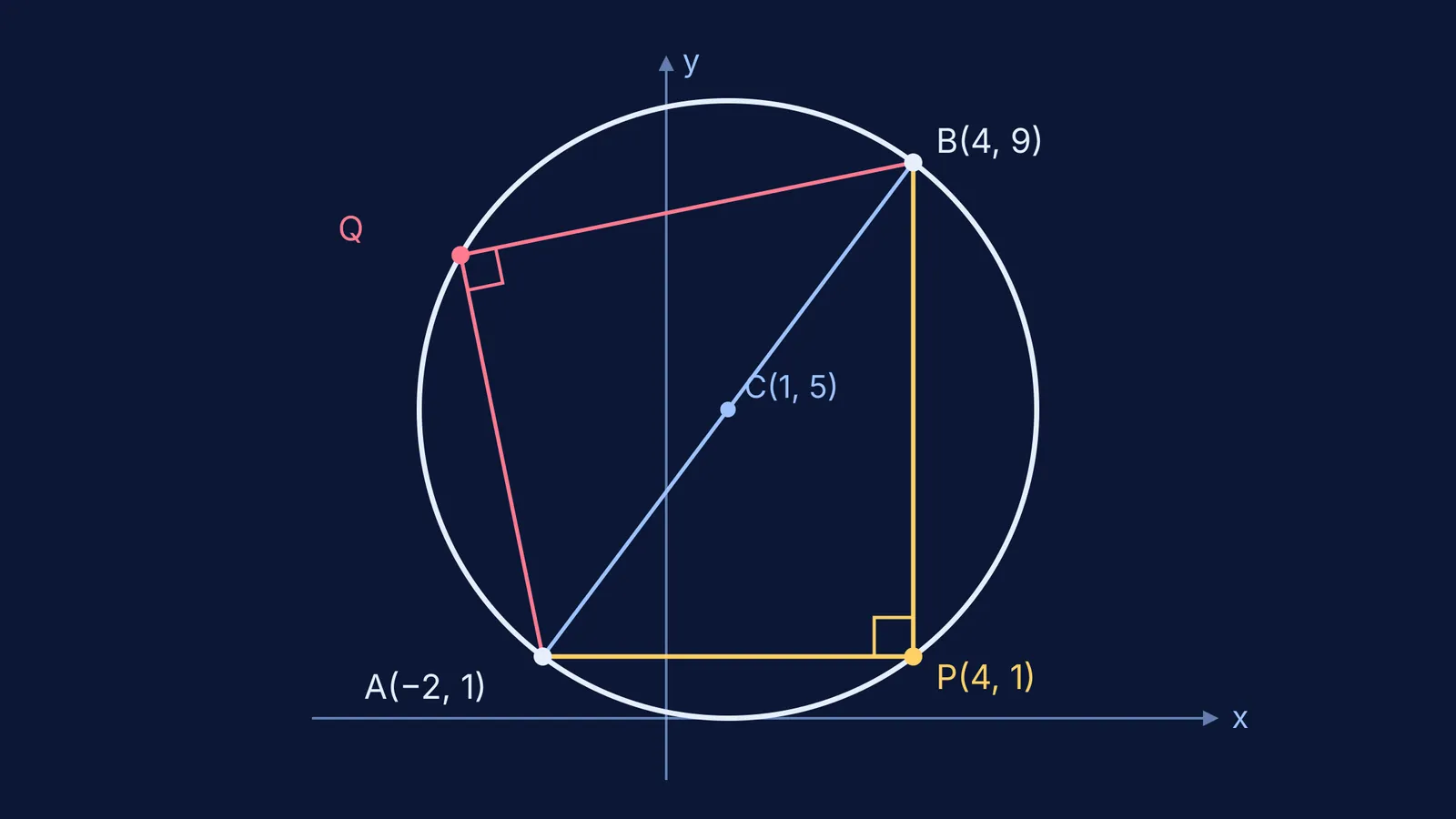
Take A(−2, 1) and B(4, 9), the points in the diagram above.
Diameter form:
(x + 2)(x − 4) + (y − 1)(y − 9) = 0
x² − 2x − 8 + y² − 10y + 9 = 0
x² + y² − 2x − 10y + 1 = 0
Centre-radius form: the centre is the midpoint, ((−2 + 4)/2, (1 + 9)/2) = (1, 5). AB = √(6² + 8²) = 10, so r = 5.
(x − 1)² + (y − 5)² = 25
x² − 2x + 1 + y² − 10y + 25 = 25
x² + y² − 2x − 10y + 1 = 0
Both methods give the same equation. Test one point too: P(4, 1) gives 9 + 16 = 25, so it lies on the circle, and from P, PA runs straight left while PB runs straight up.
The check works for any endpoints. Expand the diameter form and complete the square, as the NCERT chapter does in its centre-and-radius example. You get centre ((x₁ + x₂)/2, (y₁ + y₂)/2) and r² = ((x₁ − x₂)/2)² + ((y₁ − y₂)/2)²: half of AB, squared.
Where do students lose marks on this?
Sign slips. If x₁ = −2, the bracket is (x + 2). Write (x − (−2)) first if you rush.
Mixing coordinates. Pairing x with y₁, or writing (x − x₁)(y − y₁), gives a different curve.
Writing = r². The diameter form is set equal to 0.
Using it for any chord. The form needs AB to be a diameter. A chord that is not a diameter does not fix a unique circle, and the right-angle argument does not hold.
How should you practise this form?
Derive it once yourself from the slope condition, without notes.
Solve three questions both ways, diameter form and midpoint-radius, and compare the expanded equations.
Then do mixed questions where you first decide whether the given points form a diameter, a chord, or three points on the circle.
For the three-point case, see the circle through three given points. For tangents and chords, read circles in coordinate geometry. To revisit the semicircle theorem, see Class 9 circles: chords, arcs and cyclic quadrilaterals.
If your answer and the book's answer differ and you cannot see why, the Fermi Problem Library has worked problems with a step-by-step solver that explains the reasoning rather than printing an answer. To go back over slopes, midpoints or the general equation of a circle, each has its own lesson in the Fermi Concept Library.


