

On this page
The intercept a circle makes on an axis is the length of the chord it cuts off on that axis. One line of algebra gives the answer, and one sign slip gives a wrong answer that still looks reasonable. Here are both formulas, where they come from, and what happens when the circle only touches an axis or misses it.
What is the formula for the intercept on the x-axis and y-axis?
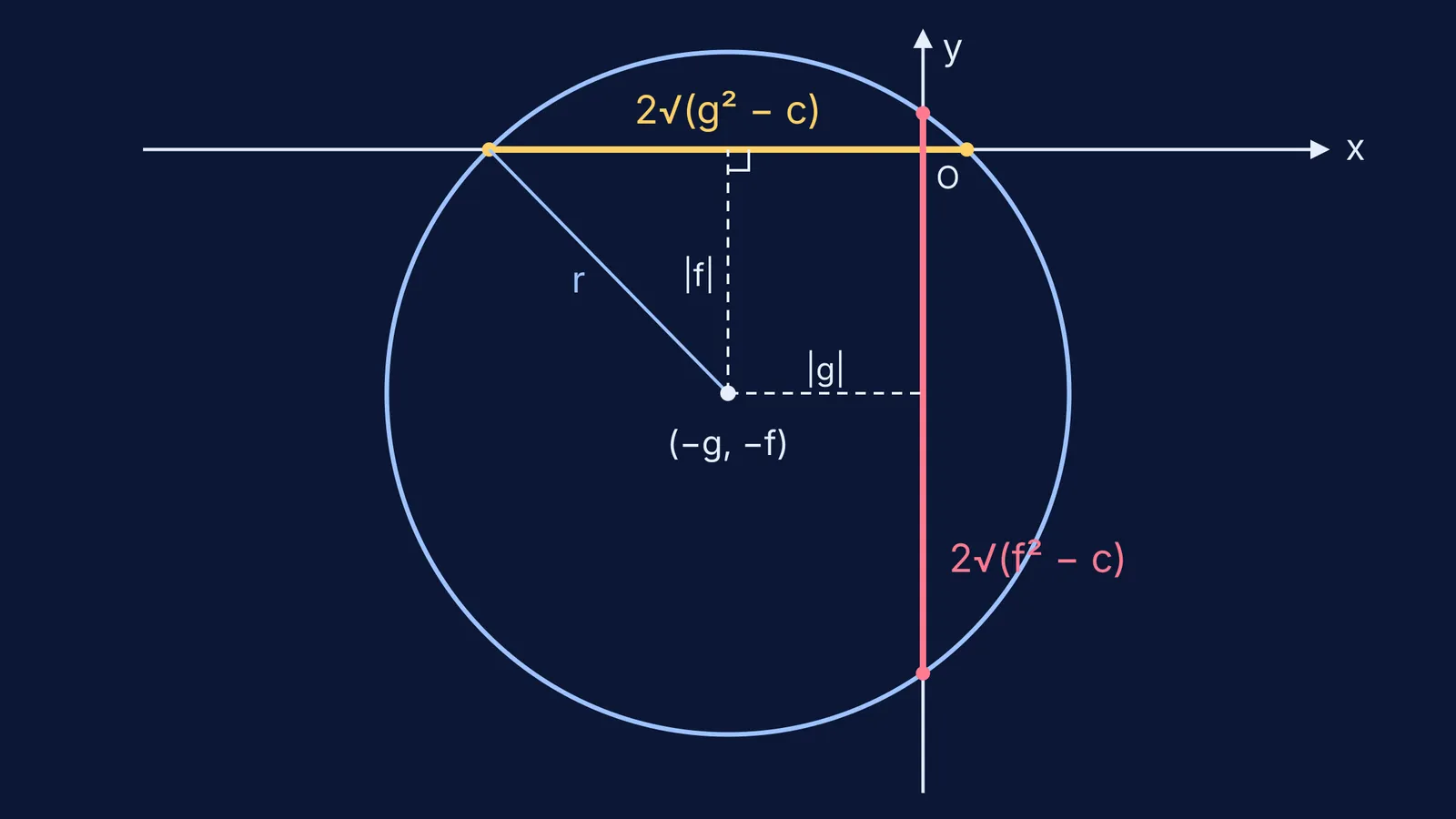
Write the circle in general form, x² + y² + 2gx + 2fy + c = 0. Completing the square, the method NCERT uses in Example 3 of its Class 11 chapter on conic sections, turns this into (x + g)² + (y + f)² = g² + f² − c. So the centre is (−g, −f) and the radius is √(g² + f² − c).
The x-axis intercept of x² + y² + 2gx + 2fy + c = 0 is 2√(g² − c), and the y-axis intercept is 2√(f² − c), as listed in this summary of circle intercepts on Careers360.
The x-axis formula uses g, which goes with x; the y-axis formula uses f.
Why is the intercept 2√(g² − c)?
The algebra route. Put y = 0 to get x² + 2gx + c = 0. Its roots x₁ and x₂ are where the circle crosses the axis, and x₁ + x₂ = −2g and x₁x₂ = c. The chord length is |x₁ − x₂| = √((x₁ + x₂)² − 4x₁x₂) = √(4g² − 4c) = 2√(g² − c).
The geometry route. The centre (−g, −f) is at a distance |f| from the x-axis. Drop a perpendicular from the centre to the chord. It cuts the chord in half and gives a right triangle with hypotenuse r. So half the chord is √(r² − f²) = √(g² − c), the same answer, as the diagram above shows.
For the y-axis, put x = 0 instead: y² + 2fy + c = 0 gives 2√(f² − c).
A worked example from NCERT
Take the circle from NCERT's Example 3, x² + y² + 8x + 10y − 8 = 0, which the textbook shows has centre (−4, −5) and radius 7.
Read off the coefficients: 2g = 8, so g = 4; 2f = 10, so f = 5; c = −8.
x-axis intercept: 2√(g² − c) = 2√(16 + 8) = 2√24 = 4√6.
y-axis intercept: 2√(f² − c) = 2√(25 + 8) = 2√33.
Check with geometry: the centre is 5 units from the x-axis, so half the chord is √(49 − 25) = √24. That matches step 2.
What if the circle touches or does not cut an axis?
The quantity under the root tells you, because g² − c is a quarter of the discriminant of x² + 2gx + c = 0. For the x-axis:
g² > c: two real roots, so the circle cuts the x-axis at two points and the intercept is 2√(g² − c).
g² = c: one repeated root, so the circle touches the x-axis. The intercept is zero and the axis is a tangent.
g² < c: no real roots, so the circle does not meet the x-axis. There is no intercept.
The Careers360 page works the last case for x² + y² + 4x − 4y + 7 = 0, where the formula gives 2√(−3), so there is no x-intercept. For the y-axis, use f² instead. Geometrically, the circle touches an axis when the centre's distance to it equals the radius, and misses it when that distance is larger.
One circle shows both cases: x² + y² − 6x − 4y + 9 = 0. Here g = −3, f = −2 and c = 9, so the centre is (3, 2) and the radius is 2. For the x-axis, g² − c = 0: the circle touches it, since the centre is 2 above it. For the y-axis, f² − c = −5: the circle misses it, since the centre is 3 away.
Quick checks before you mark the answer
Coefficient check. x² and y² must have coefficient 1. For 2x² + 2y² − x = 0 (NCERT Exercise 10.1, question 9), divide by 2 first.
Halving check. g is half the coefficient of x: with 8x, g = 4.
Sign check. The sign of g does not matter, because it is squared. The sign of c always matters.
Origin check. If c = 0, the circle passes through the origin and the intercepts are 2|g| and 2|f|.
Size check. No intercept can be longer than the diameter, 2r.
For practice, the Fermi Problem Library has worked problems with a step-by-step solver that explains the reasoning, so you can see where a sign went wrong. If completing the square feels shaky, the Fermi Concept Library gives each concept its own lesson and its place in the map.
To go further, read our guide to circles in coordinate geometry: tangents, chords and families, learn how to find a circle through three given points, and revise distances in straight-line coordinate geometry, which extend the centre-distance check to any chord.


