

On this page
Compound interest means you earn interest not just on your initial money (the principal), but also on the interest that has already piled up, as the U.S. Securities and Exchange Commission explains in its guide to the Rule of 72. Because the pile grows faster and faster, your money follows a curve rather than a straight line.
If an exam question or a financial plan says your money doubles in n years, it gives you enough information to find the exact interest rate. It also tells you what will happen over the next n years.
What is the exact formula when money doubles?
According to Wikipedia, the formula for the total amount A under compound interest is A = P(1 + r/100)ⁿ, where P is the principal, r is the annual percentage rate, and n is the number of years.
If the money doubles, the final amount is twice the principal (A = 2P). Putting this into the formula gives:
2P = P(1 + r/100)ⁿ
The P cancels out on both sides, which means the time it takes to double does not depend on how much money you started with. You are left with:
2 = (1 + r/100)ⁿ
To find the interest rate r, you take the nth root of both sides (or raise both sides to the power of 1/n):
2^(1/n) = 1 + r/100
r = 100 × (2^(1/n) − 1)
If money doubles in five years, the exact rate is 100 × (2^(1/5) − 1), which is 14.87 percent.
How do you estimate the rate quickly?
Taking the fifth or tenth root of 2 is difficult without a calculator. For mental math or multiple-choice questions, the financial world uses a shortcut called the Rule of 72.
The U.S. Securities and Exchange Commission notes that by dividing 72 by the annual rate of return, investors can get a rough estimate of how many years it will take for an investment to double.
You can also run the rule in reverse. If an investment doubles in eight years, you divide 72 by 8. The estimated interest rate is 9 percent. The exact mathematical answer is 9.05 percent, so the rule gets you very close to the truth. The number 72 is chosen because it divides easily by many common numbers like 2, 3, 4, 6, 8, 9, and 12.
What happens with continuous compounding?
The standard formula assumes interest is added once a year. If interest is added continuously—every possible instant—the math changes. According to Wikipedia, continuous compounding uses the mathematical constant e instead of discrete periods.
The formula becomes A = Pe^(rt), where r is the rate expressed as a decimal. When the money doubles, 2P = Pe^(rt), which simplifies to 2 = e^(rt).
Taking the natural logarithm of both sides gives ln(2) = rt. Because the natural logarithm of 2 is approximately 0.693, the exact formula for doubling time becomes t = 0.693 / r.
This leads to the Rule of 69.3. When dealing with continuous compounding, you divide 69.3 by the percentage rate to find the exact doubling time. For annual compounding, 72 remains the better and easier approximation.
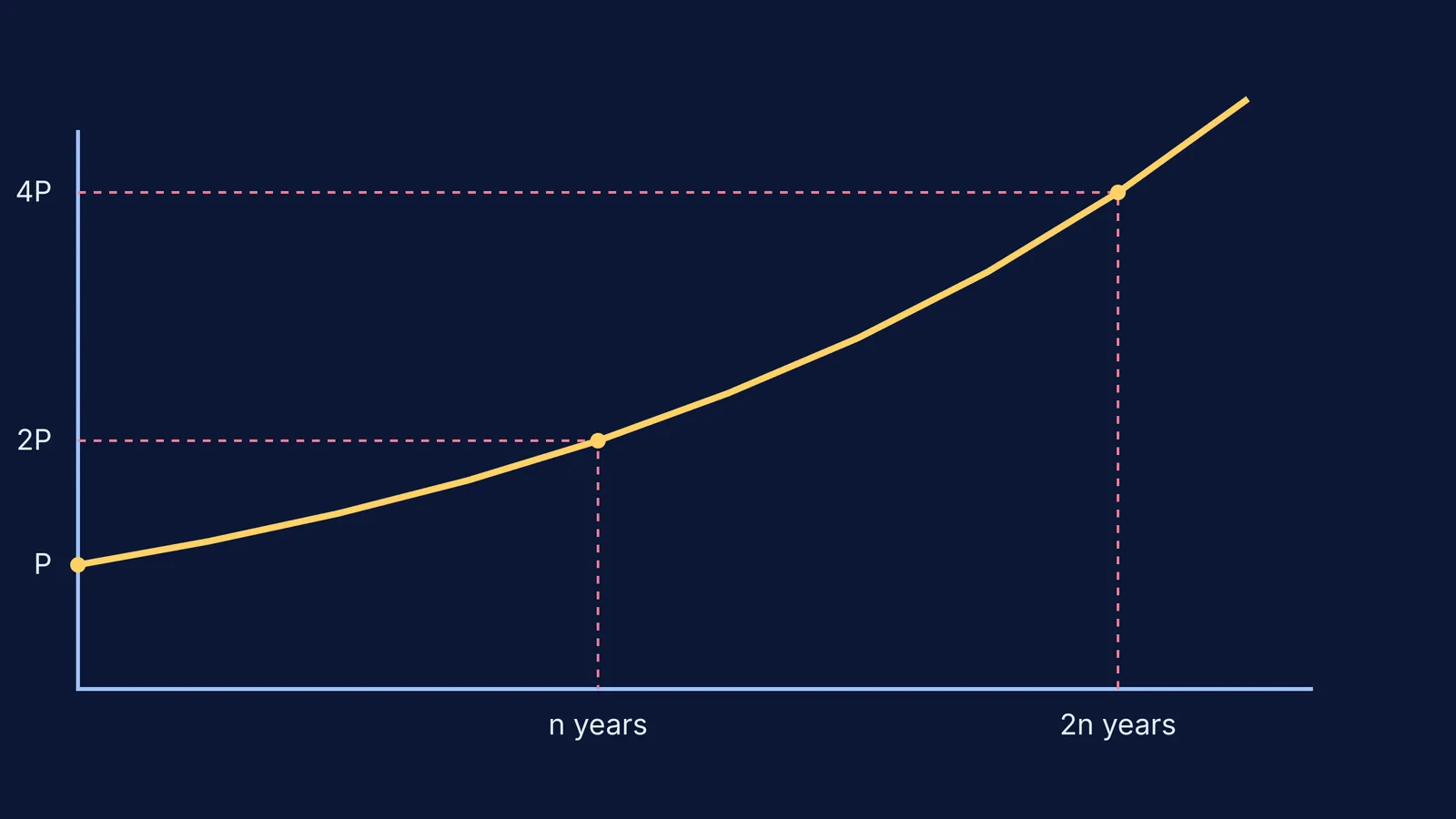
Why does money that doubles in n years quadruple in 2n years?
Compound interest is a form of exponential growth. If your money doubles in the first block of n years, that new, larger amount becomes your starting point for the next block.
During the next n years, the doubled amount doubles again. Two multiplied by two is four. If you wait a third block of n years, it doubles a third time to become eightfold the original amount.
You can also prove this with the formula. If we know that (1 + r/100)ⁿ = 2, we want to find the multiplier for twice the time:
Multiplier = (1 + r/100)²ⁿ
Using the rules of powers, we can rewrite this as:
Multiplier = ((1 + r/100)ⁿ)²
Since the inside bracket is exactly 2, the multiplier is exactly four.
This compounding mechanism is closely related to geometric progressions, much like the methods used for rewriting them with a GP, and it forms the basis of exponential models via dy/dt = ky in physics and biology.
When you are stuck on compound interest or exponential growth questions, the Fermi Problem Library has worked problems with a step-by-step solver that explains the reasoning rather than printing an answer.


