

On this page
The Indian NCERT Class 8 Mathematics syllabus introduces compound interest in its "Comparing Quantities" chapter. When you calculate simple interest, the principal remains the same every year. But with compound interest, the interest from the first year is added to the principal, meaning you earn "interest on your interest" from the second year onwards.
While you can always calculate simple and compound interest separately and subtract them, competitive exams and board questions often ask for the exact difference. Using a shortcut formula saves time and cuts down on calculation errors.
What is the difference between compound and simple interest for 2 years?
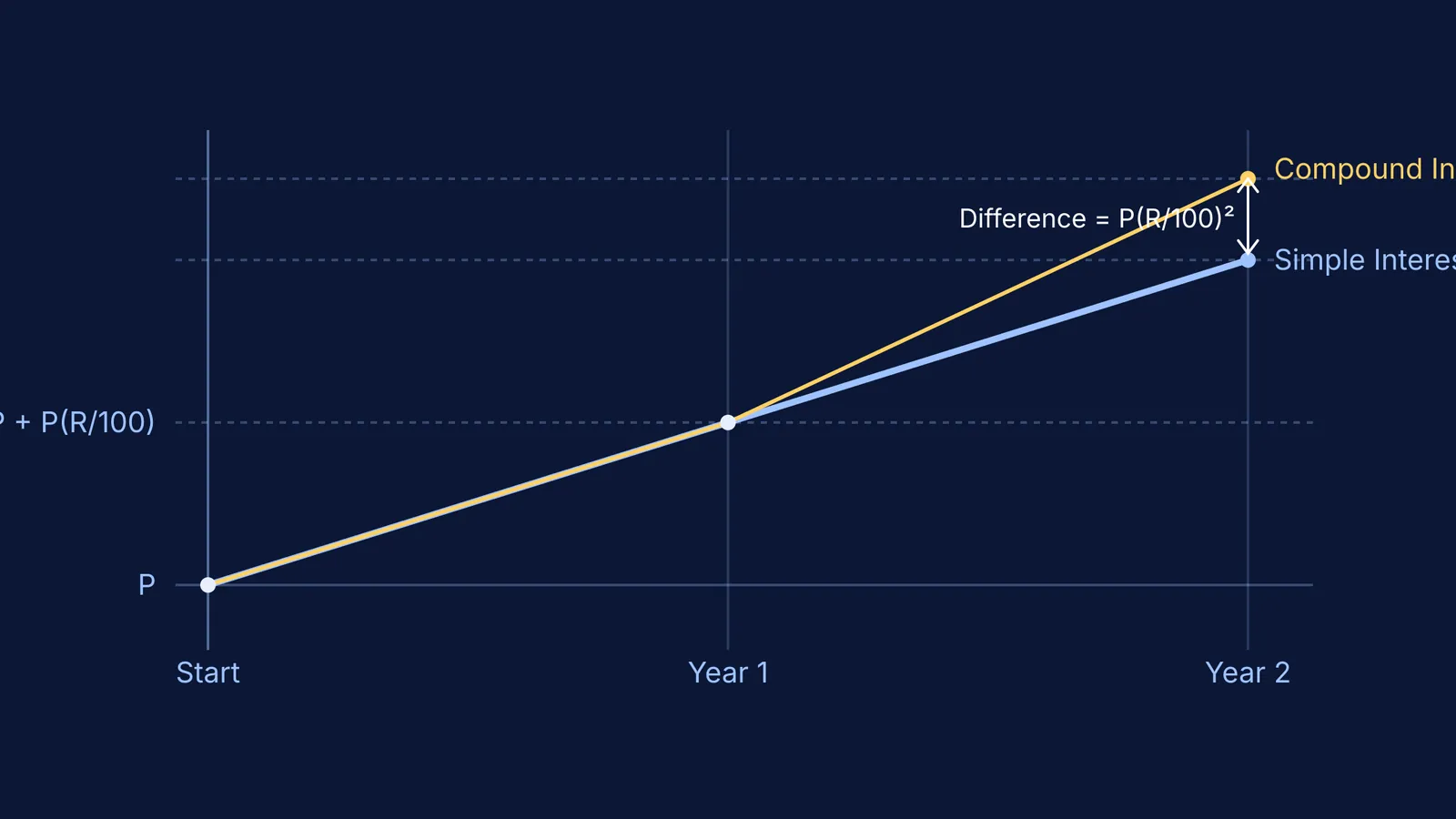
For any principal sum (P) invested at an annual interest rate (R) for exactly two years, the difference between compound interest (CI) and simple interest (SI) is given by a single term:
Difference = P(R/100)²
This shortcut is mathematically exact. Because simple and compound interest are always equal for the first year (assuming annual compounding), the entire difference comes from the second year. That difference is simply the interest charged on the first year's interest.
If you have a gap in how interest compounds year by year, you can explore the mathematical foundations in the Concept Library before tackling complex formulas.
How is the two-year formula derived?
To see why the shortcut works, we can write out the standard formulas for both types of interest over two years.
First, the simple interest for two years is: SI = (P × R × 2) / 100
Next, the total compound interest for two years is the final amount minus the principal: CI = P(1 + R/100)² − P
When you expand the squared bracket (using the identity (a + b)² = a² + 2ab + b²), the compound interest becomes: CI = P[1 + 2(R/100) + (R/100)²] − P CI = P + P(2R/100) + P(R/100)² − P CI = P(2R/100) + P(R/100)²
Now, subtract the simple interest from the compound interest: CI − SI = [P(2R/100) + P(R/100)²] − P(2R/100)
The P(2R/100) terms cancel each other out, leaving exactly: Difference = P(R/100)²
How do you find the principal when the difference is given?
Exam questions, such as those in the NCERT syllabus, often twist the problem around: they tell you the difference between CI and SI for two years, along with the rate, and ask you to find the original principal.
Because the formula is Difference = P(R/100)², you can rearrange it to solve for P: P = Difference / (R/100)²
We know Difference = 15 and R = 5.
Substitute the values into the rearranged formula: P = 15 / (5/100)²
Simplify the fraction: 5/100 = 1/20, and (1/20)² = 1/400.
P = 15 / (1/400)
P = 15 × 400 = 6000
The original principal sum is ₹6,000. For more on how to lay out this working clearly in an exam, see Percentages, discounts and interest in Class 8, worked step by step.
What is the difference between CI and SI formula for 3 years?
If a question asks for the difference over a three-year period, the two-year formula is no longer enough. Over three years, the compound interest pulls further ahead because it earns interest on the interest from both year one and year two.
The shortcut formula for three years is: Difference = P(R/100)² × (300 + R)/100
Notice that the first part of the formula, P(R/100)², is exactly the same as the two-year difference. The extra multiplier (300 + R)/100 accounts for the additional compounding in the third year. For other interest scenarios, such as fixed monthly instalments, see Recurring deposit problems in ICSE Class 10 maths: the formula.
Using these algebraic shortcuts removes the need to calculate large exponent sums, meaning you spend less time doing arithmetic and more time checking your logic.


