

On this page
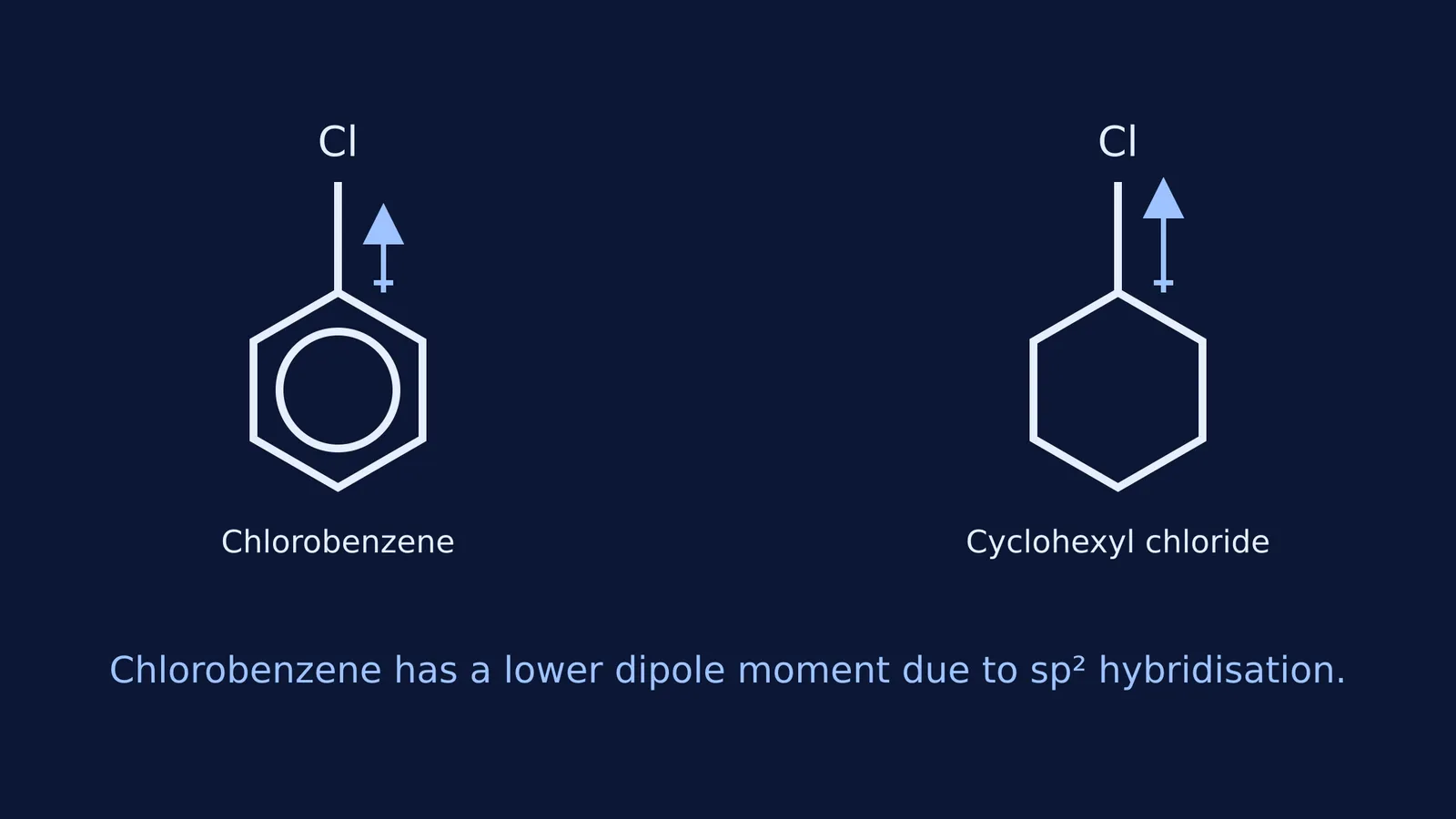
When you compare the structures of chlorobenzene and cyclohexyl chloride, you might expect them to have similar polarities. Both molecules contain a six-carbon ring and a single carbon–chlorine bond, which initially suggests their physical properties should align closely. However, experimental measurements show a distinct divergence: chlorobenzene has a lower dipole moment compared to cyclohexyl chloride. This fact often surprises students first learning organic chemistry, as they assume the identical halogens should dominate the overall polarity in the same way.
This unexpected difference is a frequent and important question in the CBSE Class 12 chemistry syllabus and a staple of JEE and NEET preparations. Examiners test this concept repeatedly because it bridges fundamental structural theory with observable physical properties. To understand why the aromatic ring makes such a profound difference in the measured dipole moment, we need to look deeply at the behaviour of the carbon atom and the electrons shared in the covalent bond.
How does hybridisation affect electronegativity?
The first major difference lies in the hybridisation of the carbon atom attached to the chlorine.
In cyclohexyl chloride, the chlorine atom is bonded to an sp³ hybridised carbon. This type of carbon is formed from one *s* and three *p* orbitals, meaning it has 25% *s*-character/Chemical_Bonding/Valence_Bond_Theory/Hybridization). In chlorobenzene, the chlorine atom is attached directly to the benzene ring, making it an sp² hybridised carbon. This carbon is formed from one *s* and two *p* orbitals, giving it 33.3% *s*-character/Chemical_Bonding/Valence_Bond_Theory/Hybridization).
The percentage of *s*-character is crucial. Because *s*-orbitals are spherical and held closer to the nucleus than *p*-orbitals, a higher *s*-character makes the atom more electronegative. In chlorobenzene, this more electronegative sp² carbon holds the shared electrons of the C–Cl bond more tightly than the sp³ carbon in cyclohexyl chloride does. This inward pull reduces the electronegativity difference between the carbon and the chlorine. As a result, less electron density is pulled towards the chlorine, which lowers the overall polarity of the bond.
If you are struggling to picture how hybridisation shapes molecular properties, the Fermi Concept Library contains every concept in chemistry, each with its own lesson and its place in the map.
Why does resonance reduce the dipole moment?
The second key factor is resonance, specifically the +R (positive resonance) effect.
Chlorine is in Group 17, so it has three lone pairs of electrons in its valence shell. In chlorobenzene, these lone pairs are in conjugation with the delocalised π-electrons of the benzene ring. This allows electron density from the chlorine atom to spread back into the aromatic ring. This "back-donation" opposes the normal inductive pull (the -I effect) of the highly electronegative chlorine atom, significantly decreasing the net charge separation across the bond.
Cyclohexyl chloride, on the other hand, features a saturated cyclohexane ring with no π-bonds. Without a conjugated system of alternating double and single bonds, resonance cannot happen. The electron density remains firmly and statically pulled towards the highly electronegative chlorine atom by its strong inductive effect. This maintains a high, uninterrupted, and localised charge separation across the carbon-chlorine bond, leading to a much larger overall dipole moment.
How does partial double-bond character change bond length?
Because of the continuous resonance in chlorobenzene, the C–Cl bond takes on a distinct partial double-bond character. It is a fundamental principle that double bonds are physically shorter and noticeably stronger than corresponding single bonds due to the increased electron density pulling the nuclei closer together. Consequently, the measured C–Cl bond length in chlorobenzene is notably shorter than the pure single C–Cl bond found in cyclohexyl chloride.
Since the dipole moment is calculated by multiplying the charge separation by the distance between the charges, chlorobenzene has both a smaller charge separation and a shorter distance. Together, these two effects significantly lower its overall dipole moment compared to its non-aromatic counterpart.
When working through similar comparisons, Fermi's AI tutor teaches rather than answers, checking understanding as it goes and drawing the figure to help you piece together the reasoning.
A checklist for exam questions
If you face an exam question comparing dipole moments of haloarenes and haloalkanes, hit these three points to secure full marks:
State the hybridisation: Identify the sp² carbon in the arene and the sp³ carbon in the alkane.
Explain the electronegativity: Mention that the higher *s*-character of the sp² carbon reduces the C–X bond polarity.
Draw the resonance: Show how lone pair delocalisation creates a partial double bond, reducing both charge separation and bond length.
For more practice on applying these rules to numerical problems, the Fermi Problem Library has worked problems with a step-by-step solver that explains the reasoning rather than printing an answer. You can also review how these ideas apply in our guide to Percentage ionic character from dipole moment or see how similar molecules react in Aqueous vs alcoholic KOH with haloalkanes.


