

On this page
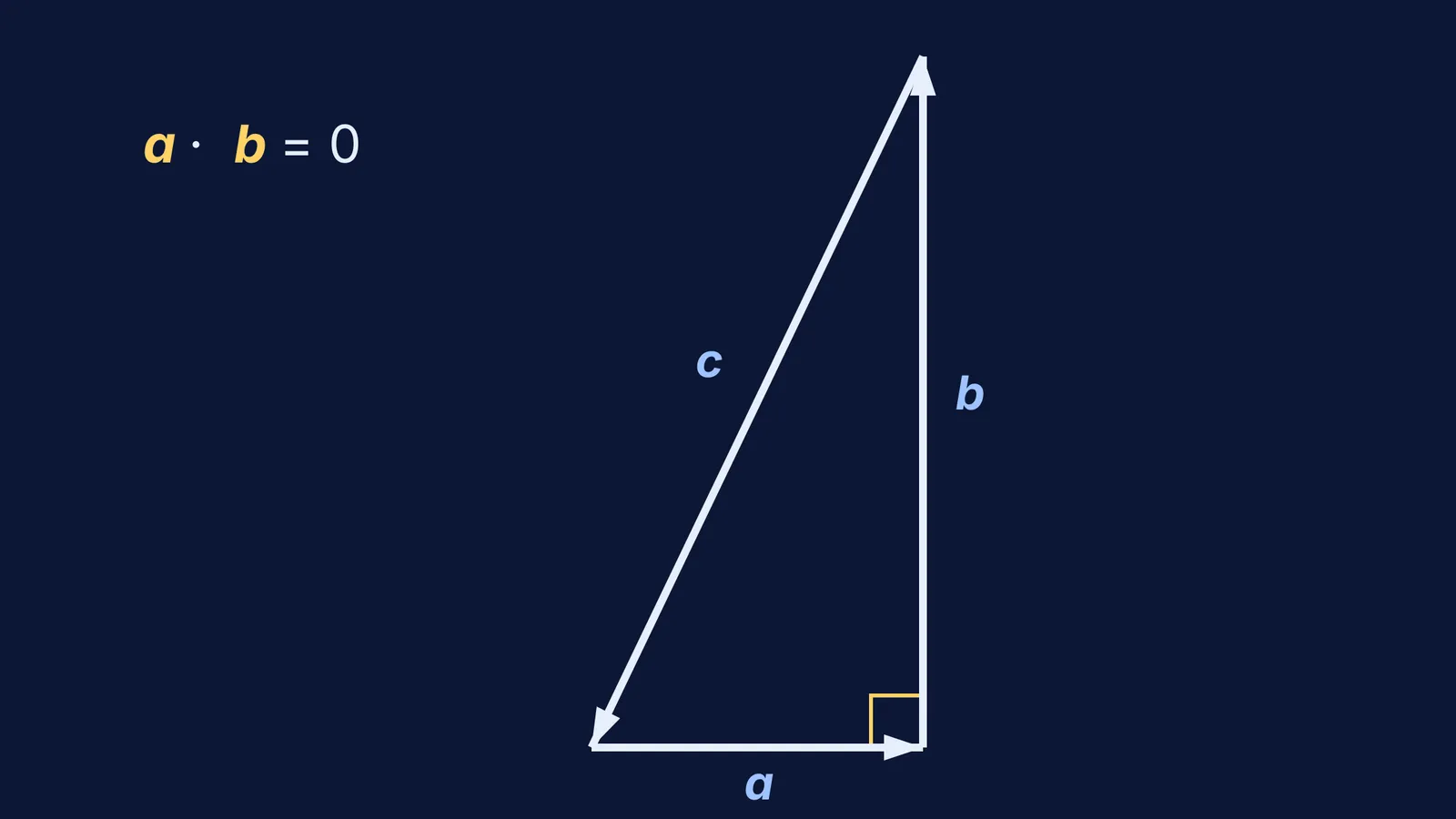
If you are given three vectors, proving they form a right-angled triangle takes two steps: verifying that they actually close into a triangle, and finding a 90° angle between two of the sides.
Do the vectors form a triangle?
If you have three vectors that represent the sides of a triangle, they must form a closed loop. According to the OpenStax University Physics textbook, when you add vectors head-to-tail, the resultant is drawn from the very first tail to the final head. If the vectors form a closed shape, the final head meets the starting tail. This means their sum is zero: a + b + c = 0.
If one of the vectors is already the resultant of the other two, you will see a + b = c. Either way, this confirms the vectors form a triangle.
Often, a problem gives you the position vectors of three points A, B, and C rather than the sides. In that case, you must first find the side vectors by subtracting the position vectors:
AB = b - a
BC = c - b
CA = a - c
Because (b - a) + (c - b) + (a - c) = 0, these three side vectors are guaranteed to form a closed triangle.
If you find yourself guessing which vector to subtract from which or struggling to picture how vectors sit in 3D space, this points to a concept gap. The Fermi Concept Library contains every concept in physics, chemistry, biology, mathematics and computing, each with its own lesson and its place in the map, helping you see why position vectors work before you calculate them.
How do you check if vectors form a right-angled triangle using the dot product?
Once you have your three side vectors, you need to check if any two of them are perpendicular. The most efficient way to do this is with the dot product (or scalar product), which multiplies the matching components of two vectors and adds the results: u · v = u₁v₁ + u₂v₂ + u₃v₃.
As the OpenStax Calculus Volume 3 textbook states, two nonzero vectors are orthogonal (perpendicular) if and only if their dot product is zero. You simply compute the dot product for each pair of sides. If any pair evaluates to exactly zero, those two sides meet at a right angle.
*(Note: Even if the vectors are oriented head-to-tail rather than starting from the same point, a dot product of zero still means the lines are perpendicular, because -0 is still 0.)*
Can you use the Pythagorean theorem instead?
Yes, you can also prove this by finding the length of each side (the magnitude of the vector) and checking if the square of the longest side equals the sum of the squares of the other two sides.
To find the magnitude of a vector v = ⟨v₁, v₂, v₃⟩, you calculate the square root of the sum of the squares of its components: ||v|| = √(v₁² + v₂² + v₃²). You must do this for all three side vectors, and then square those magnitudes.
While the Pythagorean method is just as valid, computing three magnitudes and squaring them often takes more steps and leaves more room for arithmetic errors than calculating a single dot product. If the question asks you to "show that the vectors form a right-angled triangle," the dot product method is usually faster and more direct.
What does a step-by-step example look like?
Let's look at an example using vectors adapted from OpenStax Calculus Volume 3. Suppose you have three side vectors:
a = ⟨1, 0, 5⟩
b = ⟨10, 3, -2⟩
c = ⟨-11, -3, -3⟩
First, check if they form a triangle. Adding their components gives ⟨1 + 10 - 11, 0 + 3 - 3, 5 - 2 - 3⟩ = ⟨0, 0, 0⟩. Since they sum to exactly zero, they form a closed loop.
Next, test the pairs for a right angle using the dot product. Let's check a and b: a · b = (1)(10) + (0)(3) + (5)(-2) = 10 + 0 - 10 = 0
Because the dot product evaluates to zero, the vectors a and b are orthogonal. You have successfully proven that these three vectors form a right-angled triangle.
For more on vector properties and how to apply them, you can read our guides on checking for collinear points with vectors, finding velocity and acceleration vectors from r(t), and using vectors to find torque about a point.


