

On this page
It is a classic "trick" question in physics exams like JEE Main and NEET-UG: you have a pendulum bob with a charge, and it is set swinging in a uniform magnetic field. Does it swing faster, slower, or at the exact same rate?
Because we learn that electric fields change a pendulum's time period by adding an extra constant force, it is tempting to assume a magnetic field does the same. However, the magnetic force behaves entirely differently.
Here is why the period stays exactly the same, and how to prove it.
What is the time period of a charged pendulum in a magnetic field?
For a simple pendulum swinging in a plane, applying a uniform magnetic field perpendicular to that plane has absolutely no effect on its time period.
If a pendulum of length L and bob mass m has an original time period T = 2π√(L/g), its period in the magnetic field will still be:
T = 2π√(L/g)
The presence of the charge q and the magnetic field B do not alter the frequency of the back-and-forth swing, according to standard mechanics problems on platforms like Toppr.
Why does the period stay the same?
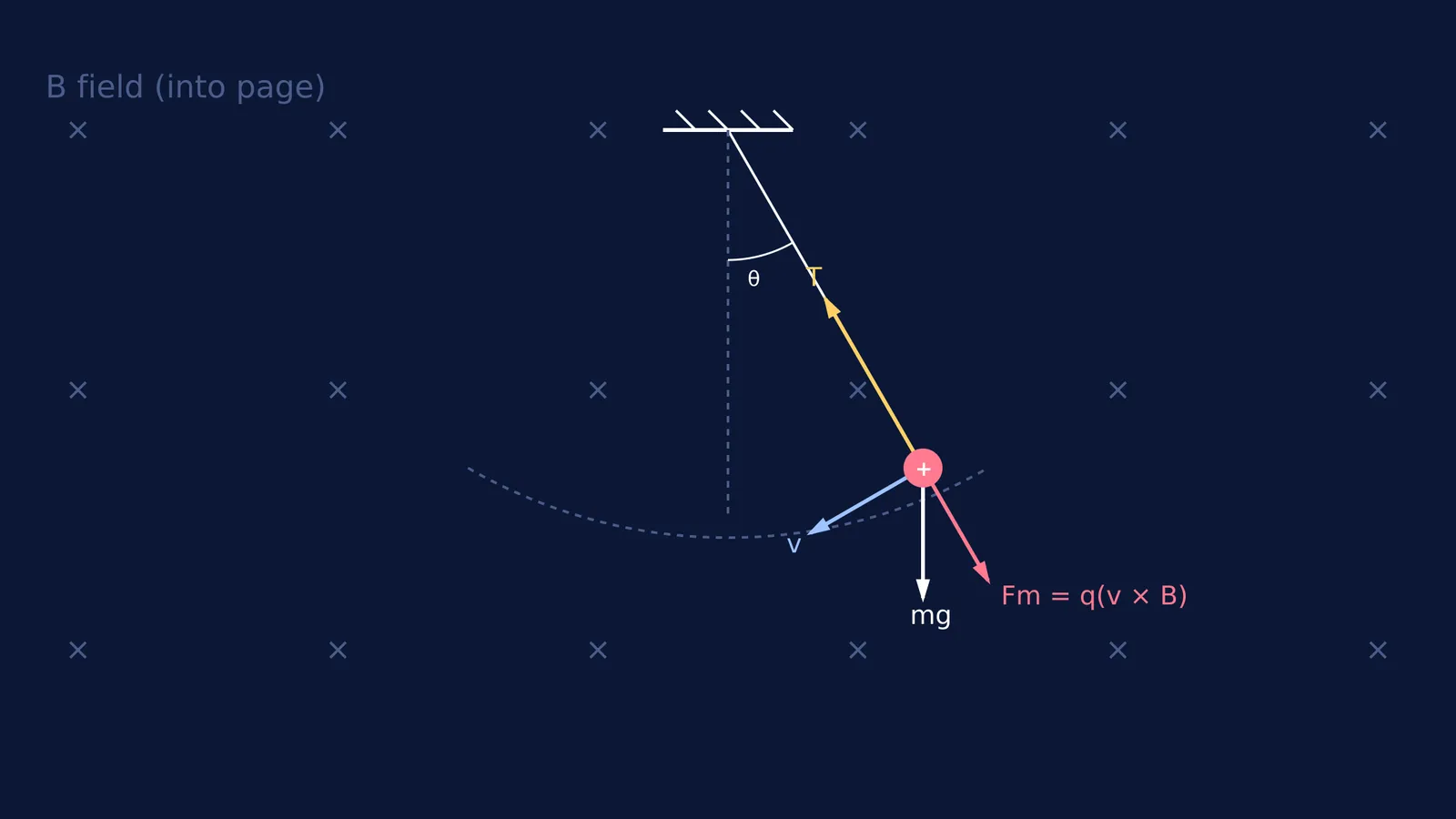
The secret lies in the direction of the magnetic force. The Lorentz force acting on a moving charge is given by the formula F_m = q(v × B).
This mathematical cross product means the magnetic force is always perpendicular to both the velocity v and the magnetic field B.
The velocity of the bob is always tangential to its circular path.
The magnetic field is perpendicular to the entire plane of the swing.
Therefore, the magnetic force must point purely along the radial line (along the direction of the string itself).
For a pendulum to change its time period, it needs a change in the *restoring force*—the tangential pull that brings the bob back to the centre. Gravity provides this tangential pull (−mg sin θ). Because the magnetic force acts purely radially, it has zero component in the tangential direction. It does no work on the bob throughout its entire swing, which means it cannot add or remove kinetic energy from the system. It simply guides the bob's motion without speeding it up or slowing it down, leaving the restoring force completely undisturbed.
Does the tension in the string change?
Yes. While the time period is unaffected, the tension in the string is altered.
In a normal pendulum, the tension provides the centripetal force needed to keep the bob moving in a circle. The standard equation for the radial direction is T − mg cos θ = mv²/L.
When the magnetic field is turned on, the radial magnetic force qvB pushes or pulls along the string. The new equation becomes:
T − mg cos θ ± qvB = mv²/L
The tension at any angle will now fluctuate depending on the bob's speed and direction. For instance, at the lowest point of the swing where the velocity is highest, the magnetic force reaches its maximum value, creating a significant change in string tension compared to a field-free environment. However, because this force acts squarely along the string, the tangential acceleration—and thus the swing's rhythm—remains untouched.
What is the difference between electric and magnetic fields?
Examiners love to test if you know the difference between electric and magnetic fields in these mechanics problems. Use the Fermi Problem Library to see worked problems with a step-by-step solver that explains the reasoning:
Electric Field (E): Creates a force qE that is constant in both magnitude and direction. It acts just like a second gravitational field. You must find the new "effective gravity" vector by adding the g and qE/m vectors. The period will change.
Magnetic Field (B): Creates a velocity-dependent force qvB that is always perpendicular to motion. For a perpendicular field, it acts radially, does no work, and the period does not change.
How do you solve effective gravity problems?
When faced with a pendulum in a weird environment—be it a field or an accelerating lift—use this checklist to find the time period:
Identify constant forces: List all forces that act constantly on the bob, regardless of its speed. This includes real gravity (mg), electric forces (qE), and pseudo-forces (−ma) from accelerating frames.
Find effective gravity: Add these constant force vectors together and divide by mass to find the effective gravity vector.
Ignore radial-only forces: Discard any forces that always act perpendicular to the velocity (like the Lorentz force). They change tension, not the time period. The period is simply T = 2π√(L/g_eff).


