

On this page
Rub a glass rod with silk and the rod picks up a positive charge. As the NCERT Class 12 Physics chapter on electric charges puts it, some electrons move from the rod to the silk, and no new charge is created. That hides a counting question that turns up in board exams, JEE Main and NEET-UG: how many electrons moved? The answer comes from one short equation, q = ne, and one fixed number, e.
How many electrons make up one coulomb?
The elementary charge e is exactly 1.602176634 × 10⁻¹⁹ C, one of the seven defining constants of the SI fixed by the BIPM. Because it is defined rather than measured, NIST lists its uncertainty as "exact". It was fixed in November 2018, in the revision usually called the 2019 redefinition, which we cover in the seven SI base units and their 2019 redefinition.
To get the number of electrons in one coulomb, divide: n = 1 C ÷ (1.602176634 × 10⁻¹⁹ C) ≈ 6.241509 × 10¹⁸. NCERT rounds this to "about 6 × 10¹⁸ electrons in a charge of –1C" (NCERT, section 1.4.3).
NCERT's Example 1.1 shows how big a coulomb is: if 10⁹ electrons leave a body every second, collecting 1 C takes roughly 200 years (NCERT Example 1.1).
What does q = ne actually mean?
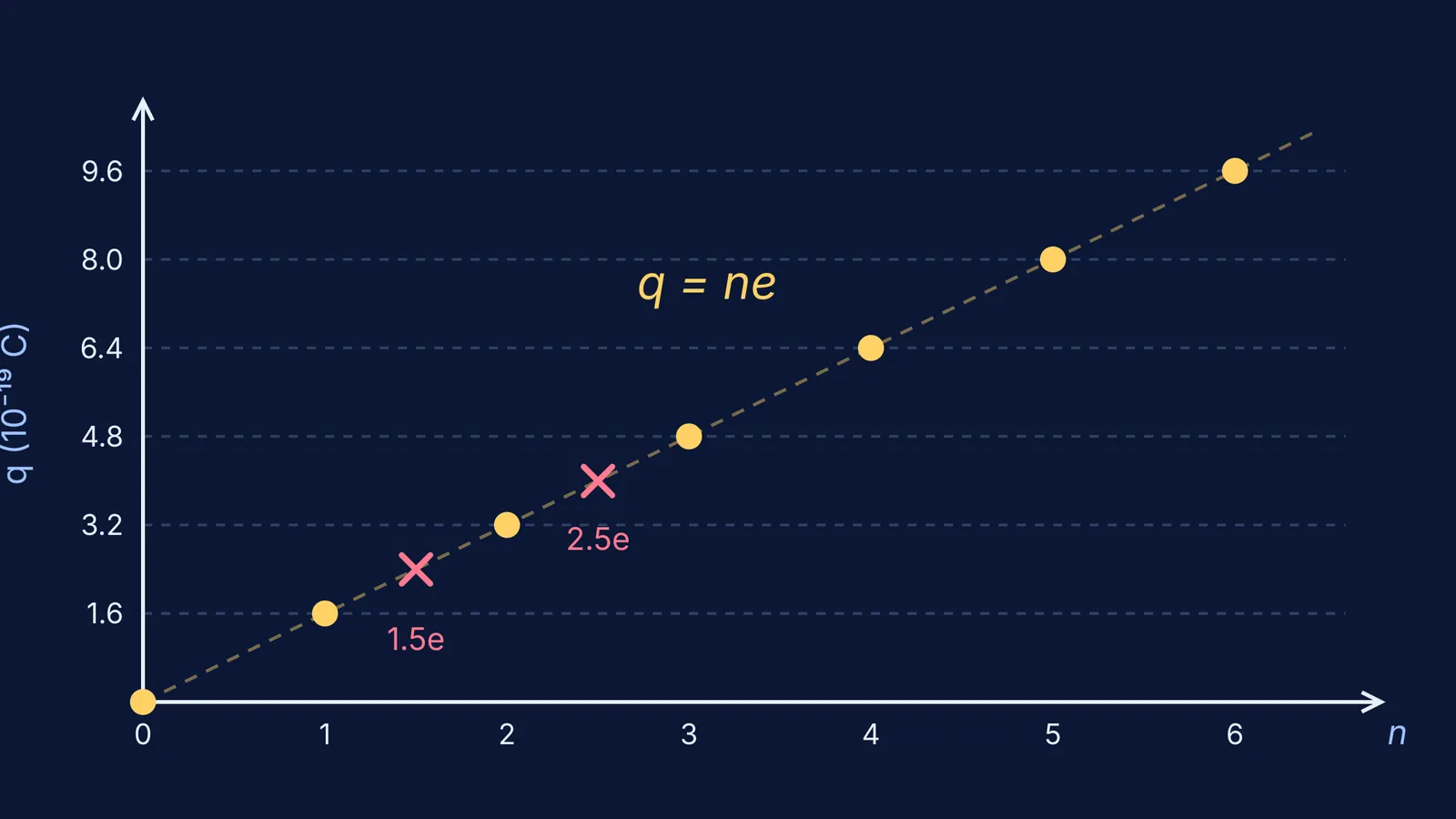
Quantisation of charge means every free charge is an integer multiple of e, so q = ne where n is a positive or negative whole number (NCERT, section 1.4.3). The same section credits Faraday's laws of electrolysis with first suggesting this, and Millikan with demonstrating it experimentally in 1912. You can read how he did it in Millikan's oil-drop experiment.
NCERT also makes a point students often skip. A charge of 1 µC contains something like 10¹³ times e. At that scale, adding or removing one electron makes no visible difference, so charge behaves as if it were continuous. Quantisation only matters at the microscopic level, where the charges involved are a few tens or hundreds of e and can be counted (NCERT).
How many electrons move when you rub a rod?
Here is a worked example with made-up but realistic numbers. A glass rod rubbed with silk ends up with a charge of +4.8 nC. How many electrons were transferred, and which way? Use e = 1.6 × 10⁻¹⁹ C, or the exact BIPM value if the question asks for it.
Read the sign. Positive means the rod lost electrons. It did not gain protons, because in rubbing it is electrons that move.
Convert the prefix: 4.8 nC = 4.8 × 10⁻⁹ C.
Divide by e: n = 4.8 × 10⁻⁹ ÷ 1.6 × 10⁻¹⁹ = 3.0 × 10¹⁰ electrons.
With the exact e, n = 2.996 × 10¹⁰. The two answers differ only because e was rounded. They are not a fraction of an electron.
Apply conservation: the silk now carries –4.8 nC, having gained the same 3.0 × 10¹⁰ electrons.
Why do fractional charges never show up in these sums?
Quarks do carry fractional charge. The Particle Data Group's review of free quark searches says quarks have charges of 1/3 e or 2/3 e, but quantum chromodynamics predicts they cannot be observed travelling freely, because they are confined inside hadrons, the family of particles that includes protons and neutrons. The same review states that experiments have produced no evidence for free propagating quarks. The story of how quarks were proposed is in our post on Murray Gell-Mann and the quarks inside protons and neutrons.
So the things your exam asks about (rods, spheres, oil drops, ions) always carry whole-number multiples of e. This gives a common multiple-choice question: which of these cannot be the charge on a body? Try 6.4 × 10⁻¹⁹ C, 9.6 × 10⁻¹⁹ C, 2.4 × 10⁻¹⁹ C and 1.6 × 10⁻¹⁸ C. Dividing by 1.6 × 10⁻¹⁹ gives n = 4, 6, 1.5 and 10. Only 2.4 × 10⁻¹⁹ C fails, because no body can hold one and a half electrons' worth of charge.
A quick checklist before you write the answer
Convert the prefix first: µC is 10⁻⁶ C (NCERT) and nC is 10⁻⁹ C.
Divide by e and look at n: a whole number for small charges, a big number for everyday ones.
Use the sign for direction: positive means electrons left, negative means electrons arrived.
Check the partner: the cloth or the other sphere ends up with an equal and opposite charge.
If you keep getting these wrong at the prefix or sign step, the Fermi Problem Library has worked problems with a step-by-step solver that explains the reasoning rather than printing an answer. If the idea of a smallest unit of charge still feels shaky, the Fermi Concept Library gives every concept in physics its own lesson and shows where it fits on the map.
Next time you rub a comb on dry hair, try a rough count: a single nanocoulomb is already about six billion electrons.


